
Thomas sat on a cracked concrete step behind an abandoned warehouse on the edge of the city. Beside him, his seven-year-old daughter slept fitfully, her small chest rising and falling with the ragged sound of asthma that had no medicine left to calm it.
Three years earlier he had buried his wife after a long illness that swallowed every dollar they owned. Two years ago the garage where he worked as a mechanic closed when the owner died. Last year the apartment was lost. Last month the shelters turned them away because they were full. Yesterday the last of the food stamps had run out.
Now the sun was setting, and the temperature was dropping fast. Emma’s breathing had grown worse. She needed the inhaler she hadn’t had in two days. Thomas had exactly twelve cents in his pocket and no one left to call.
Sometimes we find ourselves in situations where we have no idea how God will fulfill His promise to supply all our needs. However, God can do the impossible. The 21st chapter of Numbers illustrates the confidence we should have when God makes a promise.
The first part of chapter 21 tells us Israel conquered Arad, which was on the southern edge of the promised land. However, instead of going north into Canaan, Israel went south toward the Red Sea, then east, and then turned north on a highway that ran east of Edom and Moab.
Num. 21:16 ¶ And from there they continued to Beer, that is the well where Yahweh said to Moses, “Assemble the people, that I may give them water.”
The Hebrew word “Beer” is the word for well. In other words, this verse could read, “they continued to Well, that is the well where Yahweh said …”
Num. 21:17 ¶ Then Israel sang this song:
“Spring up, O well! Sing to it!
Num. 21:18 The well, which the leaders dug,
Which the nobles of the people carved out,
With the scepter and with their staffs.”
Apparently, Yahweh supplied water this time by having the leaders dig a well.
And from the wilderness they continued to Mattanah,
Num. 21:19 and from Mattanah to Nahaliel, and from Nahaliel to Bamoth,
Num. 21:20 and from Bamoth to the valley that is in the land of Moab, at the top of Pisgah which overlooks the wasteland.
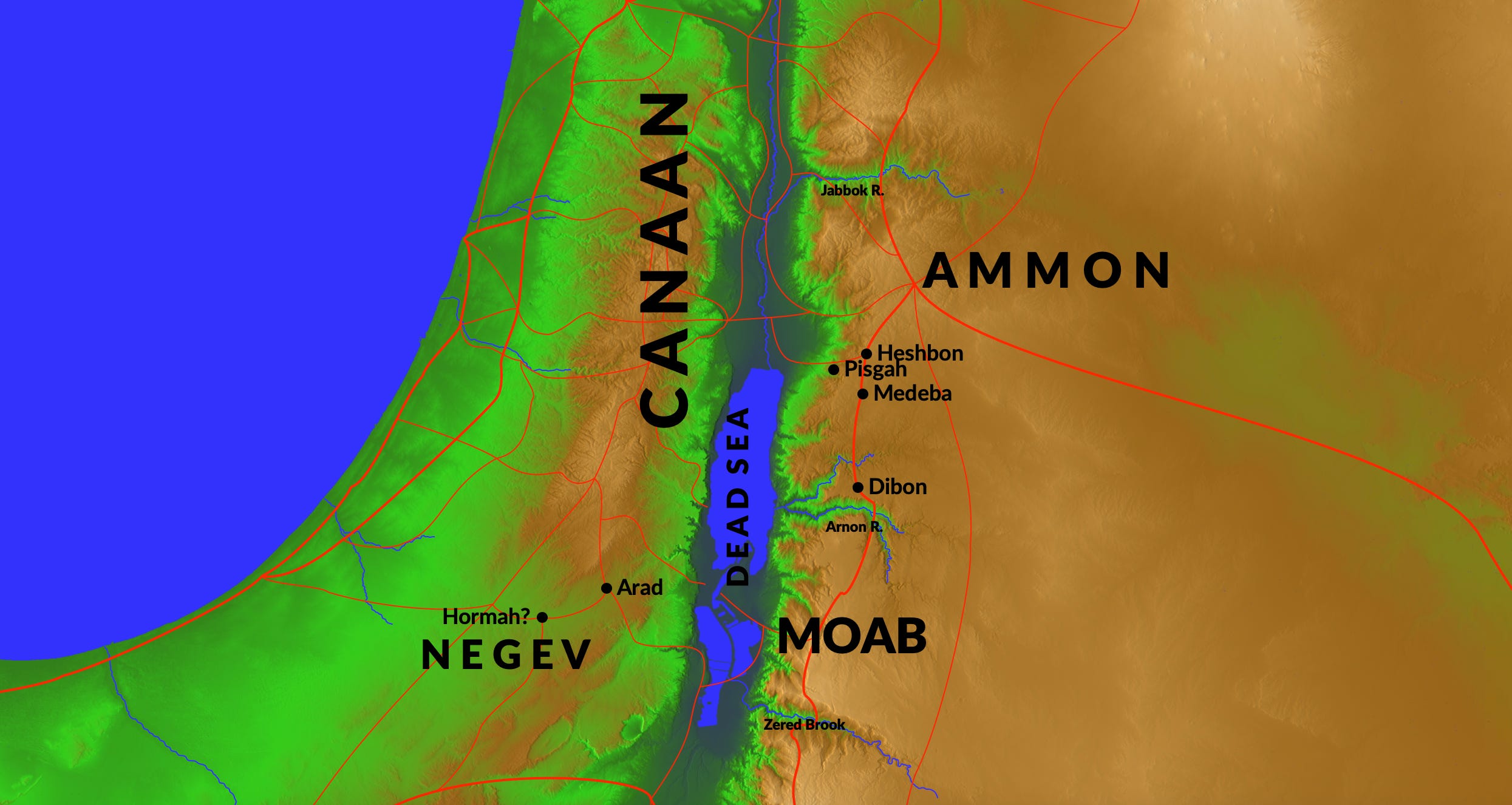
There are many cities listed in the Old Testament whose location is unknown to us today. Also, while we have a general sense where Edom, Moab, and Ammon were located, their borders shifted over time during the Old Testament time period, just as borders of countries shift over time today.
Num. 21:21 ¶ Then Israel sent messengers to Sihon, king of the Amorites, saying,
The Amorites were a subset of the Canaanites (see Genesis 10:16). While we think of the Canaanites living west of the Jordan River and Dead Sea, this verse indicates some of them, the Amorites, also lived east of the Jordan River and Dead Sea. They may have been living between Ammon and Canaan.
Num. 21:22 “Let me pass through your land. We will not turn off into field or vineyard; we will not drink water from wells. We will go by the king’s highway until we have passed through your border.”
Israel asked for permission to travel through the Amorites in order to get to Canaan.
Num. 21:23 But Sihon would not allow Israel to pass through his border. So Sihon gathered all his people and went out to meet Israel in the wilderness and came to Jahaz and fought against Israel.
Num. 21:24 Then Israel struck him with the edge of the sword and took possession of his land from the Arnon to the Jabbok, as far as the sons of Ammon; for the border of the sons of Ammon was Jazer.
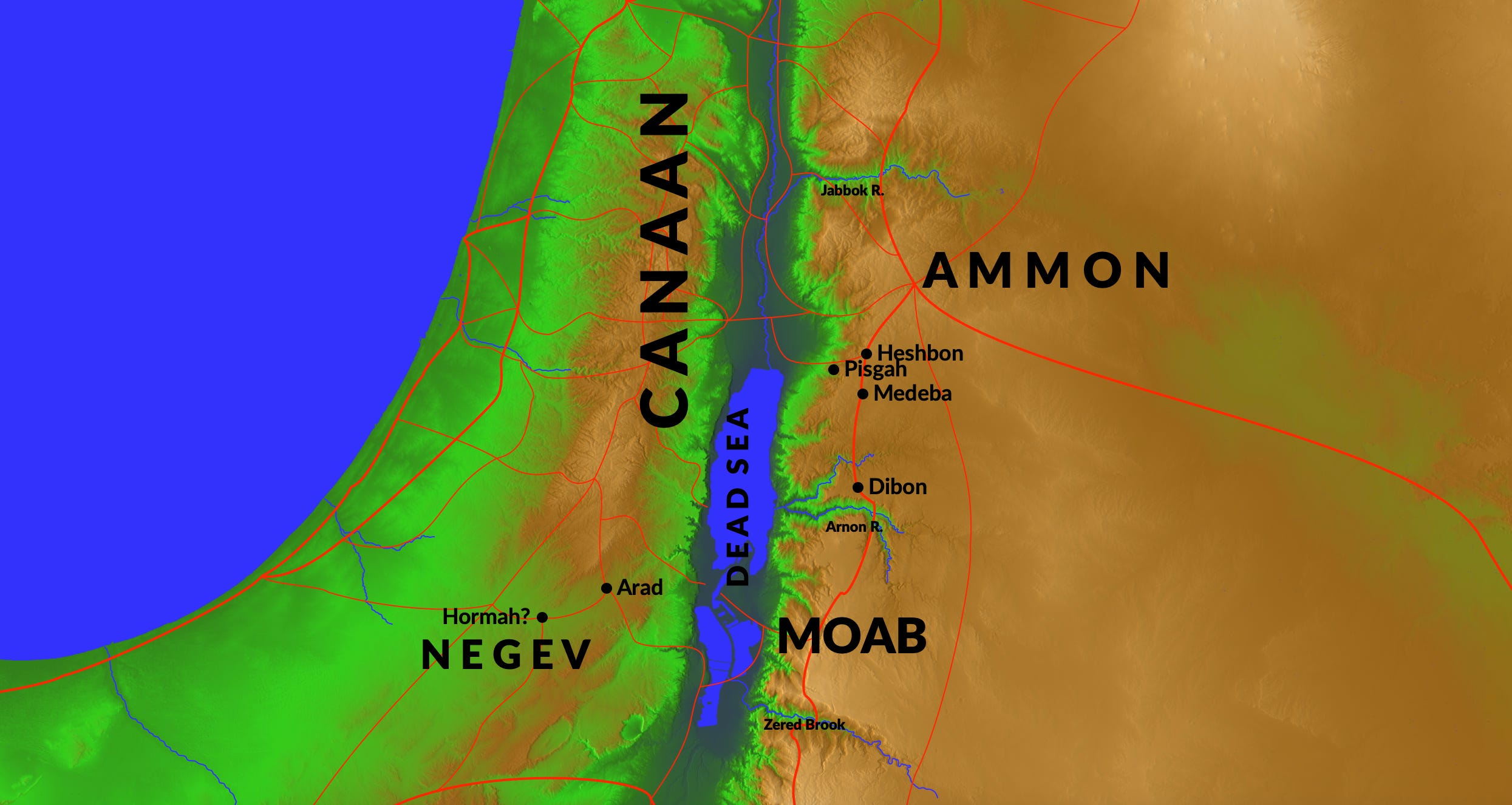
The borders of the Amorites were the Jabbok River on the north, the Arnon River on the south, and Ammon on the east.
Num. 21:25 And Israel took all these cities, and Israel lived in all the cities of the Amorites, in Heshbon, and in all her towns.
Num. 21:26 For Heshbon was the city of Sihon, king of the Amorites. Now it was he who had fought against the former king of Moab and had taken all his land out of his hand, as far as the Arnon.
Look at the phrase “it was he who had”. Before Sihon’s confrontation with Israel, he had fought Moab and taken land away from Moab.
Num. 21:27 Therefore those who use proverbs say,
“Come to Heshbon! Let it be built!
So let the city of Sihon be established.
Heshbon is the city of Sihon (see verse 26). Hebrew poetry is very repetitive. The art of Hebrew poetry is to say the same thing in multiple ways. Both lines in verse 27 say the same thing.
Num. 21:28 For a fire went forth from Heshbon,
A flame from the town of Sihon;
It devoured Ar of Moab,
The dominant heights of the Arnon.
The first two lines of verse 28 say the same thing because Heshbon is the town of Sihon.
The last two lines of verse 28 also say the same thing because Ar was a city in Moab which dominated the heights of the Arnon River. In other words, Sihon went forth from Heshbon and conquered Ar of Moab.
Num. 21:29 Woe to you, O Moab!
You perish, O people of Chemosh!
He has given his sons as fugitives,
And his daughters into captivity,
To an Amorite king, Sihon.
Chemosh was the god of Moab. Thus, the Moabites were the people of Chemosh.
The pronoun “he” in the third line of verse 29 refers to Chemosh.
Since Moab lost the battle against Sihon the Amorite, verse 29 says Chemosh gave up his sons and daughters (the Moabites) to the Amorites.
Num. 21:30 But we have cast them down,
Heshbon perishes as far as Dibon,
And we have made desolate even to Nophah,
Which reaches to Medeba.”
The pronoun “we” refers to Israel. The Amorites had defeated Moab, but Israel defeated the Amorites.
Before the fight with Israel, Heshbon, the capital of the Amorites, controlled Dibon and Medeba. After the battle with Israel, the Amorites did not control those cities because Israel had conquered them.
Num. 21:31 ¶ Thus Israel lived in the land of the Amorites.
Num. 21:32 And Moses sent to spy out Jazer, and they captured its towns and dispossessed the Amorites who were there.
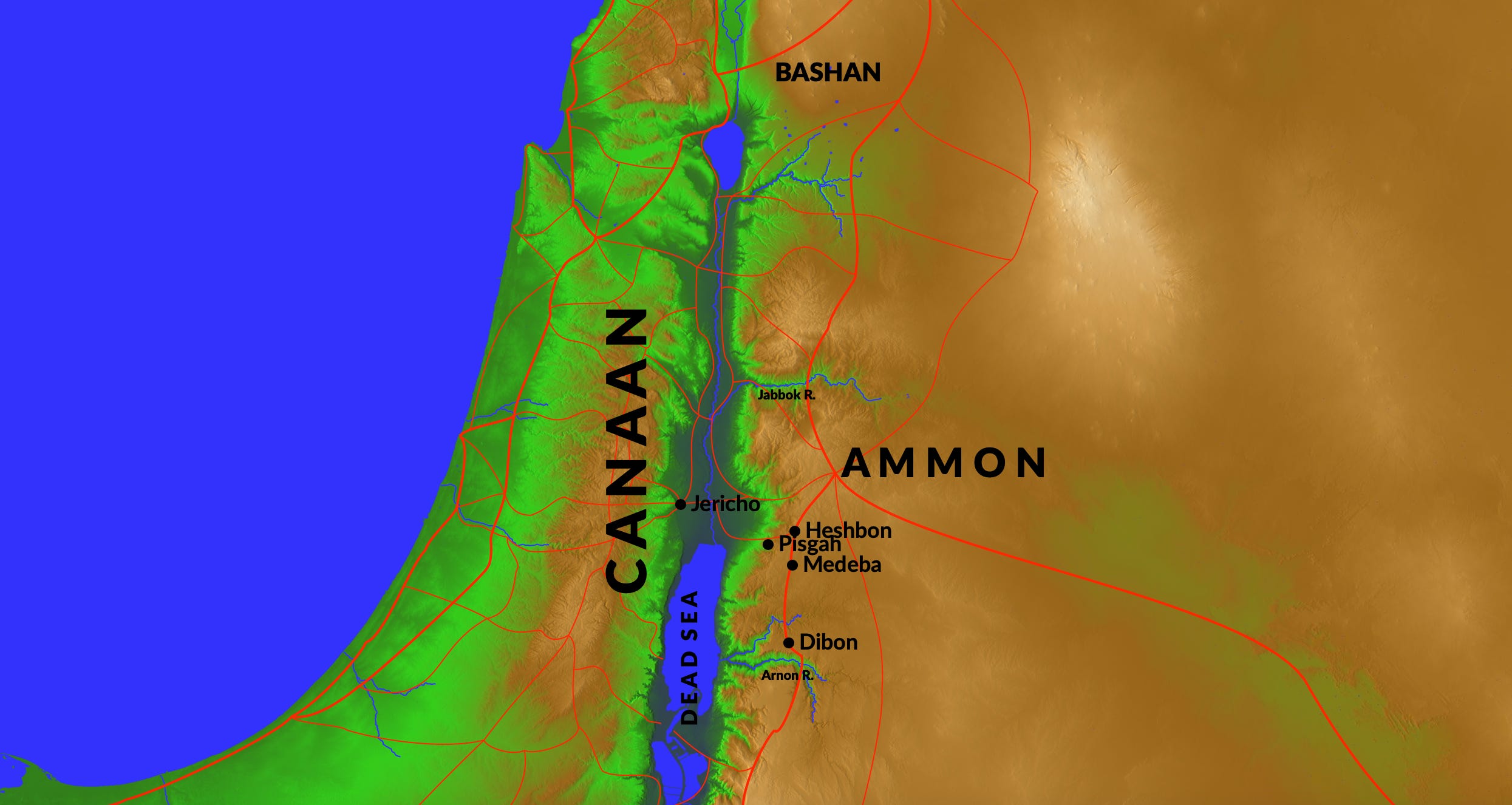
Num. 21:33 ¶ Then they turned and went up by the way of Bashan, and Og the king of Bashan went out to meet them, he and all his people for battle at Edrei.
The term “way of Bashan” refers to a highway that went to Bashan.
Num. 21:34 But Yahweh said to Moses, “Do not fear him, for I have given him into your hand, and all his people and his land; and you shall do to him as you did to Sihon, king of the Amorites, who lived at Heshbon.”
Take note of Yahweh’s promise to give Og into the hand of Israel.
Notice the word “fear”. I assume Og had a bigger army than Israel, and that is why Moses may have been afraid.
Num. 21:35 So they struck down him and his sons and all his people, until there was no survivor remaining for him; and they possessed his land.
On this occasion, Israel believed Yahweh. They went out and conquered Og.
Num. 22:1 ¶ Then the sons of Israel set out and camped in the plains of Moab beyond the Jordan opposite Jericho.
The phrase “beyond the Jordan” is stated from the perspective of the promised land. Thus, “beyond the Jordan” is the area east of the Jordan River.
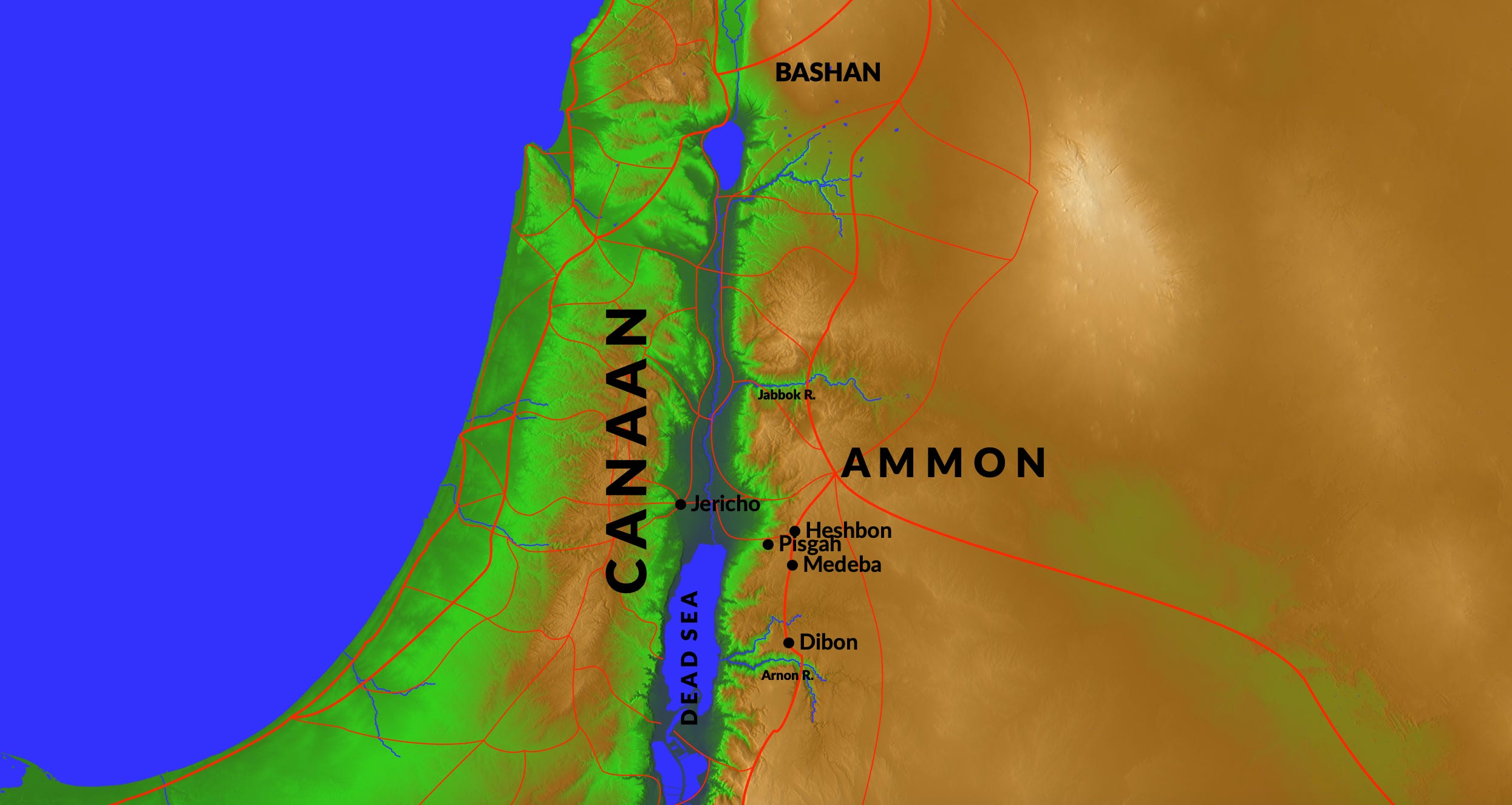
At this point in time, Israel had conquered a huge swath of territory on the east side of the Jordan River, and they camped in the plain that was directly east of Jericho on the east side of the Jordan River. The promised land was the land west of the Jordan River.
Many times in life we are faced with a situation where it seems impossible for God to fulfill His promise. However, just as Yahweh was able to easily give Og into the hand of Israel, so too God can easily fulfill every promise He has made to us.
Thanks for visiting Bible Mountain. If you have already joined my email list, thank you and please tell others about Bible Mountain. If you have not joined my email list yet, please do so now. In order to join, go to BibleMountain.com, click on subscribe, and that will take you to a page where you can sign up. Your email address will not be sold nor given away. Once again, thanks for visiting Bible Mountain.
“Scripture quotations taken from the (LSB®) Legacy Standard Bible®, Copyright © 2021 by The Lockman Foundation. Used by permission. All rights reserved. Managed in partnership with Three Sixteen Publishing Inc. LSBible.org and 316publishing.com.”