
There are many people who believe they will go to heaven because they are good people. Since they don’t murder, rape, lie, or steal, they think God will not turn them away after they die. There are other people who don’t believe in life after death. They believe that when we die here on earth, we simply cease to exist.
The Bible makes it clear there is life after death, and that everyone will either spend eternity in heaven or hell. The 20th chapter of Numbers records an incident that illustrates the way to get to heaven.
At the beginning of the book of Numbers, the Israelites were at Mount Sinai and it was one year after they had come out of Egypt. After a census and some instructions about how to travel and how to arrange their camp, they set out for the promised land. The exit from Sinai is recorded in the 10th chapter of Numbers, which tells us the exit occurred one year and one month after they left Egypt.
The 13th chapter of Numbers tells the story of the 12 spies who went to spy out the land. Then we read in the 14th chapter that, because Israel doubted God’s ability to deliver the land to them, they had to wander in the wilderness for 40 years. The 15th through 19th chapters tell about some challenges to the leadership of Moses.
When we get to the 20th chapter, the text subtly shifts and gives the sense that many decades have passed and the forty years of wandering was coming to an end. Moses asked Edom for permission to travel through Edom, but permission was denied.
Num. 20:23 ¶ And Yahweh spoke to Moses and Aaron at Mount Hor by the border of the land of Edom, saying,
Num. 20:24 “Aaron will be gathered to his people, for he shall not enter the land which I have given to the sons of Israel because you rebelled against My command at the waters of Meribah.
This incident is recorded in the first half of chapter 20. Even though Aaron’s death is recorded in the same chapter as the incident at Meribah, it is possible that many years elapsed between Meribah and Mount Hor.
Num. 20:25 Take Aaron and his son Eleazar and bring them up to Mount Hor;
Num. 20:26 and strip Aaron of his garments and put them on his son Eleazar. So Aaron will be gathered to his people and will die there.”
Num. 20:27 So Moses did just as Yahweh had commanded, and they went up to Mount Hor in the sight of all the congregation.
Num. 20:28 And Moses stripped Aaron of his garments and put them on his son Eleazar, and Aaron died there on the mountain top. Then Moses and Eleazar came down from the mountain.
Num. 20:29 So all the congregation saw that Aaron breathed his last, and all the house of Israel wept for Aaron thirty days.
Num. 21:1 ¶ Then the Canaanite, the king of Arad, who lived in the Negev, heard that Israel was coming by the way of Atharim, and he fought against Israel and took some of them captive.
Mount Hor was south of the land of Canaan. Arad and the Negev were on the southern end of Canaan.
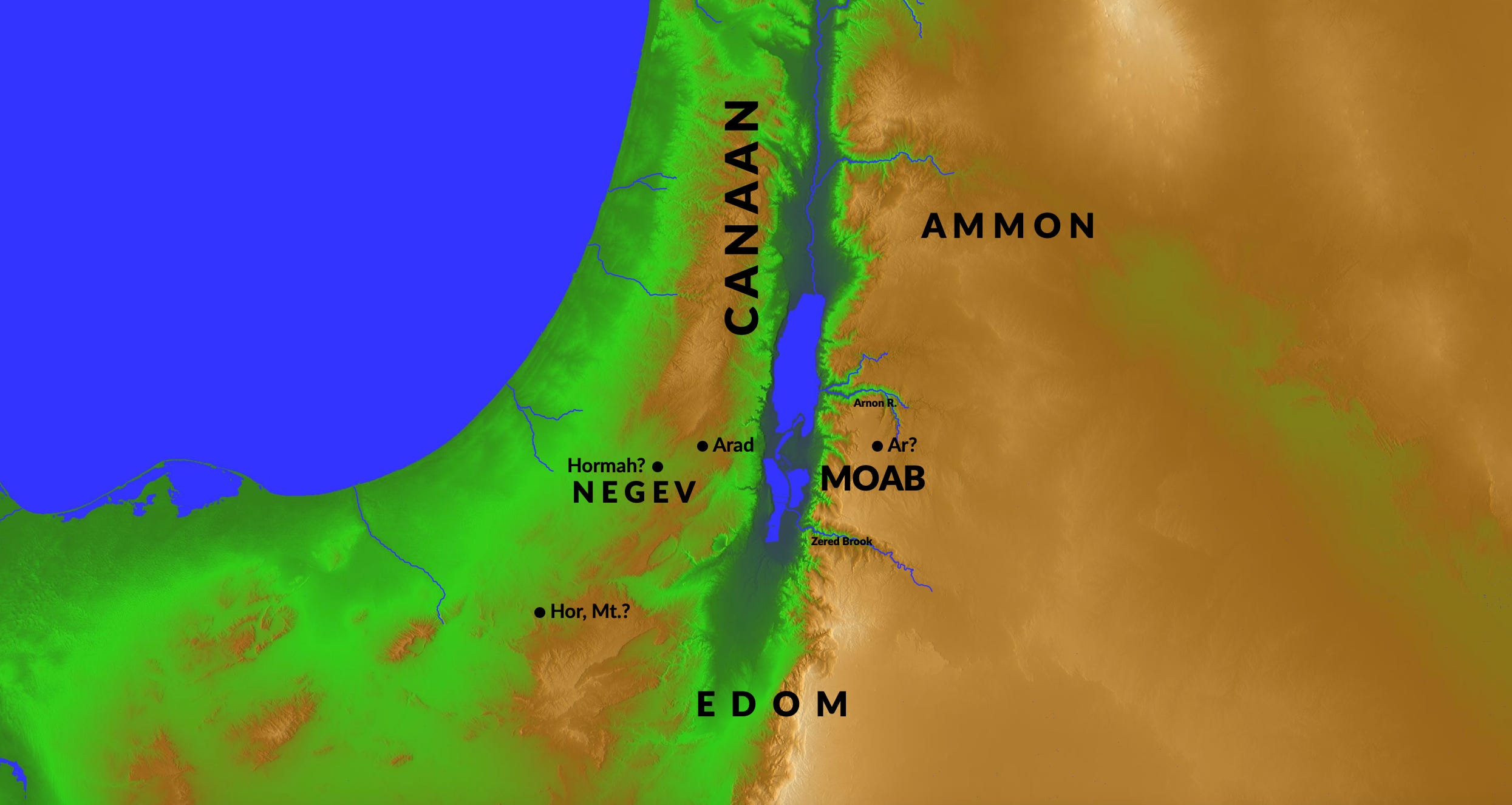
Num. 21:2 So Israel made a vow to Yahweh and said, “If You will indeed give this people into my hand, then I will devote their cities to destruction.”
Num. 21:3 Then Yahweh heard the voice of Israel and gave the Canaanites over; so they devoted them and their cities to destruction. Thus the name of the place was called Hormah.
Num. 21:4 ¶ Then they set out from Mount Hor by the way to the Red Sea, to go around the land of Edom; and the people became impatient on the way.
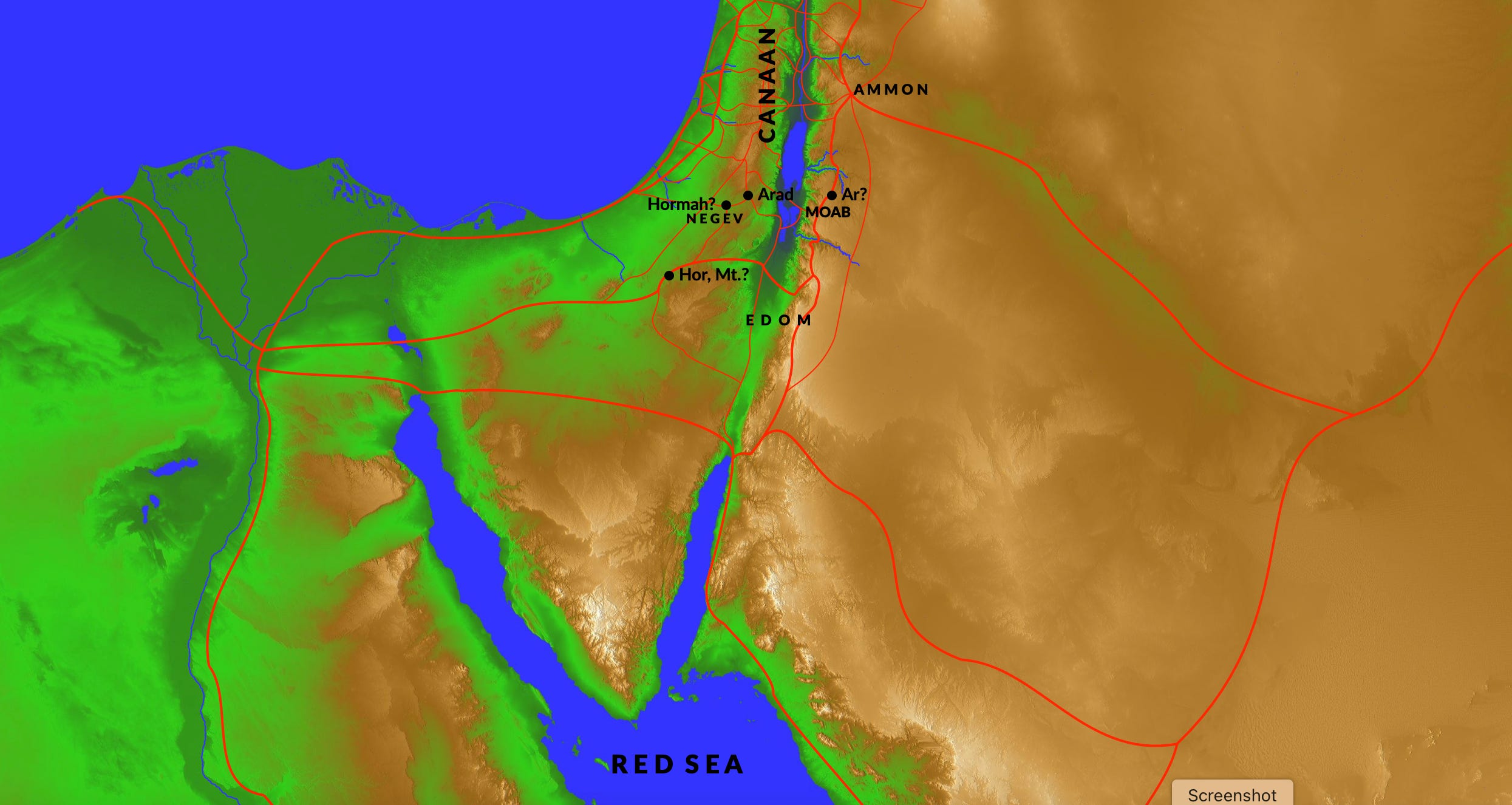
The red lines on this map represent ancient highways. Since Edom had refused Moses’ request to travel through Edom, Israel went south from Mount Hor on the road that went around the south side of Edom.
Num. 21:5 And the people spoke against God and against Moses, “Why have you brought us up out of Egypt to die in the wilderness? For there is no food and no water, and we loathe this miserable food.”
In fairness to the Israelites, this episode of complaining probably took place decades after Yahweh performed all the miracles that brought Israel out of Egypt. Many of these Israelites would not have been born when Israel left Egypt. Having said that, there was still no excuse for them to speak against God and Moses.
Num. 21:6 ¶ So Yahweh sent fiery serpents among the people, and they bit the people so that many people of Israel died.
Num. 21:7 Then the people came to Moses and said, “We have sinned because we have spoken against Yahweh and against you; pray to Yahweh, that He may remove the serpents from us.” And Moses prayed for the people.
Num. 21:8 Then Yahweh said to Moses, “Make a fiery serpent and set it on a standard; and it will be that everyone who is bitten and looks at it, will live.”
Num. 21:9 And Moses made a bronze serpent and set it on the standard; and it happened, that if a serpent bit any man, when he looked to the bronze serpent, he lived.
Don’t miss the significance of this incident. Israelites were dying from serpent bites. The only way to be saved from a serpent bite was for them to look on the bronze serpent which Moses had erected.
Jesus used this to teach about Himself. When Nicodemus asked how to be born again, Jesus said, “As Moses lifted up the serpent in the wilderness, even so must the Son of Man be lifted up; so that whoever believes will in Him have eternal life.” (John 3:14-15) Just as the Israelites had to look upon the bronze serpent in order to be saved from serpent bites, so too all people today need to believe in Jesus in order to be saved from eternal punishment in hell.
Num. 21:10 ¶ Then the sons of Israel set out and camped in Oboth.
Num. 21:11 They then set out from Oboth and camped at Iye-abarim, in the wilderness which is opposite Moab, east toward the sunrise.
Notice the phrase “east toward the sunrise”. The traditional belief about the Israelites’ route to Canaan is that the Israelites traveled up the Jordan River valley, along the shores of the Dead Sea. However, the phrase “east toward the sunrise” tells us they traveled on the east side of Edom and Moab, not the west side.
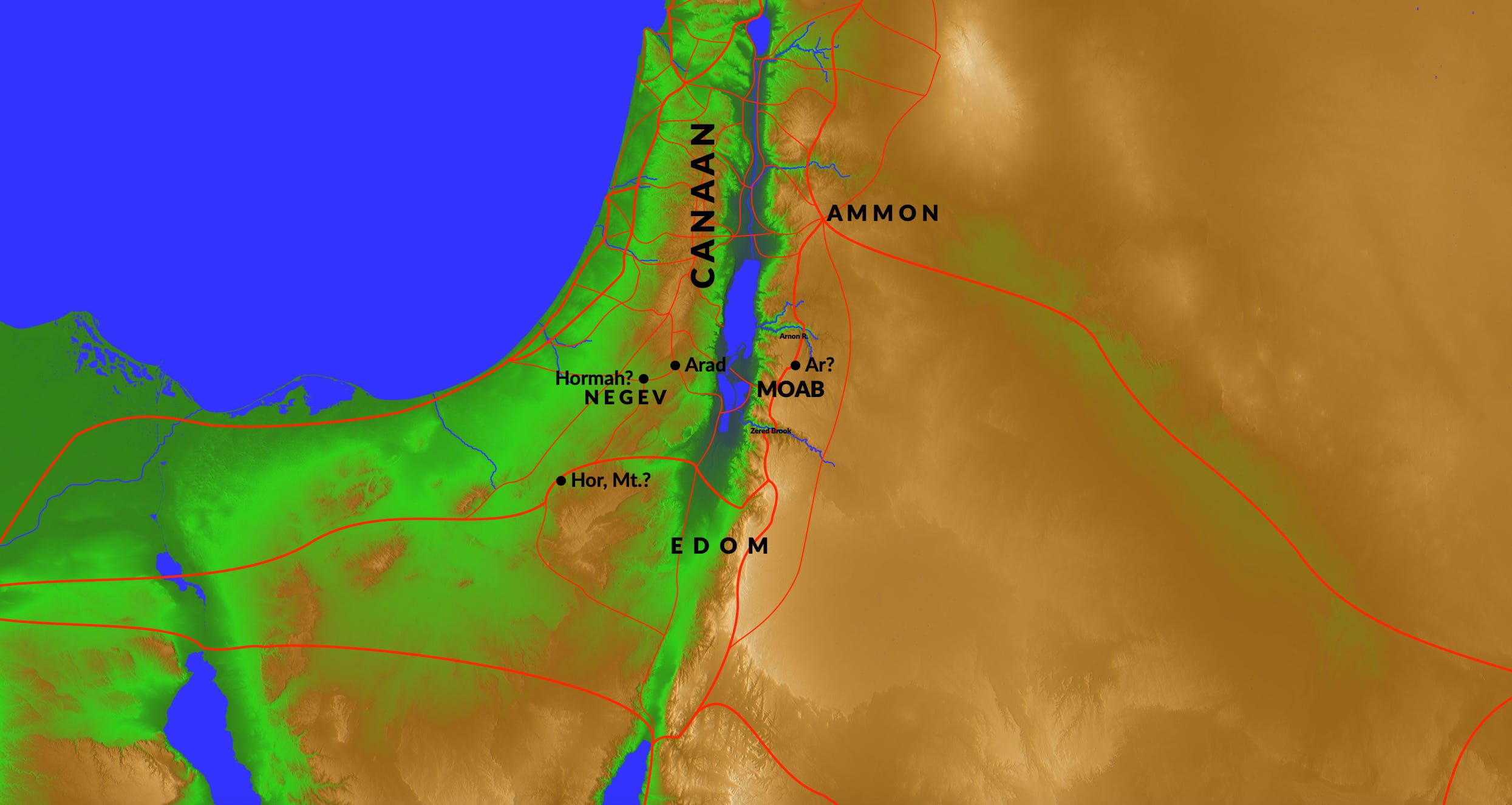
The red lines on the map indicate ancient highways.
Num. 21:12 From there they set out and camped in Wadi Zered.
Num. 21:13 From there they set out and camped on the other side of the Arnon, which is in the wilderness that comes out of the border of the Amorites, for the Arnon is the border of Moab, between Moab and the Amorites.
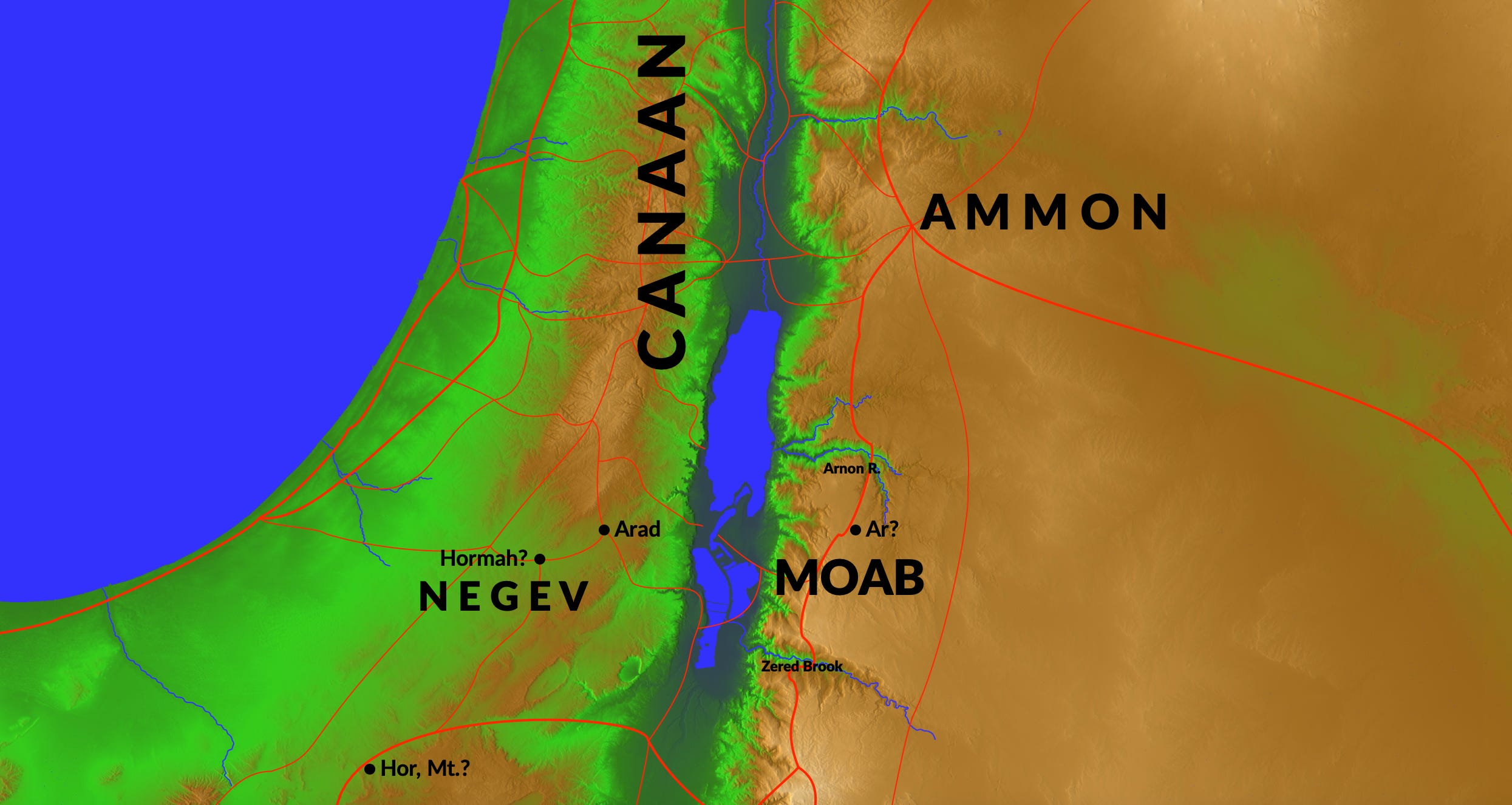
Num. 21:14 Therefore it is said in the Book of the Wars of Yahweh,
“Waheb in Suphah,
And the wadis of the Arnon,
Num. 21:15 And the slope of the wadis
That extends to the site of Ar,
And leans to the border of Moab.”
Many people believe a good God will not send people to hell; therefore, they believe that they will go to heaven simply because they are good people. However, Jesus said, “As Moses lifted up the serpent in the wilderness, even so must the Son of Man be lifted up; so that whoever believes will in Him have eternal life.” (John 3:14-15) Just as the Israelites had to look upon the bronze serpent in order to be saved from serpent bites, so too all people today need to believe in Jesus in order to spend eternity in heaven instead of enduring eternal punishment in hell.
Thanks for visiting Bible Mountain. If you have already joined my email list, thank you and please tell others about Bible Mountain. If you have not joined my email list yet, please do so now. In order to join, go to BibleMountain.com, click on subscribe, and that will take you to a page where you can sign up. Your email address will not be sold nor given away. Once again, thanks for visiting Bible Mountain.
“Scripture quotations taken from the (LSB®) Legacy Standard Bible®, Copyright © 2021 by The Lockman Foundation. Used by permission. All rights reserved. Managed in partnership with Three Sixteen Publishing Inc. LSBible.org and 316publishing.com.”