
Western civilization tends to be individualistic. We believe in personal autonomy, individual rights, and the idea that sons should not be punished for the sins of the father and vice versa. Today’s Scripture reading tells us about a time when the entire nation of Israel was punished for the sin of one man. This does not mean we should abandon individualism in the political and economic sphere, but it does mean we should ponder if individualism has no place in the church.
The sixth chapter of Joshua records the conquest of Jericho. The Israelites marched around the city of Jericho once per day for six days. Then on the seventh day they marched around it seven times. After the seventh lap, the priests sounded trumpets, the people shouted, and the walls fell down. Then the Israelites went up into the city and killed every inhabitant, both male and female, both young and old, and all the animals.
Joshua 6:25 However, Rahab the harlot and her father’s household and all she had, Joshua preserved alive; and she has lived in the midst of Israel to this day, for she hid the messengers whom Joshua sent to spy out Jericho.
Joshua 6:26 ¶ Then Joshua made them swear an oath at that time, saying, “Cursed before Yahweh is the man who rises up and builds this city Jericho; with the loss of his firstborn he shall lay its foundation, and with the loss of his youngest son he shall set up its gates.”
Notice the words “oath” and “cursed”. Joshua cursed Jericho, essentially prohibiting anyone from ever rebuilding the city.
This curse was issued around 1400 BC. Around 500 years later, in the ninth century BC, during the reign of King Ahab, a man named Hiel built Jericho. When he laid its foundations, he lost his firstborn son. When he set up the gates, he lost his youngest son (see 1 Kings 16:34).
Joshua 6:27 So Yahweh was with Joshua, and the report about him was in all the land.
Joshua 7:1 ¶ But the sons of Israel acted unfaithfully in regard to the things devoted to destruction. Achan, the son of Carmi, the son of Zabdi, the son of Zerah, from the tribe of Judah, took some of the devoted things; therefore the anger of Yahweh burned against the sons of Israel.
Take note of the word “but”. Everything seemed to be great. However, unbeknownst to Joshua and most of the Israelites, one man had deliberately disobeyed Yahweh’s instructions regarding the loot of Jericho.
Joshua 7:2 ¶ Now Joshua sent men from Jericho to Ai, which is near Beth-aven, east of Bethel, and said to them, “Go up and spy out the land.” So the men went up and spied out Ai.
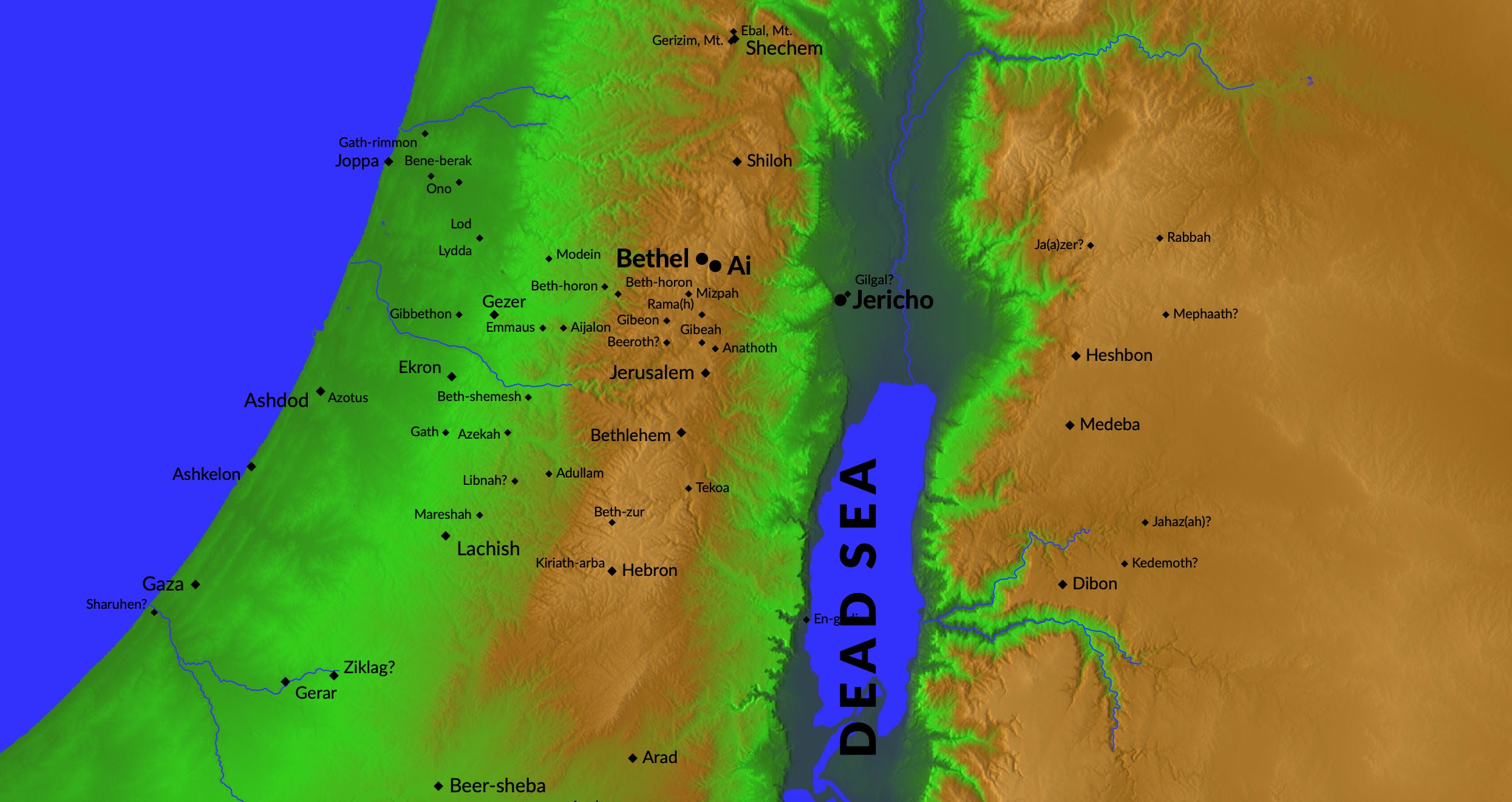
On the map, the dark greens are the lowest elevations. The browns are the higher elevations. The light greens are in between. You can see the mountain range running north to south between the Jordan River and the Mediterranean Sea.
Jericho was down in the Jordan River Valley. Most of the cities of Canaan were at the higher elevations. Thus, after conquering Jericho, the next step was to go up into the hills and conquer the cities up there.
The first target was Ai.
Joshua 7:3 Then they returned to Joshua and said to him, “Do not have all the people go up; only about two or three thousand men need go up to strike down Ai; do not have all the people toil up there, for they are few.”
Joshua 7:4 So about three thousand men from the people went up there, but they fled from the men of Ai.
Joshua 7:5 And the men of Ai struck down about thirty-six of their men and pursued them from the gate as far as Shebarim and struck them down on the descent, so the hearts of the people melted and became as water.
The word “descent” refers to the elevation change between Ai and Jericho. As the men of Israel fled from Ai back toward Jericho, they were going downhill.
Joshua 7:6 ¶ Then Joshua tore his clothes and fell to the earth on his face before the ark of Yahweh until the evening, both he and the elders of Israel; and they put dust on their heads.
Joshua 7:7 Joshua said, “Alas, O Lord Yahweh, why did You ever bring this people over the Jordan, only to give us into the hand of the Amorites, to make us perish? If only we had been willing to live beyond the Jordan!
Look at the word “perish”. Joshua was afraid Israel would cease to exist.
Joshua 7:8 O Lord, what can I say since Israel has turned their back before their enemies?
Joshua 7:9 And the Canaanites and all the inhabitants of the land will hear of it, and they will surround us and cut off our name from the earth. And what will You do for Your great name?”
Here we see the words “cut off our name”. Again, Joshua was assuming the worst was about to happen.
I have mixed feelings about Joshua’s response. On the one hand, it was understandable why Joshua was pessimistic. Joshua did not know that Achan had taken possession of some forbidden items. Therefore, Joshua had no idea why they were suddenly losing on the battlefield to a small city. On the other hand, Joshua was overly pessimistic in light of everything Yahweh had done for them. He was assuming the worst instead of hoping this was a temporary setback. Joshua knew that Yahweh had promised to give them the land. He was very quick to assume that Yahweh would not follow through on His promise.
This is a natural tendency, and one we should guard against. We should not assume the worst every time we experience an obstacle. Instead, we should deal with the obstacle, and trust that God will do what He promised.
God promised to supply all our needs. When we face a financial problem, we should not assume that we will be destroyed financially. Instead, we should trust God, and look at our trial as an opportunity to demonstrate that we trust God to do as He said He would do.
Joshua 7:10 ¶ So Yahweh said to Joshua, “Rise up! Why is it that you have fallen on your face?
Notice Yahweh asked “why”. It appears that Yahweh thought Joshua was being too pessimistic.
Joshua 7:11 Israel has sinned, and they have also trespassed against My covenant which I commanded them. And they have even taken some of the things devoted to destruction and have both stolen and dealt falsely. Moreover, they have also put them among their own things.
Joshua 7:12 Therefore the sons of Israel cannot rise before their enemies; they turn their backs before their enemies, for they have become devoted to destruction. I will not be with you anymore unless you destroy the things devoted to destruction from your midst.
Ponder the consequences that accrued to the whole nation because of the sin of one man. This should cause us to ponder the possibility that if we sin, we might bring adversity upon our families or churches.
Joshua 7:13 Rise up! Set the people apart as holy and say, ‘Set yourselves apart as holy for tomorrow, for thus Yahweh, the God of Israel, has said, “There are things devoted to destruction in your midst, O Israel. You cannot rise before your enemies until you have removed the things devoted to destruction from your midst.”
Western civilization is based on individualism. This involves the belief that the entire community should not suffer for the mistakes of one person. However, we saw in today’s passage that Yahweh made the entire nation of Israel suffer because one man did something wrong.
Perhaps we should ponder the limits of individualism. Is it possible that individualism has no place in the church or family? Is it possible that the sin of one man in the 21st century can bring harsh consequences upon his family or church?
Thanks for visiting Bible Mountain. If you have already joined my email list, thank you, and please tell others about Bible Mountain. If you have not joined my email list yet, please do so now. In order to join, go to BibleMountain.com, click Subscribe, and that will take you to a page where you can sign up. Your email address will not be sold or given away. Once again, thanks for visiting Bible Mountain.
“Scripture quotations taken from the (LSB®) Legacy Standard Bible®, Copyright © 2021 by The Lockman Foundation. Used by permission. All rights reserved. Managed in partnership with Three Sixteen Publishing Inc. LSBible.org and 316publishing.com.”