
Today, we will read a passage of Scripture which summarizes the military victories Israel achieved on both sides of the Jordan River. There is a very brief reference to peace. After Israel’s success on the battlefield, they had peace and could have continued to have peace, if they had made the right choice. This illustrates the reality we live in today regarding peace with God.
Yesterday, we read about a coalition of cities in the northern part of the Promised Land that gathered together to fight against Israel. They were led by the king of Hazor. Israel defeated the northern coalition, just as it had defeated the cities in the south. Joshua burned the city of Hazor.
Joshua 11:21 ¶ Then Joshua came at that time and cut off the Anakim from the hill country, from Hebron, from Debir, from Anab and from all the hill country of Judah and from all the hill country of Israel. Joshua devoted them to destruction with their cities.
Look at the word “Anakim”. The descendants of Anak were renowned for being large, powerful people (see Deuteronomy 2:10, 21 and Deuteronomy 9:2).
Notice the distinction between the hill country of Judah and the hill country of Israel. This gives us a hint when the book of Joshua was written. When the Israelites settled the land of Canaan, they were known as Israel. After King Solomon died, around 400 years after Joshua’s death, the country split in half. The north was known as Israel and the south was known as Judah. The split is recorded in 1 Kings 12 and 2 Chronicles 10. The fact that the author of Joshua made a reference to Israel and Judah indicates the author of Joshua lived after the split happened, meaning he lived at least 400 years after the death of Joshua.
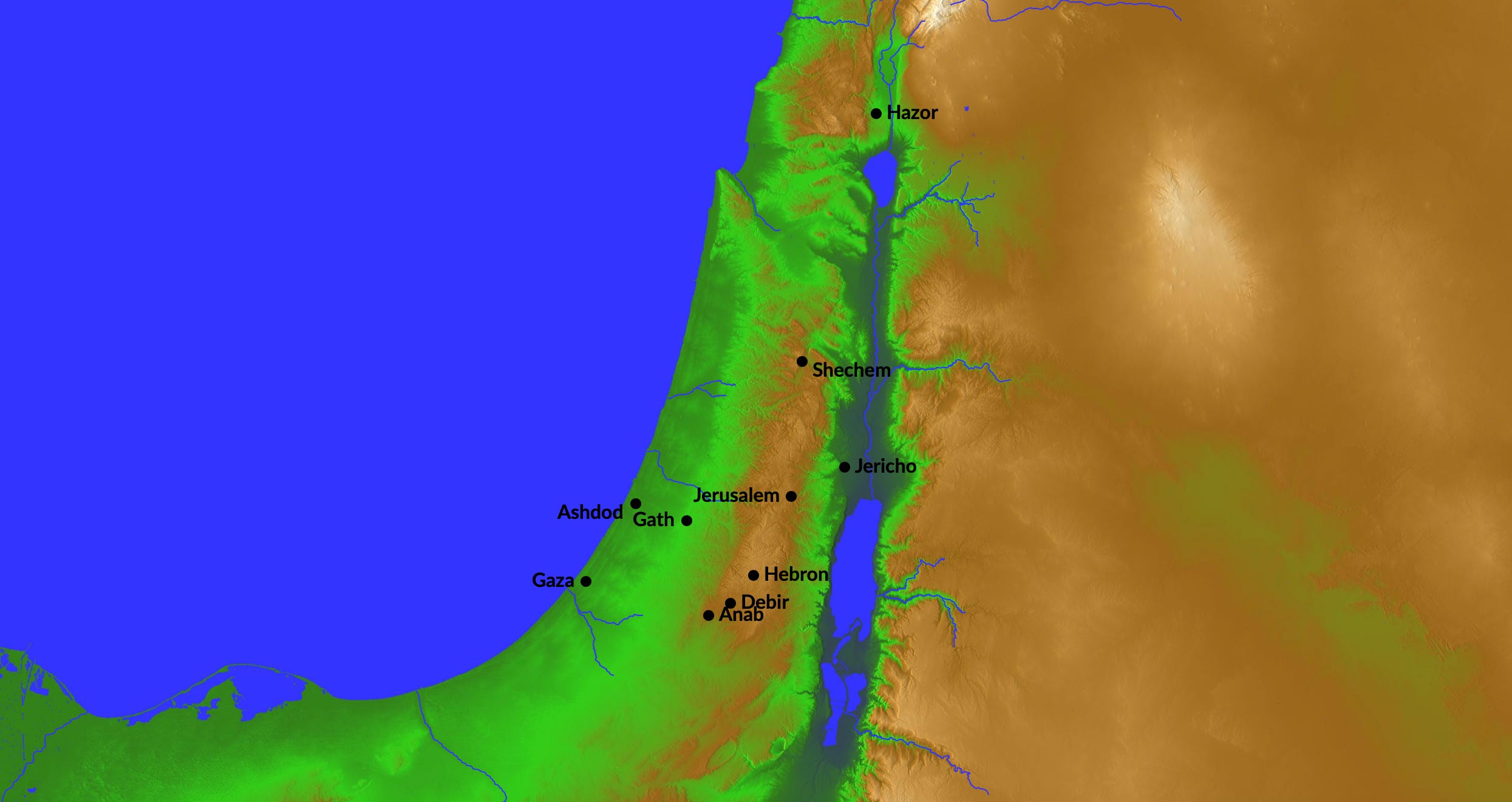
The colors on the map indicate elevation. The browns are the higher elevations. The hill country is the brown area stretching from Shechem down to Debir. The hill country of Israel was the north part of that area while the hill country of Judah was the south part of that area. The border between Israel and Judah was just north of Jerusalem.
Joshua 11:22 There were no Anakim left in the land of the sons of Israel; only in Gaza, in Gath, and in Ashdod some remained.
Gaza, Gath, and Ashdod were in the land of the Philistines.
Joshua 11:23 So Joshua took the whole land, according to all that Yahweh had spoken to Moses, and Joshua gave it for an inheritance to Israel according to their divisions by their tribes. Thus the land was quiet from war.
Don’t miss the word “quiet”. There was peace. The peace should have continued. If Israel had remained faithful to Yahweh, the peace would have been never-ending. However, Israel eventually succumbed to idolatry, and there is much warfare recorded in the books of Judges, 1 & 2 Samuel, 1 & 2 Kings, and 1 & 2 Chronicles.
Israel had peace and had to choose to obey Yahweh or disobey. They chose to disobey and suffered consequences.
Today, people have the same choice. Jesus died on the cross and rose again from the dead, giving every human the chance to be saved from eternal punishment. Each person can choose to become a Christian and spend eternity in heaven, or he can reject Christianity and spend eternity in a lake of fire.
Furthermore, every person who becomes a Christian is at peace with God. Christians are daily faced with the choice of obeying Jesus or disobeying. Someday, every believer will stand before the judgment seat of Christ and give an account of every word and deed. We will be recompensed accordingly (see 2 Corinthians 5:10).
Joshua 12:1 ¶ Now these are the kings of the land whom the sons of Israel struck down, and whose land they possessed beyond the Jordan to the east toward the sunrise, from the valley of the Arnon as far as Mount Hermon, and all the Arabah to the east:
Take note of the word “east”. Verses 1-6 refer to conquests that happened while Moses was still alive and before Israel crossed the Jordan River. These conquests are recorded in Deuteronomy.
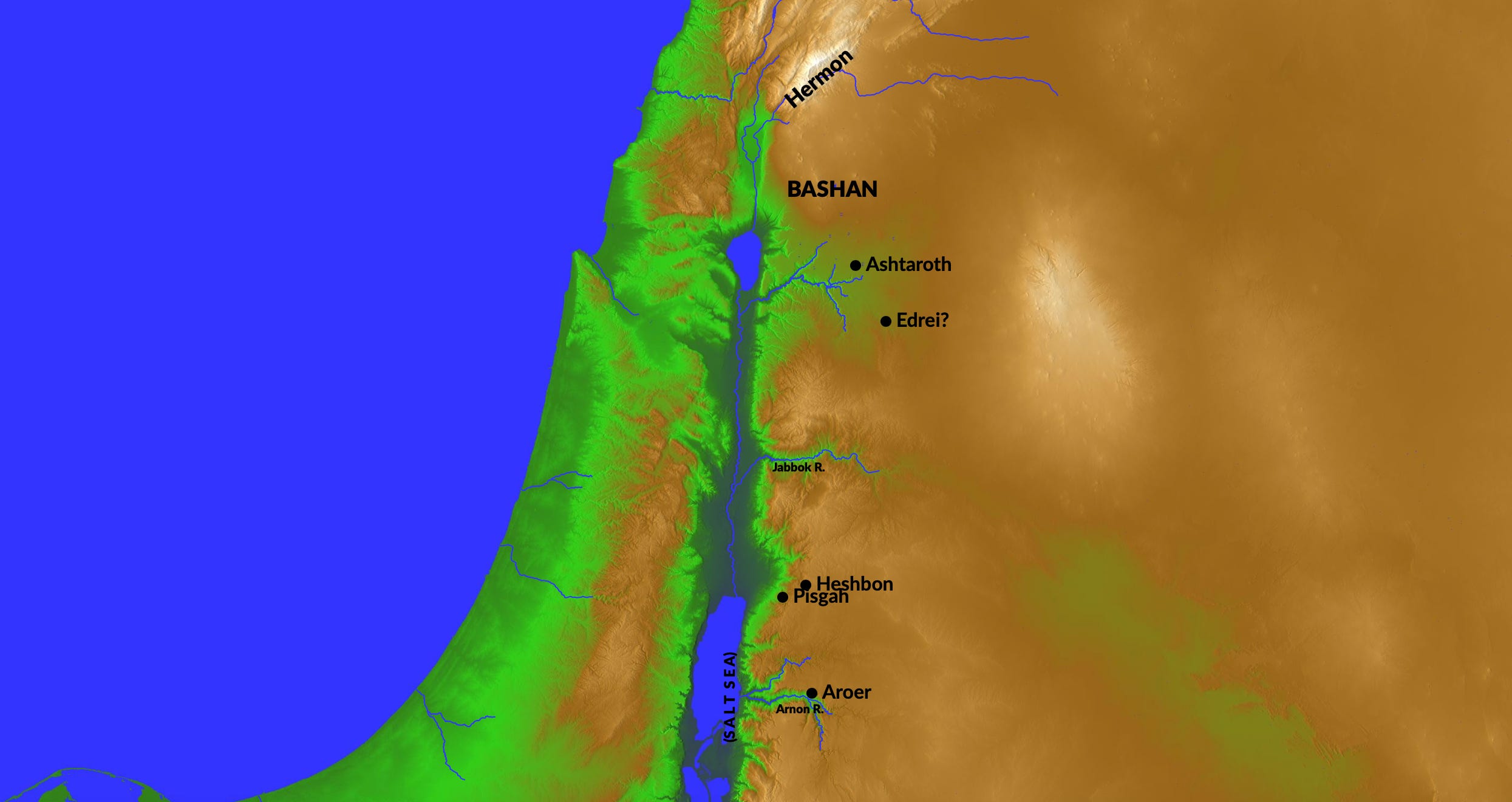
Joshua 12:2 Sihon king of the Amorites, who lived in Heshbon and ruled from Aroer, which is on the edge of the valley of the Arnon, both the middle of the valley and half of Gilead, even as far as the brook Jabbok, the border of the sons of Ammon;
Joshua 12:3 and the Arabah as far as the Sea of Chinneroth toward the east, and as far as the sea of the Arabah, even the Salt Sea, eastward toward Beth-jeshimoth, and on the south, at the foot of the slopes of Pisgah;
Joshua 12:4 and the territory of Og king of Bashan, one of the remnant of the Rephaim, who lived at Ashtaroth and at Edrei
Joshua 12:5 and ruled over Mount Hermon and Salecah and all Bashan, as far as the border of the Geshurites and the Maacathites, and half of Gilead, as far as the border of Sihon king of Heshbon.
Joshua 12:6 Moses the servant of Yahweh and the sons of Israel struck them down; and Moses the servant of Yahweh gave it to the Reubenites and the Gadites and the half-tribe of Manasseh as a possession.
Joshua 12:7 ¶ Now these are the kings of the land whom Joshua and the sons of Israel struck down beyond the Jordan toward the west, from Baal-gad in the valley of Lebanon even as far as Mount Halak, which rises toward Seir; and Joshua gave it to the tribes of Israel as a possession according to their divisions,
Take note of the word “west”. Starting in verse 7, the author listed conquests that happened under the leadership of Joshua, after Israel crossed the Jordan River.
Joshua 12:8 in the hill country and in the Shephelah and in the Arabah and on the slopes and in the wilderness and in the Negev; the Hittite, the Amorite and the Canaanite, the Perizzite, the Hivite and the Jebusite:
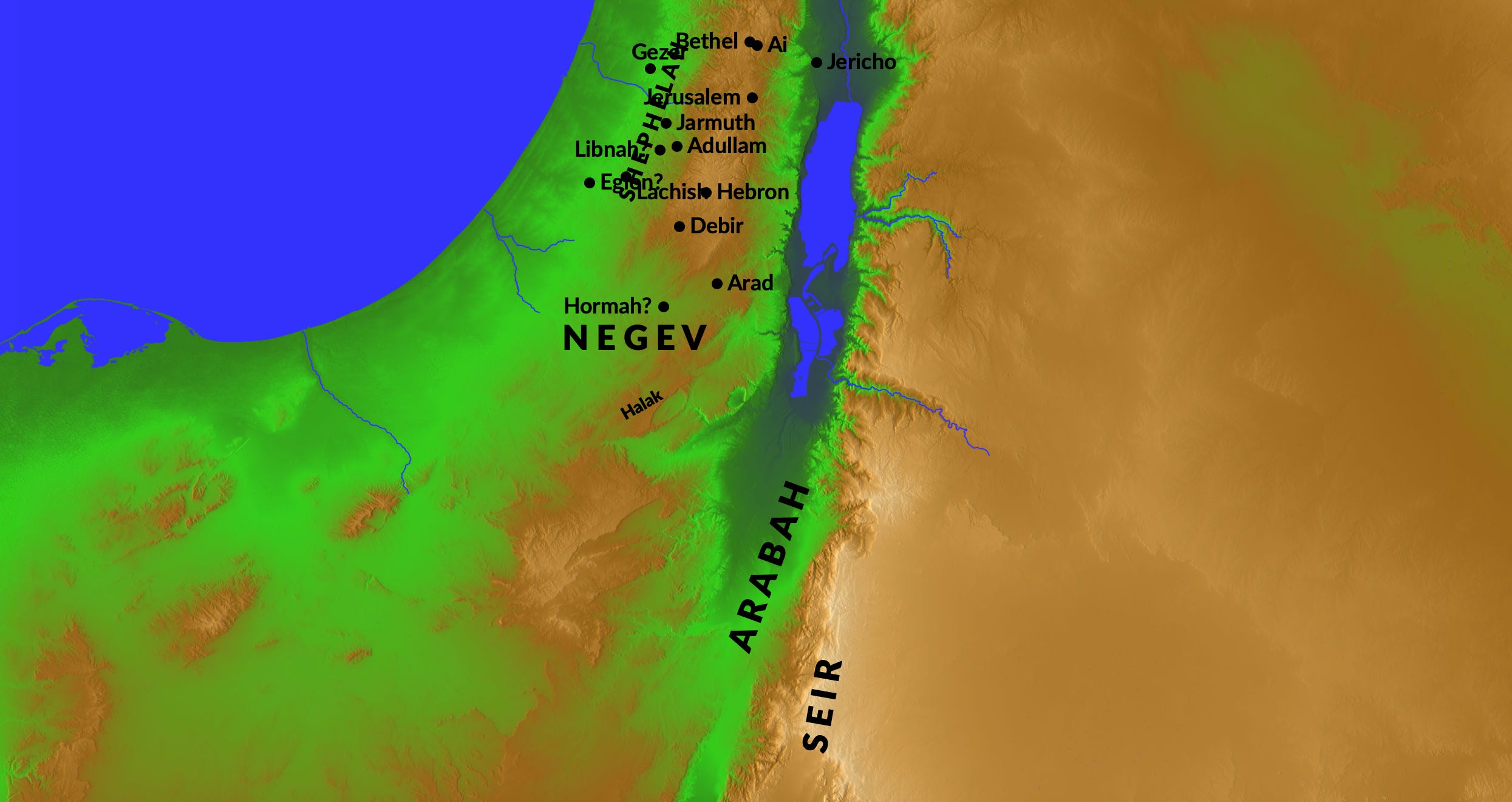
Joshua 12:9 the king of Jericho, one;
the king of Ai, which is beside Bethel, one;
Joshua 12:10 the king of Jerusalem, one;
the king of Hebron, one;
Joshua 12:11 the king of Jarmuth, one;
the king of Lachish, one;
Joshua 12:12 the king of Eglon, one;
the king of Gezer, one;
Joshua 12:13 the king of Debir, one;
the king of Geder, one;
Joshua 12:14 the king of Hormah, one;
the king of Arad, one;
Joshua 12:15 the king of Libnah, one;
the king of Adullam, one;
Joshua 12:16 the king of Makkedah, one;
the king of Bethel, one;
Just as Israel had the chance for everlasting peace in the Promised Land, so too all humans today have the chance to have everlasting peace with God. All we have to do is believe Jesus rose from the dead and confess Him as Lord. Anyone who does not make that choice will suffer eternal consequences.
Thanks for visiting Bible Mountain. If you have already joined my email list, thank you, and please tell others about Bible Mountain. If you have not joined my email list yet, please do so now. In order to join, go to BibleMountain.com, click Subscribe, and that will take you to a page where you can sign up. Your email address will not be sold or given away. Once again, thanks for visiting Bible Mountain.
“Scripture quotations taken from the (LSB®) Legacy Standard Bible®, Copyright © 2021 by The Lockman Foundation. Used by permission. All rights reserved. Managed in partnership with Three Sixteen Publishing Inc. LSBible.org and 316publishing.com.”