
Godlessness and sin are very prevalent in modern society. Most evangelical churches are lukewarm, having been corrupted by a desire to fit in with the world. Our communities are full of people who are hurting and need to know Jesus. Those of us who are faithful Christians and desire to cure these ailments are often overwhelmed by the immensity of the task.
Today, we will read a passage that describes how Yahweh gave Israel an improbable victory, and did so in a very improbable time frame. This should encourage us that the task of fixing our society is not too hard for God.
Yesterday, we read that after the kings of Jerusalem, Hebron, Jarmuth, Lachish, and Eglon lost their battle against Israel, they fled and hid in the cave at Makkedah. Joshua brought the kings out of the cave and told the chiefs of Israel to place their feet on the necks of the kings, saying that Yahweh was also going to deliver all their enemies into their hands. Then Joshua killed the five kings and hung them on trees until evening.
Joshua 10:28 ¶ Now Joshua captured Makkedah on that day and struck it and its king with the edge of the sword; he devoted it to destruction and every person who was in it. He left no survivor. Thus he did to the king of Makkedah just as he had done to the king of Jericho.
Notice the words “every person” and “he left no survivor”. Yahweh had told Israel to kill all the Canaanites (see Deuteronomy 20:16). Makkedah was a Canaanite city; thus, it had to be destroyed.
It is unknown where Makkedah was located. It is assumed that it was in the area of Jarmuth and Lachish.
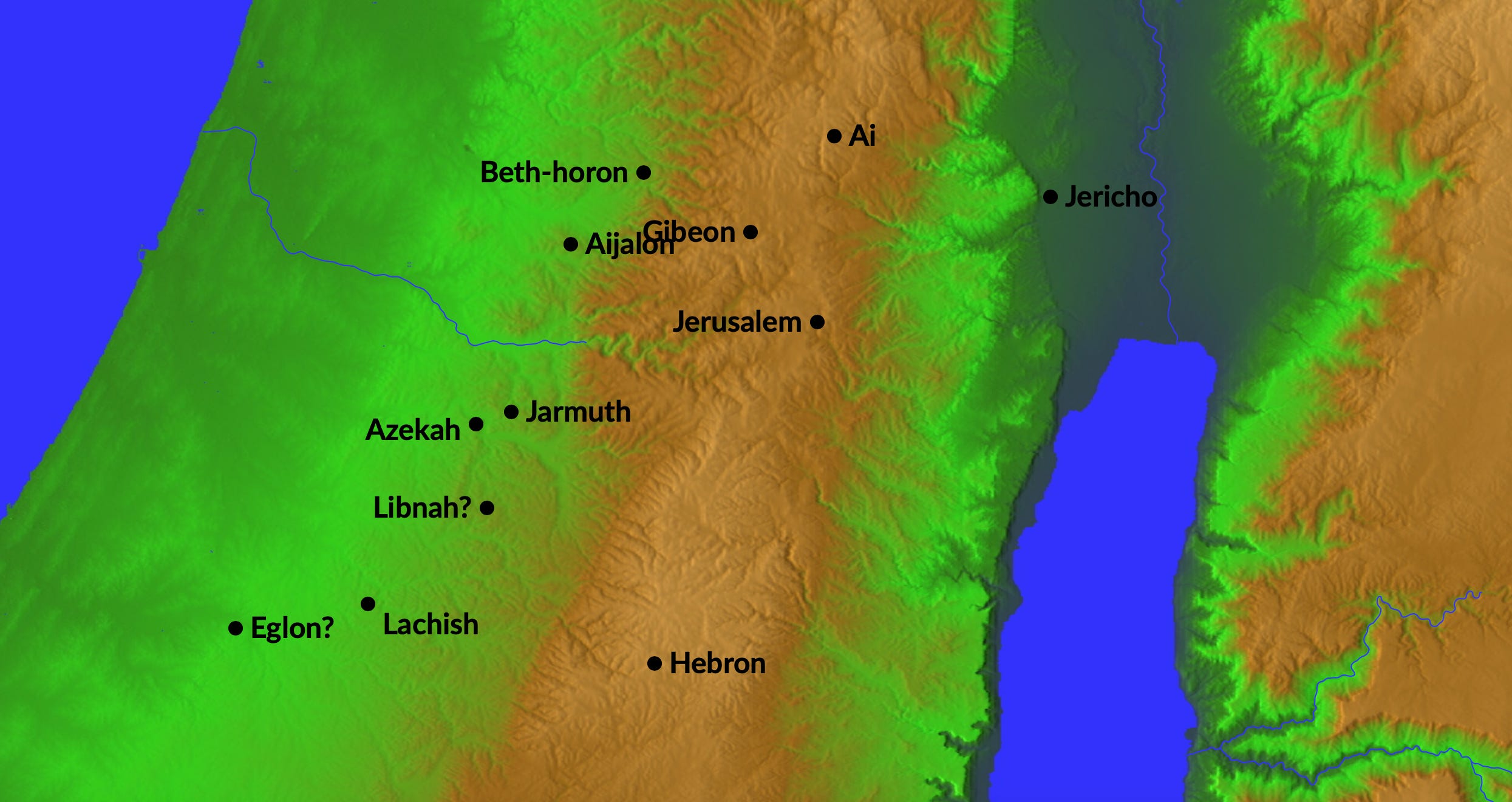
Joshua 10:29 ¶ Then Joshua and all Israel with him passed on from Makkedah to Libnah and fought against Libnah.
It is not certain where Libnah was located, but it was probably near Jarmuth and Lachish.
Joshua 10:30 And Yahweh gave it also with its king into the hands of Israel, and he struck it and every person who was in it with the edge of the sword. He left no survivor remaining in it. Thus he did to its king just as he had done to the king of Jericho.
In this verse we once again see the words “every person” and “he left no survivor”.
Joshua 10:31 ¶ And Joshua and all Israel with him passed on from Libnah to Lachish, and they camped by it and fought against it.
Lachish was one of the cities that had gathered to fight Gibeon, but was then defeated by Israel. Lachish was a walled city. Many of the men of Lachish had been killed in the battle at Gibeon, but many residents of Lachish would have stayed in the city.
Joshua 10:32 And Yahweh gave Lachish into the hands of Israel; and he captured it on the second day and struck it and every person who was in it with the edge of the sword, according to all that he had done to Libnah.
Take note of the words “second day”. Sometimes it took months or years to conquer a walled city. The fact that Israel captured it in two days indicates the extraordinary nature of their victory.
Joshua 10:33 ¶ Then Horam king of Gezer came up to help Lachish, and Joshua struck him and his people down until there was no survivor remaining for him.
This is the first time the city of Gezer is mentioned in the Bible.
The text doesn’t say why Horam decided to help Lachish. After all the success Israel had on the battlefield, it seems that no city would voluntarily get involved in fighting against Israel. Perhaps Horam correctly deduced that his city would be targeted eventually, so he decided to fight at a time and place of his choosing. Regardless, Gezer got involved and they were defeated as well.
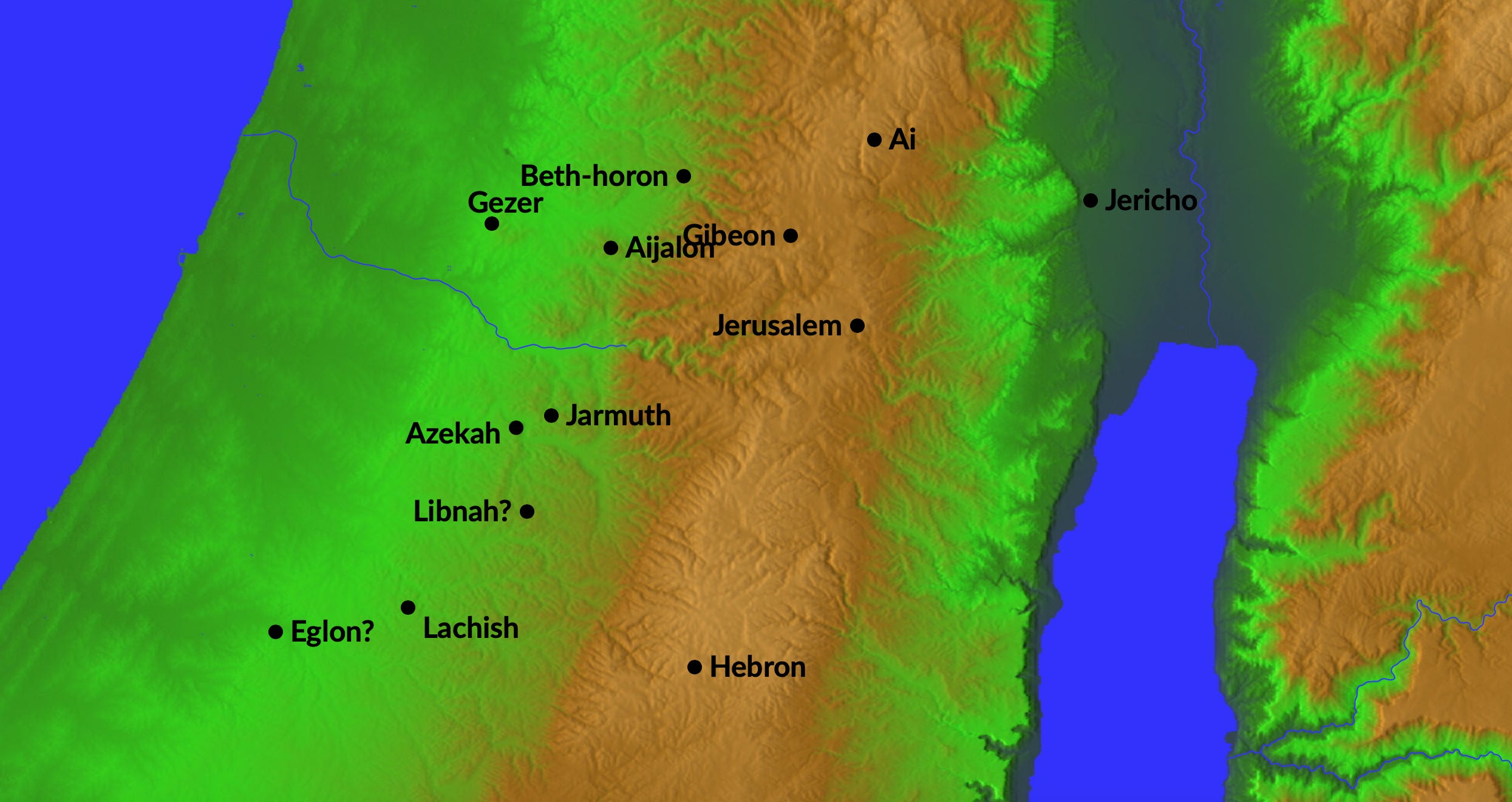
It is about 20 miles / 32 km from Gezer to Lachish. Humans can travel about 30 miles per day, so Gezer to Lachish could have been a one-day journey.
Joshua 10:34 ¶ And Joshua and all Israel with him passed on from Lachish to Eglon, and they camped by it and fought against it.
It was only about 7 miles / 11 km from Lachish to Eglon.
Joshua 10:35 And they captured it on that day and struck it with the edge of the sword; and every person who was in it, he devoted to destruction on that day according to all that he had done to Lachish.
Just as with Lachish, many of the men of Eglon had already been killed. At this point Joshua and Israel killed the rest of the inhabitants.
Joshua 10:36 ¶ Then Joshua and all Israel with him went up from Eglon to Hebron, and they fought against it.
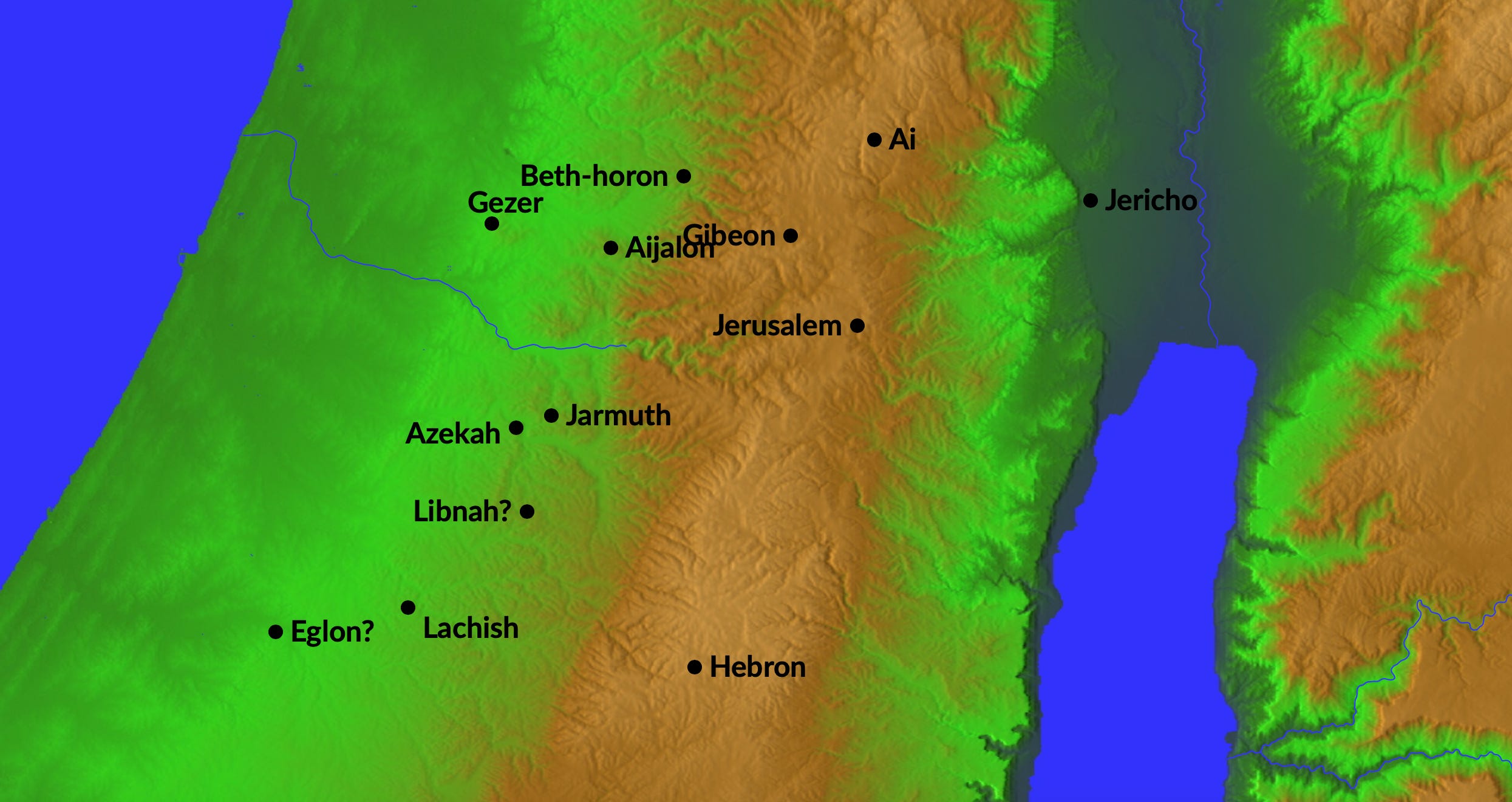
It is about 22 miles / 35 km from Eglon to Hebron. More important is the elevation change. Eglon is 400 feet / 120 m above sea level. Hebron is 3,000 feet / 900 m above sea level. Going up to Hebron was like climbing a small mountain.
Joshua 10:37 And they captured it and struck it and its king and all its cities and all the persons who were in it with the edge of the sword. He left no survivor remaining, according to all that he had done to Eglon. And he devoted it and every person who was in it to destruction.
Notice the word “king”. Israel had already killed the king of Hebron (see Joshua 10:23-26). The text does not say how much time elapsed between the killing of the five kings and when Joshua went and besieged Hebron. It is possible that the king mentioned in verse 37 was the successor to the king who was killed in verse 26.
Look at the words “all its cities”. Hebron was a prominent city. It was so prominent that it ruled over other nearby cities.
Once again we see the words “no survivor” and “every person”. At this point in time, Joshua and the Israelites were obeying Yahweh and destroying all the Canaanites.
Joshua 10:38 ¶ Then Joshua and all Israel with him returned to Debir, and they fought against it.
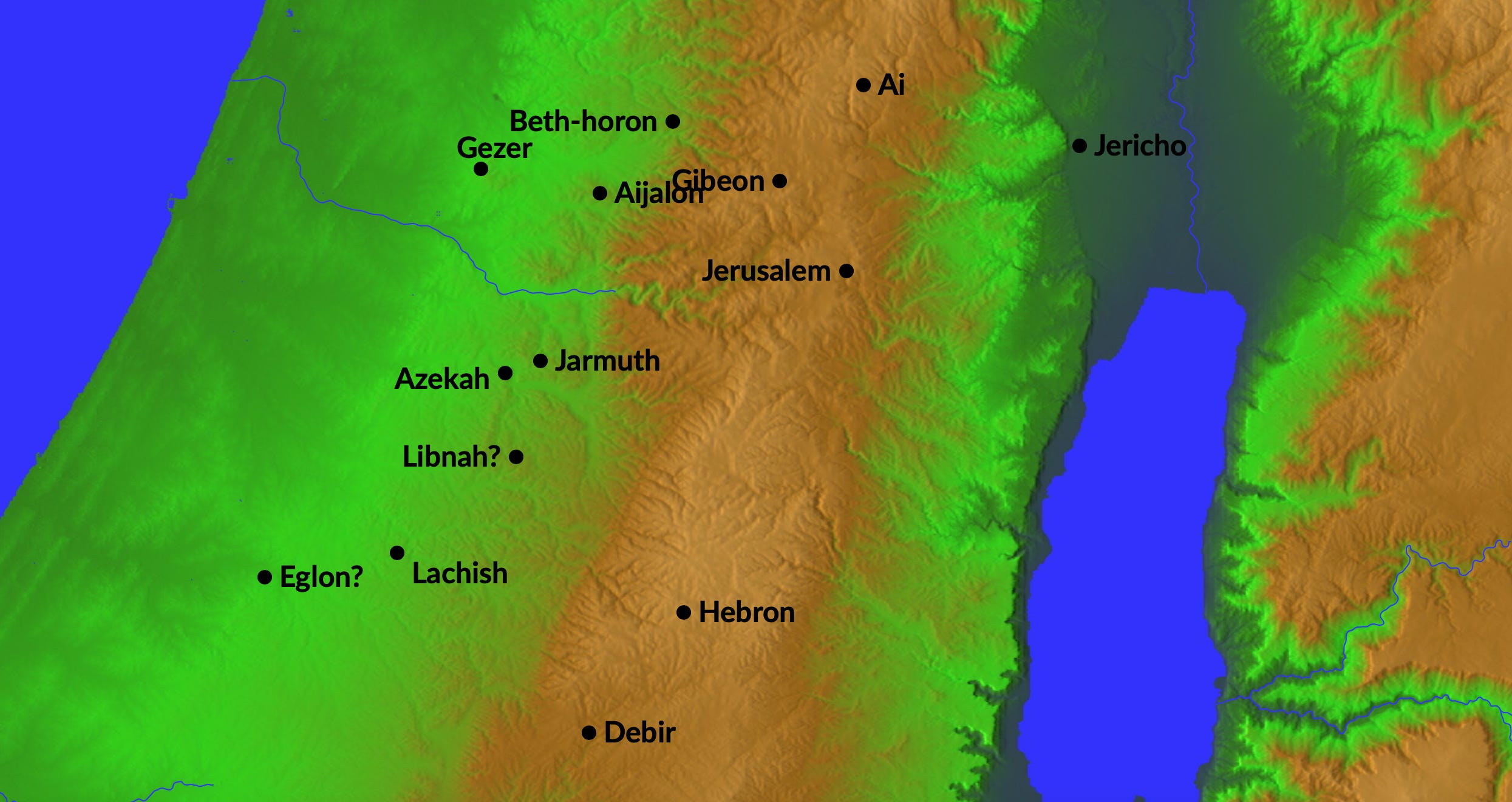
It was about 8 miles / 13 km from Hebron to Debir. The elevation of Debir was lower than Hebron. The difference was about 1,000 feet / 300 m.
Joshua 10:39 And he captured it and its king and all its cities, and they struck them with the edge of the sword and devoted every person who was in it to destruction. He left no survivor remaining. Just as he had done to Hebron, so he did to Debir and its king, as he had also done to Libnah and its king.
Joshua 10:40 ¶ Thus Joshua struck all the land—the hill country and the Negev and the Shephelah and the slopes—as well as all their kings. He left no survivor remaining, but he devoted to destruction all who breathed, just as Yahweh, the God of Israel, had commanded.
The hill country refers to the hills that stretched from Ai down to Hebron.
The word “shephelah” means “foothills” or “lowlands”, referring to the rolling hills located just below the hill country.
The word “negev” means south. Sometimes the Hebrew word “negev” was used to indicate a direction. Other times the word was used as the proper name of the region on the south side of Israel.
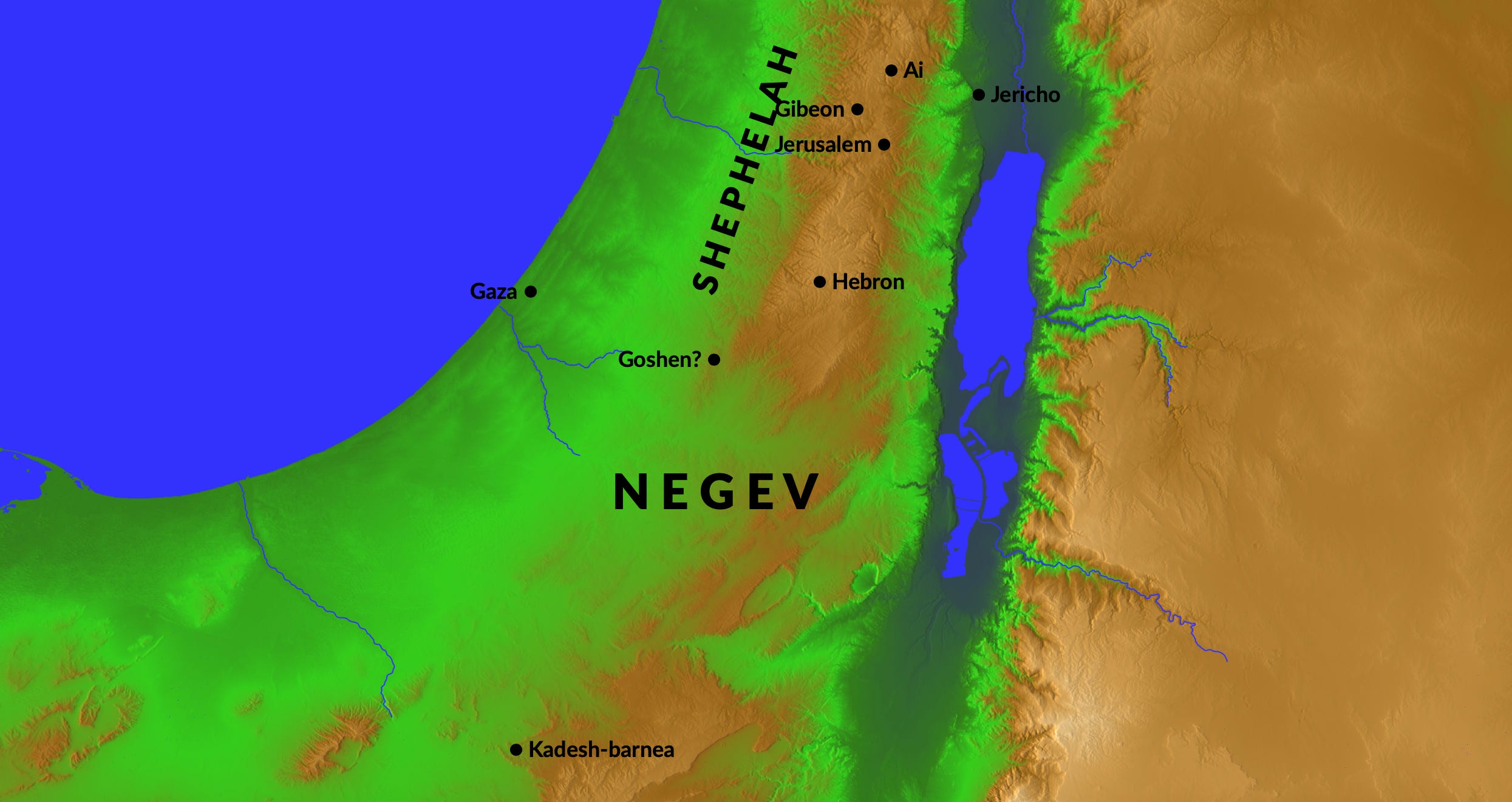
Joshua 10:41 And Joshua struck them from Kadesh-barnea even as far as Gaza, and all the country of Goshen even as far as Gibeon.
Joshua 10:42 And Joshua captured all these kings and their lands at one time because Yahweh, the God of Israel, fought for Israel.
Don’t miss the words “at one time”. Joshua and Israel captured many walled cities. It often took many years, if not decades, to conquer that many walled cities. Israel conquered all of them at one time because Yahweh was fighting for them.
Joshua 10:43 So Joshua and all Israel with him returned to the camp at Gilgal.
We saw in today’s passage that Israel achieved multiple victories against powerful, well-fortified cities. They did so in a very short time frame. They were able to do that because Yahweh fought for them.
Those of us who desire to see modern churches and society renounce their sins are often overwhelmed with a sense that revival in our culture is impossible. We don’t even know where to start. However, just as Yahweh did the impossible and gave Israel many improbable victories, so too Yahweh can work a miracle today. Nothing is impossible with God. Humans cannot revive our culture, but God can.
Thanks for visiting Bible Mountain. If you have already joined my email list, thank you, and please tell others about Bible Mountain. If you have not joined my email list yet, please do so now. In order to join, go to BibleMountain.com, click Subscribe, and that will take you to a page where you can sign up. Your email address will not be sold or given away. Once again, thanks for visiting Bible Mountain.
“Scripture quotations taken from the (LSB®) Legacy Standard Bible®, Copyright © 2021 by The Lockman Foundation. Used by permission. All rights reserved. Managed in partnership with Three Sixteen Publishing Inc. LSBible.org and 316publishing.com.”