
It is easy to find friends and be a friend when life is pleasant and prosperous. Unfortunately, human nature is such that friendship during times of trial does not come naturally. Job’s calamity illustrates that the true test of friendship occurs when life goes sour.
In the third section of Job, Eliphaz spoke and declared that trouble does not come from nothing. Therefore, Job was suffering because he had sinned; however, if Job would repent, then he would prosper. We know Eliphaz was wrong because the first two chapters of Job tell us Job had not sinned; rather, he was suffering because Satan was trying to prove a point to Yahweh.
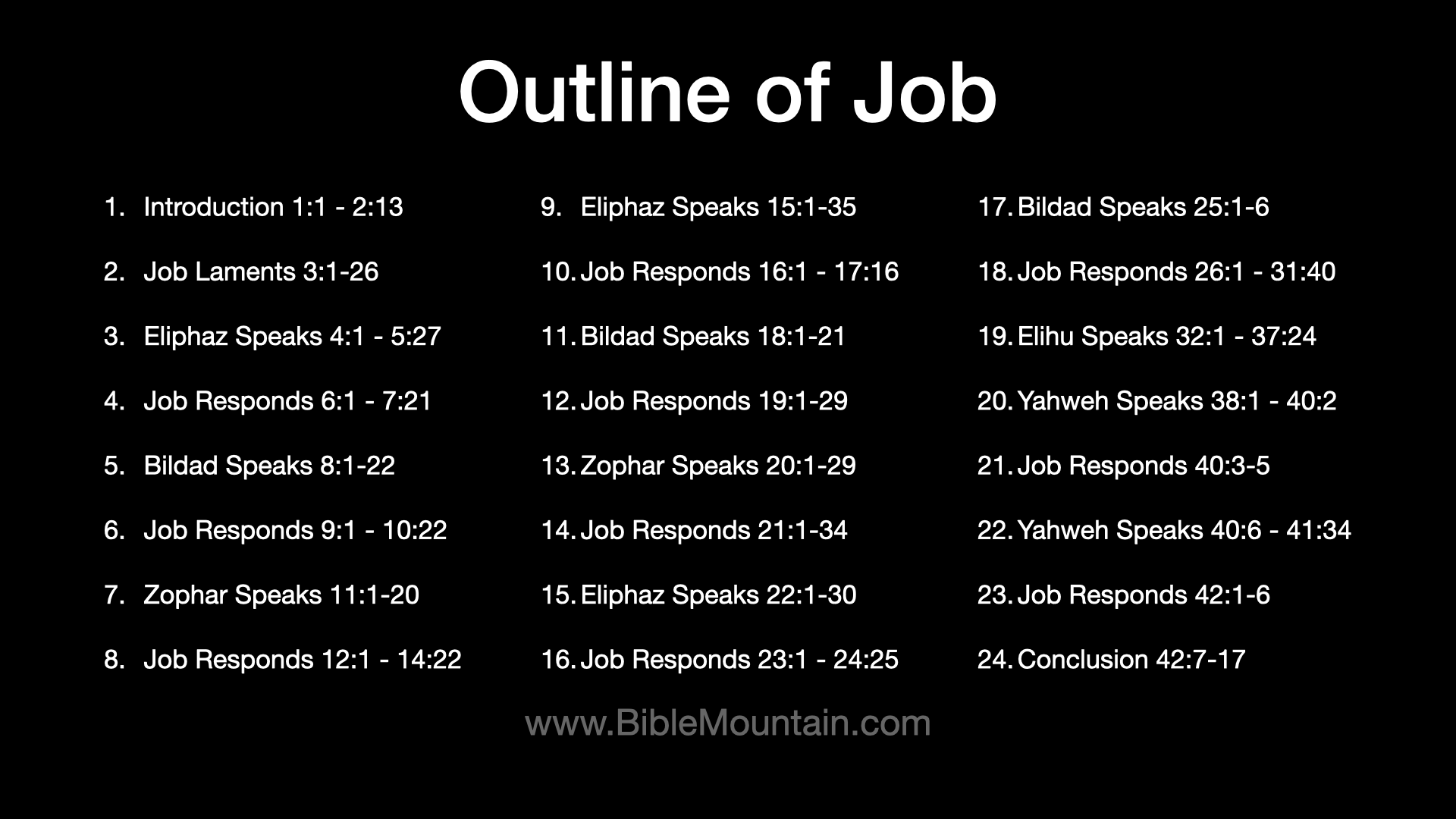
In the following verses, which is what I call the fourth section of Job, we will read Job’s response to Eliphaz.
Job 6:1 ¶ Then Job answered and said,
Job 6:2 “Oh that my vexation were actually weighed
And laid in the balances together with my destruction!
Job 6:3 For then it would be heavier than the sand of the seas;
Therefore my words have been rash.
Look at the word “rash”. Job admitted his words were rash, but he justified it on the basis of the vexation he was experiencing.
Job 6:4 For the arrows of the Almighty are within me,
Their poison my spirit drinks;
The horrors of God are arranged against me.
Notice Job’s belief that God was attacking him. Based on the first two chapters of Job, we know it was Satan that attacked Job, but Job did not know about the dialogue between Yahweh and Satan; therefore, Job did not really understand why he had suffered his calamity.
Job 6:5 Does the wild donkey bray over his grass,
Or does the ox low over his fodder?
Donkeys braw and oxen low when they are hungry, nervous, or distressed. The answer to Job’s question is no, they do not bray or low when they have food to eat. Job’s point was he was speaking rashly because he was being attacked, just as donkeys or oxen make noises when they are distressed.
Job 6:6 Can something tasteless be eaten without salt,
Or is there any taste in the slime of a yolk?
Job 6:7 My soul refuses to touch them;
They are like loathsome food to me.
Job 6:8 ¶ “Oh that my request might come to pass,
And that God would grant my hope!
Job 6:9 Would that God were willing to crush me,
That He would release His hand and cut me off!
This is a repeat of Job’s desire to cease to exist, a desire he had expressed before Eliphaz spoke (see Job 3).
Job 6:10 But it is still my comfort,
And I rejoice in unsparing pain,
That I have not at all hidden away the words of the Holy One.
Job still believed he had not sinned against God. He was correct in that he was not suffering due to sin.
Job 6:11 What is my strength, that I should wait?
And what is my end, that I should endure?
Look at the word “strength”. The Bible does not tell us how old Job was at this point in his life. However, chapter one tells us about Job’s children going to each other’s houses, indicating his children were adults, putting Job closer to old age than to youth. At that age, Job was losing physical strength and had no hope of ever gaining strength again. Therefore, Job concluded he was better off dying.
Look also at the word “end”. Since Job was at or approaching old age, and since he was penniless and covered with boils, it appeared he had no future prospects; therefore, he believed he was better of being killed.
This is an argument that is somewhat prevalent in the 21st century. When a person becomes elderly and cannot work or make a contribution to society, then people conclude they are worthless. That mentality leads to the killing of elderly people. Sometimes the killing is done proactively by either putting them to death or helping them commit suicide. It can also be done passively by refusing to give them medical care.
Proactively putting elderly people to death is wrong because Genesis 9:6 says “Whoever sheds man’s blood, By man his blood shall be shed.”
Job 6:12 Is my strength the strength of stones,
Or is my flesh bronze?
Job 6:13 Is it that there is no help within me,
And that the success of sound wisdom is driven from me?
Job asked if he was incapable of helping people or if his wisdom had been driven from him. The answer was no, Job still had wisdom, and even though he was penniless, he had something to offer if people were willing to listen to him.
Today, elderly people have a wealth of knowledge and experience which should be valued by younger generations.
Job 6:14 ¶ “For the despairing man lovingkindness should be from his friend;
But he forsakes the fear of the Almighty.
The pronoun “he” refers to Eliphaz. Job stated that as a despairing man, he should have received love from his friend Eliphaz; however, Eliphaz had forsaken the fear of the Almighty.
Job 6:15 My brothers have betrayed me like a wadi,
Like the torrents of wadis which pass away,
Job 6:16 Which grow dark because of ice
And upon which the snow hides itself.
A wadi is a river which dries up during the dry season. Just as relying on a wadi for your daily water will result in a lack of water at certain seasons, so too Job’s friends were not being friends when Job needed them the most.
It is easy to gain friends when you are healthy and wealthy. Finding and keeping friends when you are sick and poor is difficult. Likewise, it is easy to be a friend when your friend doesn’t need anything from you. It is hard to be a friend when your friend is sick and poor.
This reminds us that we should be willing to be a friend when our friend needs a friend, not just when they can do something for us in return. Jesus spoke about this in Luke 6:33 when He asked, “if you do good to those who do good to you, what credit is that to you?”
The following verses describe the futility of relying on wadis, which illustrates the uselessness of Job’s friends.
Job 6:17 When they become waterless, they are silent;
When it is hot, they vanish from their place.
Job 6:18 The paths of their course wind along;
They go up into a formless place and perish.
Job 6:19 The caravans of Tema looked;
The travelers of Sheba hoped for them.
Job 6:20 They were ashamed for they had trusted;
They came there and were humiliated.
Job 6:21 Indeed, you have now become such;
You see a terror and are afraid.
Job 6:22 Have I said, ‘Give me something,’
Or, ‘Offer a bribe for me from your wealth,’
Job 6:23 Or, ‘Give me escape from the hand of the adversary,’
Or, ‘Redeem me from the hand of the ruthless men’?
The answer to these questions was no.
Job 6:24 ¶ “Instruct me, and I will be silent;
And cause me to understand how I have erred.
Job challenged Eliphaz to give an example of Job’s sin. That was a wise challenge.
That is a good reminder to us that if we are going to confront someone for doing something wrong, we should be ready to prove our contention, not just throw out an accusation. Likewise, if you hear an accusation against someone, be dubious if there is no proof.
Job 6:25 How painful are upright words!
But what does your reproof prove?
Job 6:26 Do you think to reprove my words,
Or think of the words of one in despair as wind?
Job 6:27 You would even cast lots for the orphans
And bargain over your friend.
Job 6:28 So now be willing to face me,
And see if I lie to your face.
Job 6:29 Now turn from this, let there be no unrighteousness;
Even turn from this, my righteousness is yet in it.
Job 6:30 Is there unrighteousness on my tongue?
Cannot my palate discern destruction?
Job 7:1 ¶ “Is not man conscripted to labor on earth,
And are not his days like the days of a hired man?
Job 7:2 As a slave who pants for the shade,
And as a hired man who eagerly hopes for his wages,
Job 7:3 So am I apportioned months of worthlessness,
And nights of trouble are appointed me.
Job 7:4 If I lie down I say,
‘When shall I arise?’
But the twilight continues,
And I am saturated with tossing until dawn.
It is easy to find friends and be a friend when life is pleasant and prosperous. Unfortunately, human nature is such that friendship during times of trial does not come naturally. This reminds us that we should be willing to be a friend when our friend needs a friend, not just when they can do something for us in return. Jesus spoke about this in Luke 6:33 when He asked, “if you do good to those who do good to you, what credit is that to you?”
Do you have true friends who will stick by you and help you even if the worst thing imaginable happens to you?
Are you willing to be a friend when your friend truly needs a friend, not just when they can do something for you?
Thanks for visiting Bible Mountain. If you have already joined my email list, thank you and please tell others about Bible Mountain. If you have not joined my email list yet, please do so now. In order to join, go to Bible Mountain dotcom, click on subscribe, and that will take you to a page where you can sign up. Your email address will not be sold nor given away. Once again, thanks for visiting Bible Mountain.
“Scripture quotations taken from the (LSB®) Legacy Standard Bible®, Copyright © 2021 by The Lockman Foundation. Used by permission. All rights reserved. Managed in partnership with Three Sixteen Publishing Inc. LSBible.org and 316publishing.com.”