
Most people encounter obstacles and setbacks in life. Some people have mild setbacks like a curable illness or temporary financial problem. Other people spend their whole life fighting disease or poverty.
After Satan took away Job’s health, wealth, and prosperity, Job initially had a great attitude about it and demonstrated how we should respond to calamity, whether it is temporary or permanent. Later, which we will read about in today’s passage, Job developed a sour attitude, which illustrates the natural, but wrong, response to trials and tragedy.Yesterday, we began reading the second section of Job.
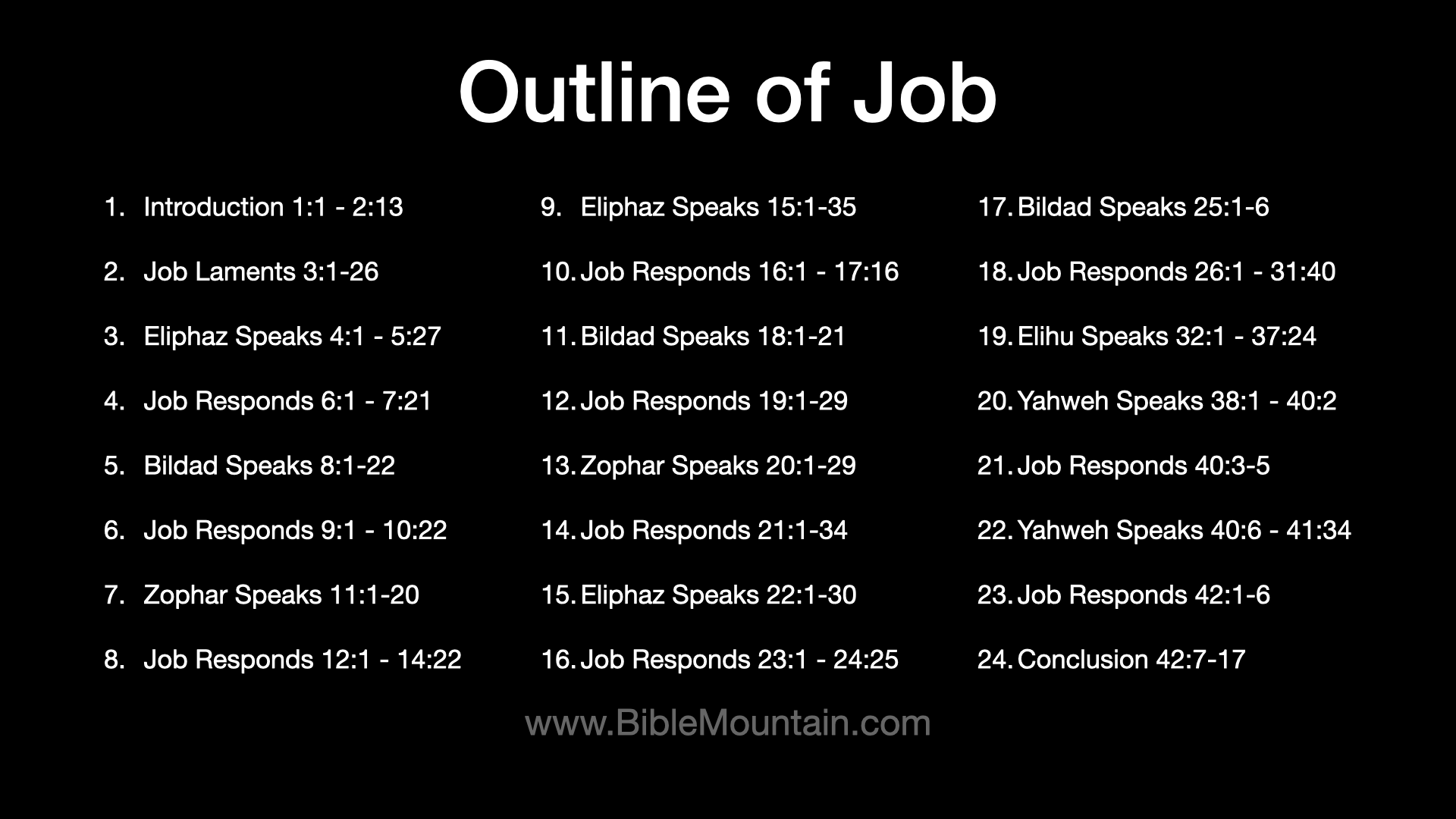
Section 2 consists of Job lamenting all the calamity that had befallen him: the loss of his wealth and children, and then being afflicted with boils from head to toe. Job started by expressing his desire that the day of his birth had never existed. Then he continued with the following:
Job 3:11 ¶ “Why did I not die from the womb,
Come forth from the womb and breathe my last?
Ponder the extent to which Job was despondent about life. He wished he had never been born. Remember, Job had lived years as a very wealthy man with a cushy life, but he did not merely wish that he had died instead of losing everything, he wished he had never existed at all.
This is quite a contrast to Job’s initial reaction to his calamity. After he lost his possessions and children he said, “Yahweh gave, and Yahweh has taken away. Blessed be the name of Yahweh” (see Job 1:21). After he was afflicted with boils and his wife encouraged him to curse God and die, he asked, “Shall we indeed accept good from God and not accept calamity?” (see Job 2:10). After both of those statements, the text says Job did not sin, nor give offense to God.
When life is hard, humans naturally wish we did not exist. That is the opposite of how we should react. The proper attitude about pain and suffering is the attitude Job initially expressed when he accepted that Yahweh gives and Yahweh takes away.
Hebrew poetry is about repetition. Notice in the following verses the various ways Job expressed his desire to have been stillborn, as well as the benefits of stillbirth.
Job 3:12 Why did the knees receive me,
And why the breasts, that I should suck?
Job 3:13 For now I would have lain down and been quiet;
I would have slept then; it would have been rest to me,
Job 3:14 With kings and with counselors of the earth,
Who rebuilt waste places for themselves,
Job 3:15 Or with princes who had gold,
Who were filling their houses with silver.
If Job had been stillborn, then, instead of suffering, he would have been with deceased kings and princes.
Job 3:16 Or why was I not like a miscarriage hidden away,
As infants that never saw light?
Job 3:17 There the wicked cease from raging,
And there the weary of strength are at rest.
Job 3:18 The prisoners are at ease together;
They do not hear the voice of the taskmaster.
Job extolled the benefits of death. When laborers and prisoners die, they no longer suffer. Likewise, Job wished he was dead so that he was not suffering.
Job 3:19 The small and the great are there,
And the slave is free from his master.
Look at the line, “The small and the great are there.” No matter our lot in life, everyone will die.
Job 3:20 ¶ “Why is light given to him who is troubled,
And life to the bitter of soul,
Take note of Job’s question because this is a central theme of the book of Job. Job essentially asked why God gives life to those who are going to spend their life in pain and suffering.
Job may not have been thinking just about himself when he asked this question. Job surely knew that his life had not been as bad as some people’s lives. Job spent years enjoying a good life. Some people suffer both poverty and illness from the time they are born up until the day they die. Job’s question is more pertinent to their lives. Why does God give life to people who will suffer from birth to death?
Job 3:21 Who long for death, but there is none,
And dig for it more than for hidden treasures,
Job 3:22 Who are glad with joy,
And rejoice when they find the grave?
Job 3:23 Why is light given to a man whose way is hidden,
And whom God has hedged in?
Job 3:24 For my groaning comes at the sight of my food,
And my roaring pours out like water.
Job 3:25 For the dread that I dread comes upon me,
And what I am afraid of befalls me.
Job 3:26 I am not complacent, nor am I quiet,
And I am not at rest, and raging comes.”
Job 4:1 ¶ Then Eliphaz the Temanite answered and said,
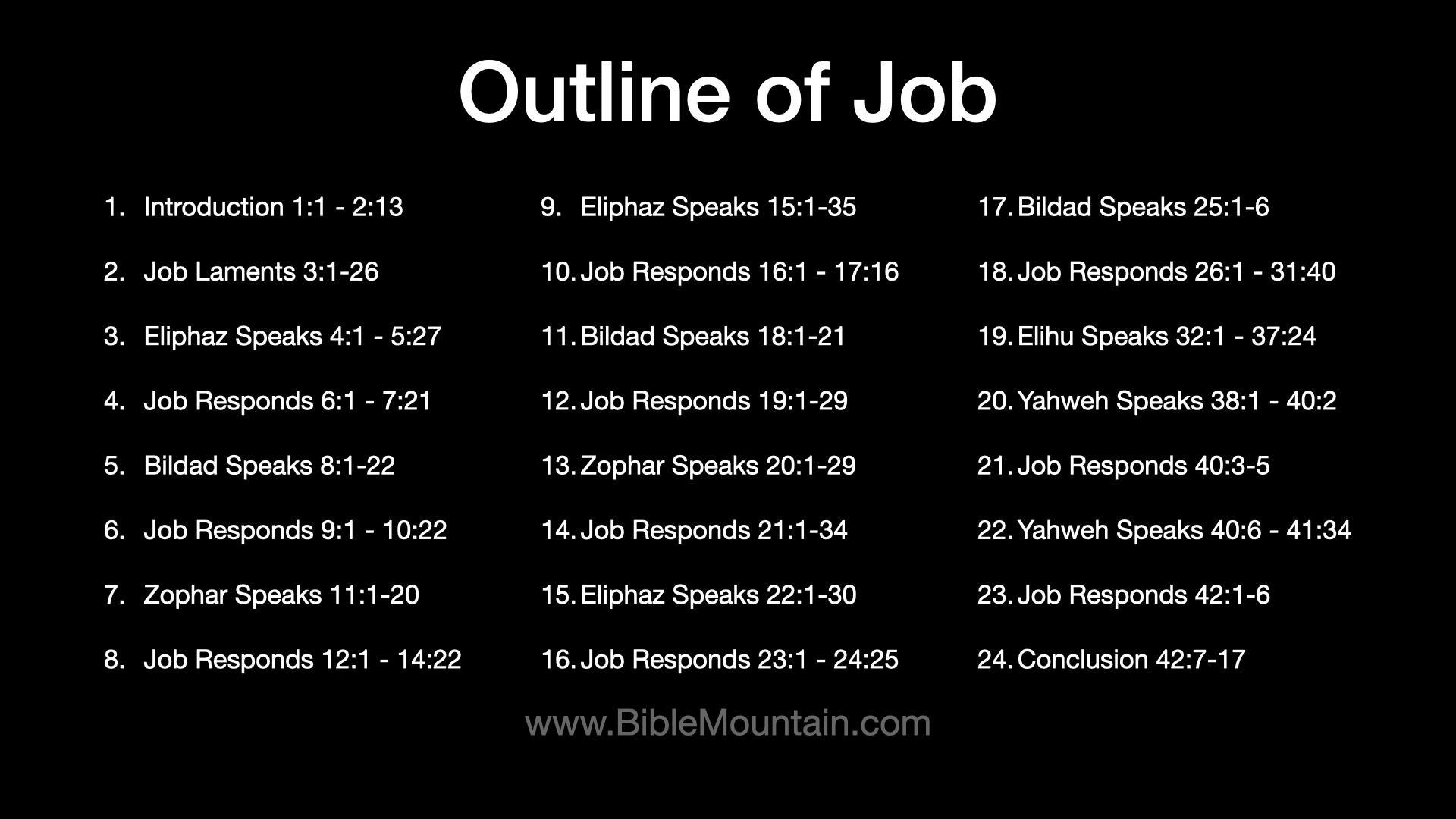
Chapter four begins the third section of Job in which Eliphaz speaks.
Job 4:2 “If one tries a word with you, will you become weary?
But who can hold back from speaking?
Eliphaz was clearly exasperated with Job.
Job 4:3 Behold, you have disciplined many,
And you have strengthened limp hands.
Notice the word “disciplined”. Eliphaz claimed that when Job was living the good life, he often disciplined others.
Notice also the word “limp”.
Job 4:4 Your words have helped the stumbling to stand,
And you have encouraged feeble knees.
Notice the words “stumbling” and “feeble”.
Job 4:5 But now it has come to you, and you are impatient;
It touches you, and you are dismayed.
The pronoun “it” refers to discipline, limpness, stumbling, and feebleness. Eliphaz stated that while Job had disciplined others and helped others in their weakness, now that he was being disciplined and helped in his weakness, he was impatient and dismayed. Eliphaz assumed that part of the reason Job was suffering was because he was being disciplined for something he did wrong.
Job 4:6 Is not your fear of God your confidence,
And the integrity of your ways your hope?
Job 4:7 ¶ “Remember now, who ever perished being innocent?
Or where were the upright wiped out?
Job 4:8 According to what I have seen, those who plow wickedness
And those who sow trouble harvest it.
In verses 7-8 Eliphaz expressed his belief that the reason people suffer is because they did something wrong. That is not why Job was suffering. The first verse of the book of Job says Job was blameless and upright. Job 1:22 and Job 2:10 confirm that Job was not suffering because he had sinned.
Job 4:9 By the breath of God they perish,
And by the wind of His anger they come to an end.
Job 4:10 The roaring of the lion and the voice of the fierce lion,
And the teeth of the young lions are broken.
Job 4:11 The lion perishes for lack of prey,
And the whelps of the lioness are scattered.
Job 4:12 ¶ “Now a word was brought to me stealthily,
And my ear received a whisper of it.
Job 4:13 Amid disquieting thoughts from the visions of the night,
When deep sleep falls on men,
Job 4:14 Dread came upon me, and trembling,
And made the multitude of my bones shake in dread.
Job 4:15 Then a spirit swept by my face;
The hair of my flesh bristled up.
Job 4:16 It stood still, but I could not recognize its appearance;
A form was before my eyes;
There was silence, then I heard a voice:
Eliphaz claimed he received a word from a spirit. By invoking the supposed spiritual source of the message, he was trying to give credibility to what he was about to say. Tomorrow, we will read the message he supposedly received.
When life is hard, humans naturally wish we did not exist. That is the opposite of how we should react. The proper attitude about pain and suffering is the attitude Job initially expressed when he accepted that Yahweh gives and Yahweh takes away.
Have there been times in your life that you wished you would die or had never existed?
How did you rise out of that despair?
What can you do now or in the future to avoid having that attitude?
Thanks for visiting Bible Mountain. If you have already joined my email list, thank you and please tell others about Bible Mountain. If you have not joined my email list yet, please do so now. In order to join, go to Bible Mountain dotcom, click on subscribe, and that will take you to a page where you can sign up. Your email address will not be sold nor given away. Once again, thanks for visiting Bible Mountain.
“Scripture quotations taken from the (LSB®) Legacy Standard Bible®, Copyright © 2021 by The Lockman Foundation. Used by permission. All rights reserved. Managed in partnership with Three Sixteen Publishing Inc. LSBible.org and 316publishing.com.”