
Modern Christianity has an unbiblical concept of worship. Many Christians think they are worshipping when they are enjoying the beauty of nature. Others think they are worshipping when they are enjoying Contemporary Christian Music. In other words, we think worship is enjoyable and something humans want to do.
However, the story of Job illustrates that true biblical worship is the opposite. The biblical concept of worship is humility and subservience, both of which are things humans do not want to do.
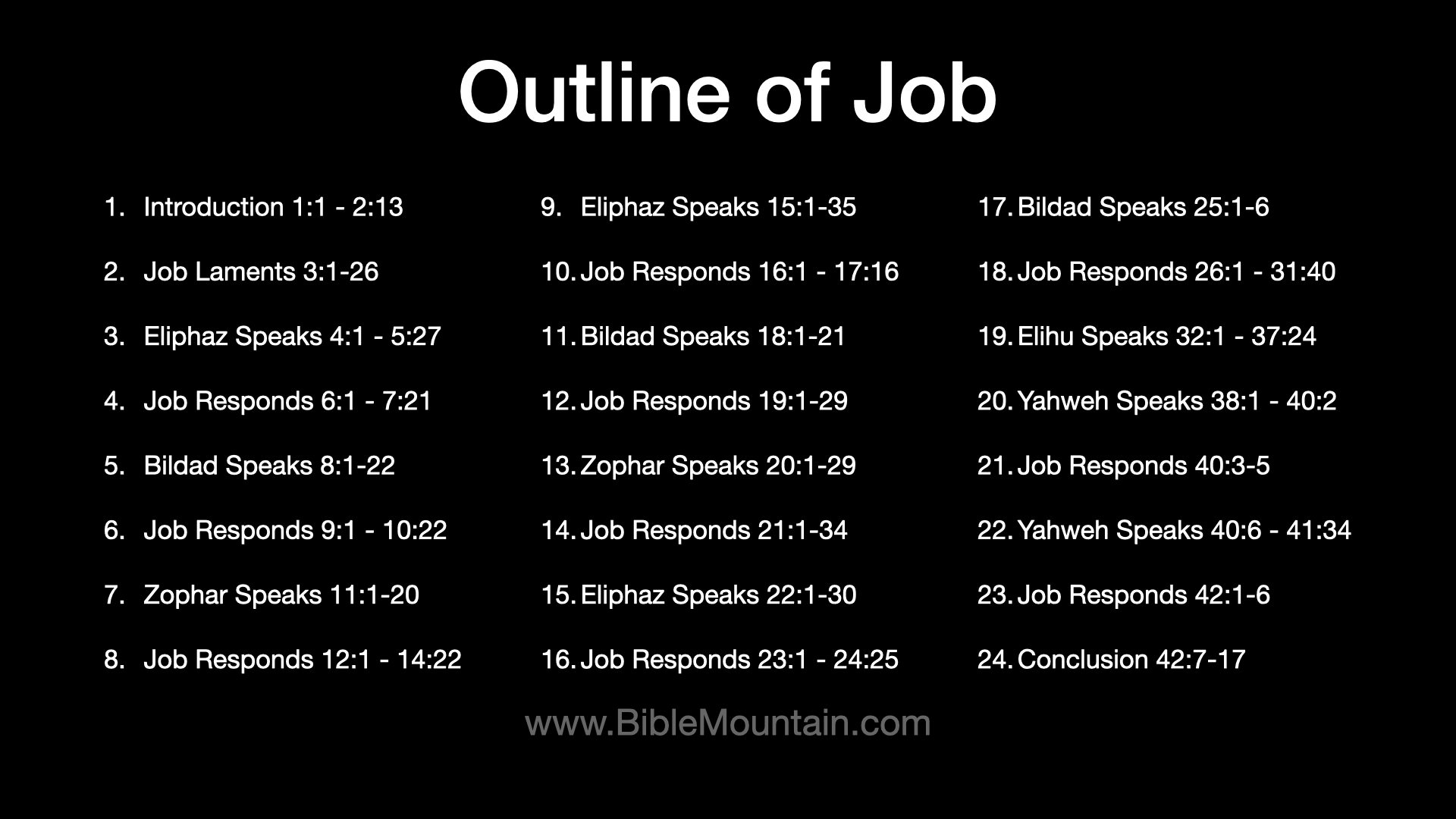
The book of Job consists of a series of speeches by Job, four other men, and Yahweh. The first two chapters, which I call section 1, introduce us to Job and describe a series of calamities which befell Job and led to the dialogue recorded in the rest of the book.
Yesterday, we started reading chapter one, the first section, and learned that Job was blameless and upright, had 10 children, and was very wealthy. When Yahweh praised Job to Satan, Satan accused Job of being fake, so Yahweh gave Satan permission to take Job’s wealth away from him. Verses 13-19 of chapter one tell us that in one day, marauders and fire from heaven took all of Job’s wealth, and a storm killed all ten of Job’s children.
Job 1:20 ¶ Then Job arose and tore his robe and shaved his head, and he fell to the ground and worshiped.
Look at the word “worship”. When Job lost everything, he worshipped.
The word “worship” is a translation of the Hebrew word “chawah”. That word is often translated “bow down”. What does a person communicate when they bow down before another person? They communicate humility and subservience.
Modern Christianity has an unbiblical concept of worship. Many Christians think they are worshipping when they are enjoying the beauty of nature. Others think they are worshipping when they are enjoying Contemporary Christian Music. However, when Job worshipped, he was not enjoying the occasion.
The word “chawah” was also used in Genesis 22:5. That is the passage where Yahweh told Abraham to offer his son Isaac as a sacrifice. When Abraham was approaching the place of sacrifice, he told his men that he was going to go chawah. Did Abraham want to do what he was about to do? Did Abraham enjoy his act of worship? No, but he worshipped anyway because worship is obedience.
Worship is not an emotional high. True biblical worship is not something humans want to do. True worship is something we do because it is the right thing to do.
Job 1:21 And he said,
“Naked I came from my mother’s womb,
And naked I shall return there.
Yahweh gave, and Yahweh has taken away.
Blessed be the name of Yahweh.”
Look at the line “Yahweh gave, and Yahweh has taken away.” Job did not have a sense of entitlement. Job understood that he was a servant of Yahweh, and he was willing to accept whatever lot in life Yahweh gave him.
Job 1:22 ¶ Through all this Job did not sin, nor did he give offense to God.
Yahweh allowed Satan to attack Job because Satan insisted Job would curse God if Job lost his wealth (see Job 1:11). Job proved Satan was wrong.
Job 2:1 ¶ Again it was the day that the sons of God came to stand before Yahweh, and Satan also came among them to stand himself before Yahweh.
Job 2:2 And Yahweh said to Satan, “Where do you come from?” Then Satan answered Yahweh and said, “From roaming about on the earth and walking around on it.”
Job 2:3 And Yahweh said to Satan, “Have you set your heart upon My servant Job? For there is no one like him on the earth, a blameless and upright man, fearing God and turning away from evil. And he still holds fast his integrity. So you incited Me against him to swallow him up in vain.”
Job 2:4 Satan answered Yahweh and said, “Skin for skin! Yes, all that a man has he will give for his life.
Job 2:5 However, send forth Your hand now, and touch his bone and his flesh; he will curse You in Your face.”
Even though Satan’s first accusation against Job was wrong, Satan did not admit he was wrong. Instead, he doubled down and insisted Job would curse God if Job lost his health.
Job 2:6 So Yahweh said to Satan, “Behold, he is in your hand, only spare his life.”
Job 2:7 ¶ Then Satan went out from the presence of Yahweh and struck Job with terrible boils from the sole of his foot to the top of his head.
Job 2:8 And he took a potsherd to scrape himself while he was sitting among the ashes.
Job 2:9 ¶ Then his wife said to him, “Do you still hold fast your integrity? Curse God and die!”
There are many times the Bible praises wise women. There are also times the Bible warns us against foolish women. This is an example of a woman reacting foolishly.
Job 2:10 But he said to her, “You speak as one of the wickedly foolish women speaks. Shall we indeed accept good from God and not accept calamity?” In all this Job did not sin with his lips.
Notice Job’s question: “Shall we indeed accept good from God and not accept calamity?” This is a good mindset to have. Job had that mindset because he did not have a sense of entitlement. He understood he was a servant of Yahweh. Job’s acceptance of his fate was an act of worship.
Job 2:11 ¶ Then Job’s three friends heard of all this calamity that had come upon him. So they came each one from his own place, Eliphaz the Temanite, Bildad the Shuhite, and Zophar the Naamathite; and they made an appointment together to come to console him and comfort him.
Job 2:12 Then they lifted up their eyes at a distance and did not recognize him, and they lifted up their voices and wept. And each of them tore his robe, and they threw dust over their heads toward the sky.
Job 2:13 Then they sat down on the ground with him for seven days and seven nights with no one speaking a word to him, for they saw that his pain was very great.
Note the words “seven days and seven nights with no one speaking”. In the 21st century, people can’t stand to have 5 minutes of silence. This illustrates how impatient we are today compared to people who lived 4,000 years ago.
Job 3:1 ¶ Afterward Job opened his mouth and cursed the day of his birth.
Chapter 3 begins section 2. Section 2 is a lament by Job, where he laments his downfall in life.
Most of the book of Job is Hebrew poetry. Unlike English poetry which is based on rhyme, Hebrew poetry does not rhyme. Instead, the idea of Hebrew poetry is repetition and contrast. The are of Hebrew poetry is to make a statement and then repeat the same idea in different words, or make a statement and then contrast that statement.
In the following verses, what is the main idea that Job expressed in multiple ways?
Job 3:2 And Job answered and said,
Job 3:3 “Let the day perish on which I was to be born,
And the night which said, ‘A man is conceived.’
The main idea Job expressed was that he wanted his date of birth to cease to exist. In the following verses, he repeats that idea in different ways.
Job 3:4 May that day be darkness;
Let not God seek it from above,
Nor light shine on it.
Job 3:5 Let darkness and shadow of death redeem it;
Let a cloud dwell upon it;
Let the blackness of the day terrify it.
Job 3:6 As for that night, let thick darkness take it;
Let it not rejoice among the days of the year;
Let it not come into the number of the months.
Job 3:7 Behold, let that night be barren;
Let no joyful shout enter it.
Job 3:8 Let those curse it who curse the day,
Who are ready to rouse Leviathan.
Job 3:9 Let the stars of its twilight be darkened;
Let it hope for light but have none,
And let it not see the breaking dawn,
Job 3:10 Because it did not shut the opening of my mother’s body,
Or hide trouble from my eyes.
The opening verses of Job tell us Job was blameless and upright. When Job lost everything, his initial response was to worship, and accept God’s right to take everything away. However, after a period of time, he began to feel sorry for himself. He began to wish he had never been born.
Modern Christianity has an unbiblical concept of worship. Many Christians think they are worshipping when they are enjoying the beauty of nature. Others think they are worshipping when they are enjoying Contemporary Christian Music. However, today’s passage tells us Job worshipped.
When Job worshipped, he was not enjoying the occasion. It was not something that came naturally. Job’s worship came after he lost all his possessions and all his children, and his act of worship was to say “Yahweh gave, and Yahweh has taken away.”
What are other examples of a false concept of worship found in modern Christianity?
What is a time you demonstrated true worship as illustrated by Job, a time when you submitted to God’s will for your life, even though you did not like it or enjoy it?
Thanks for visiting Bible Mountain. If you have already joined my email list, thank you and please tell others about Bible Mountain. If you have not joined my email list yet, please do so now. In order to join, go to Bible Mountain dotcom, click on subscribe, and that will take you to a page where you can sign up. Your email address will not be sold nor given away. Once again, thanks for visiting Bible Mountain.
“Scripture quotations taken from the (LSB®) Legacy Standard Bible®, Copyright © 2021 by The Lockman Foundation. Used by permission. All rights reserved. Managed in partnership with Three Sixteen Publishing Inc. LSBible.org and 316publishing.com.”