
There is a sizable percentage of the population who believes getting drunk is funny. They laugh at the hilarious things they or others have done while under the influence of alcohol. It is true that people do goofy things after drinking too much, but today’s passage illustrates the negative side of drunkenness. Bad things often happen when people drink too much wine or alcohol, meaning it is not really something we should laugh about.
After the flood, God promised to never flood the earth again. He gave the rainbow as a sign of His covenant with all living flesh. Then Noah and his sons began the task of repopulating the earth.
Gen. 9:20 ¶ Then Noah began to be a man of the land and planted a vineyard.
Gen. 9:21 And he drank of the wine and became drunk and uncovered himself inside his tent.
Notice the word “drunk”. Something bad happens in this passage, and it started because Noah got drunk. That is a warning to us that bad things happen when people get drunk; therefore, it is a bad idea to get drunk.
Gen. 9:22 Then Ham, the father of Canaan, saw the nakedness of his father and told his two brothers outside.
The text clearly states that it was Ham who saw the nakedness, and it was Ham who told his brothers.
Gen. 9:23 But Shem and Japheth took the garment and laid it upon both their shoulders and walked backward and covered the nakedness of their father; and their faces were turned backward, so that they did not see their father’s nakedness.
Gen. 9:24 Then Noah awoke from his wine, and he knew what his youngest son had done to him.
The implication is Shem and Japheth did the right thing, while the youngest son did the wrong thing. Notice, the text does not say Noah knew what Ham had done, it says Noah knew what his youngest son had done.
Since verse 22 tells us Ham saw the nakedness and told his brothers, we typically assume that Ham was the youngest son. However, there are at least 5 verses in Genesis that list the sons of Noah, and they are always listed in the same order: Shem, Ham, and Japheth. The order implies Ham was the second son, not the youngest son.
The Hebrew word that is translated “son” can also be translated “descendant”. In other words, the youngest son could have been a grandson or a great-grandson.
Gen. 9:25 So he said,
“Cursed be Canaan;
A servant of servants
He shall be to his brothers.”
In response to what happened, Noah cursed Canaan. We don’t know what, if anything, Canaan did.
It is possible Canaan didn’t do anything and Noah was punishing a grandson for the sin of his son. We find that concept revolting in the 21st century, but that practice has been common throughout world history.
There are two verses in the Bible which list the sons of Ham. Ham had four sons, and Canaan is listed last, implying Canaan was the youngest. It is possible Canaan was the youngest grandson, meaning the term “youngest son” used in verse 24 may refer to Canaan as Noah’s youngest grandson. If that is the case, then maybe Canaan did something to deserve being cursed. Ultimately, we have some questions about this that we cannot answer.
Gen. 9:26 And he said,
“Blessed be Yahweh,
The God of Shem;
And let Canaan be his servant.
Gen. 9:27 May God enlarge Japheth,
And let him dwell in the tents of Shem;
And let Canaan be his servant.”
The sons of Noah are always listed in the following order: Shem, Ham, and Japheth. This implies Shem was the oldest while Japheth was the youngest. Noah asked God to enlarge Japheth, perhaps his youngest son, and enable him to live in the tents of Shem, perhaps his oldest son.
Gen. 9:28 ¶ And Noah lived 350 years after the flood.
Gen. 9:29 So all the days of Noah were 950 years, and he died.
Gen. 10:1 ¶ Now these are the generations of Shem, Ham, and Japheth, the sons of Noah; and sons were born to them after the flood.
Gen. 10:2 ¶ The sons of Japheth were Gomer and Magog and Madai and Javan and Tubal and Meshech and Tiras.
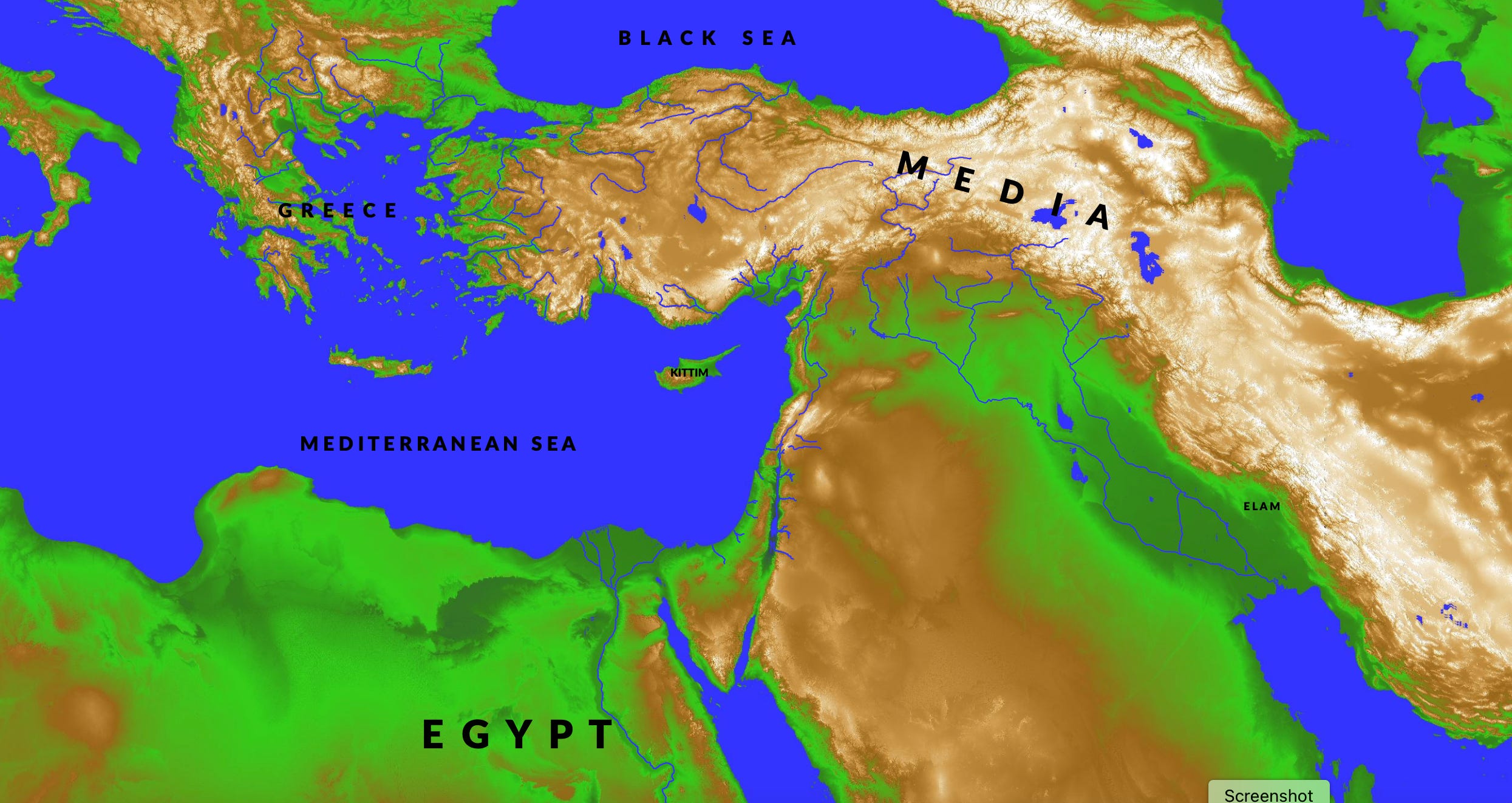
The Hebrew word “Madai” is the word for Media, or the Medes. The Medes settled near the Black and Caspian Seas.
The Hebrew word “Javan” is the word for Greece.
Gen. 10:3 The sons of Gomer were Ashkenaz and Riphath and Togarmah.
The term “Ashkenaz” is associated with Europe.
Gen. 10:4 The sons of Javan were Elishah and Tarshish, Kittim and Dodanim.
Tarshish was a city along the Mediterranean Sea. Kittim is the Hebrew word for Cyprus, an island in the Mediterranean Sea.
Gen. 10:5 From these the coastlands of the nations were separated into their lands, every one according to his tongue, according to their families, into their nations.
Notice the word “coastlands”. The descendants of Japheth settled around the Black Sea, Caspian Sea, and the north side of the Mediterranean Sea. In other words, the descendants of Japheth became the Europeans.
Gen. 10:6 ¶ The sons of Ham were Cush and Mizraim and Put and Canaan.
Cush was a country in Africa. Mizraim, is the Hebrew term for Egypt, also a country in Africa. The Canaanites settled along the southeastern corner of the Mediterranean Sea, at the point where Africa joins the Europe/Asia land mass.
In other words, the descendants of Ham became the Africans.
Gen. 10:7 The sons of Cush were Seba and Havilah and Sabtah and Raamah and Sabteca; and the sons of Raamah were Sheba and Dedan.
Gen. 10:8 Now Cush was the father of Nimrod; he began to be a mighty one on the earth.
Gen. 10:9 He was a mighty hunter before Yahweh; therefore it is said, “Like Nimrod a mighty hunter before Yahweh.”
Gen. 10:10 The beginning of his kingdom was Babel and Erech and Accad and Calneh, in the land of Shinar.
Babel and Shinar were in the Mesopotamian Valley, an area that joined Europe, Asia, and Africa.
Gen. 10:11 From that land he went out to Assyria and built Nineveh and Rehoboth-Ir and Calah,
Assyria and Ninevah were also in the Mesopotamian Valley.
Gen. 10:12 and Resen between Nineveh and Calah; that is the great city.
Gen. 10:13 Mizraim was the father of Ludim and Anamim and Lehabim and Naphtuhim
Gen. 10:14 and Pathrusim and Casluhim (from whom came the Philistines) and Caphtorim.
Gen. 10:15 ¶ Canaan was the father of Sidon, his firstborn, and Heth
Gen. 10:16 and the Jebusite and the Amorite and the Girgashite
Gen. 10:17 and the Hivite and the Arkite and the Sinite
Gen. 10:18 and the Arvadite and the Zemarite and the Hamathite; and afterward the families of the Canaanite were scattered.
Gen. 10:19 The border of the Canaanite extended from Sidon as you go toward Gerar, as far as Gaza; as you go toward Sodom and Gomorrah and Admah and Zeboiim, as far as Lasha.
Gen. 10:20 These are the sons of Ham, according to their families, according to their tongues, by their lands, by their nations.
Gen. 10:21 ¶ Also to Shem, the father of all the children of Eber, and the older brother of Japheth, children were born.
This verse tells us Shem was the older brother of Japheth.
Gen. 10:22 The sons of Shem were Elam and Asshur and Arpachshad and Lud and Aram.
Elam and Asshur were on the east side of the Mesopotamian Valley. In other words, the descendants of Shem became the Asians.
Gen. 10:23 The sons of Aram were Uz and Hul and Gether and Mash.
Gen. 10:24 Arpachshad was the father of Shelah; and Shelah was the father of Eber.
There is a sizable percentage of the population who believes getting drunk is funny. They laugh at the hilarious things they or others have done while under the influence of alcohol. It is true that people do goofy things after drinking too much, but today’s passage illustrates the negative side of drunkenness.
Noah got drunk, and something happened between him, Ham, and Canaan, which resulted in Canaan being cursed. Noah’s act of drunkenness had negative ramifications which lasted centuries. Bad things often happen when people drink too much wine or alcohol, meaning it is not really something we should laugh about.
What are some negative repercussions of drunkenness that you have observed?
To what extent is it wise to avoid alcohol all together in order to avoid the risk of becoming addicted or drunk?
Thanks for visiting Bible Mountain. If you have already joined my email list, thank you and please tell others about Bible Mountain. If you have not joined my email list yet, please do so now. In order to join, go to Bible Mountain dotcom, click on subscribe, and that will take you to a page where you can sign up. Your email address will not be sold nor given away. Once again, thanks for visiting Bible Mountain.
“Scripture quotations taken from the (LSB®) Legacy Standard Bible®, Copyright © 2021 by The Lockman Foundation. Used by permission. All rights reserved. Managed in partnership with Three Sixteen Publishing Inc. LSBible.org and 316publishing.com.”