
When we experience trials, our natural reaction is to resent the suffering and seek revenge against anyone who harms us. However, the story of Joseph, the end of which we will read today, teaches us a better way to look upon our pain and suffering.
After predicting the future of his sons, Jacob instructed his sons to bury him in Canaan, in the family burial plot. Then he breathed his last and died. After a period of mourning, Joseph received permission from Pharaoh to go to Canaan and fulfill his father’s request.
Gen. 50:7 ¶ So Joseph went up to bury his father, and with him went up all the servants of Pharaoh, the elders of his household, and all the elders of the land of Egypt,
Notice the phrases “all the servants of Pharaoh” and “all the elders of the land of Egypt”. It was not just Joseph and his family which went to Canaan to bury Jacob. The upper echelon of Egypt also went to bury Jacob.
We know from Genesis 47:9 that Jacob was 130 years old when he moved to Egypt. He went to Egypt in the second year of the famine (see Genesis 45:11). According to Genesis 47:28, Jacob lived in Egypt 17 years and died at the age of 147. This means Jacob died 12 years after the famine ended.
Gen. 50:8 and all the household of Joseph and his brothers and his father’s household; they left only their little ones and their flocks and their herds in the land of Goshen.
Gen. 50:9 There also went up with him both chariots and horsemen; and it was a very immense camp.
Gen. 50:10 And they came to the threshing floor of Atad, which is beyond the Jordan, and they lamented there with a very great and immense lamentation; and he observed seven days of mourning for his father.
Look at the phrase “which is beyond the Jordan”.
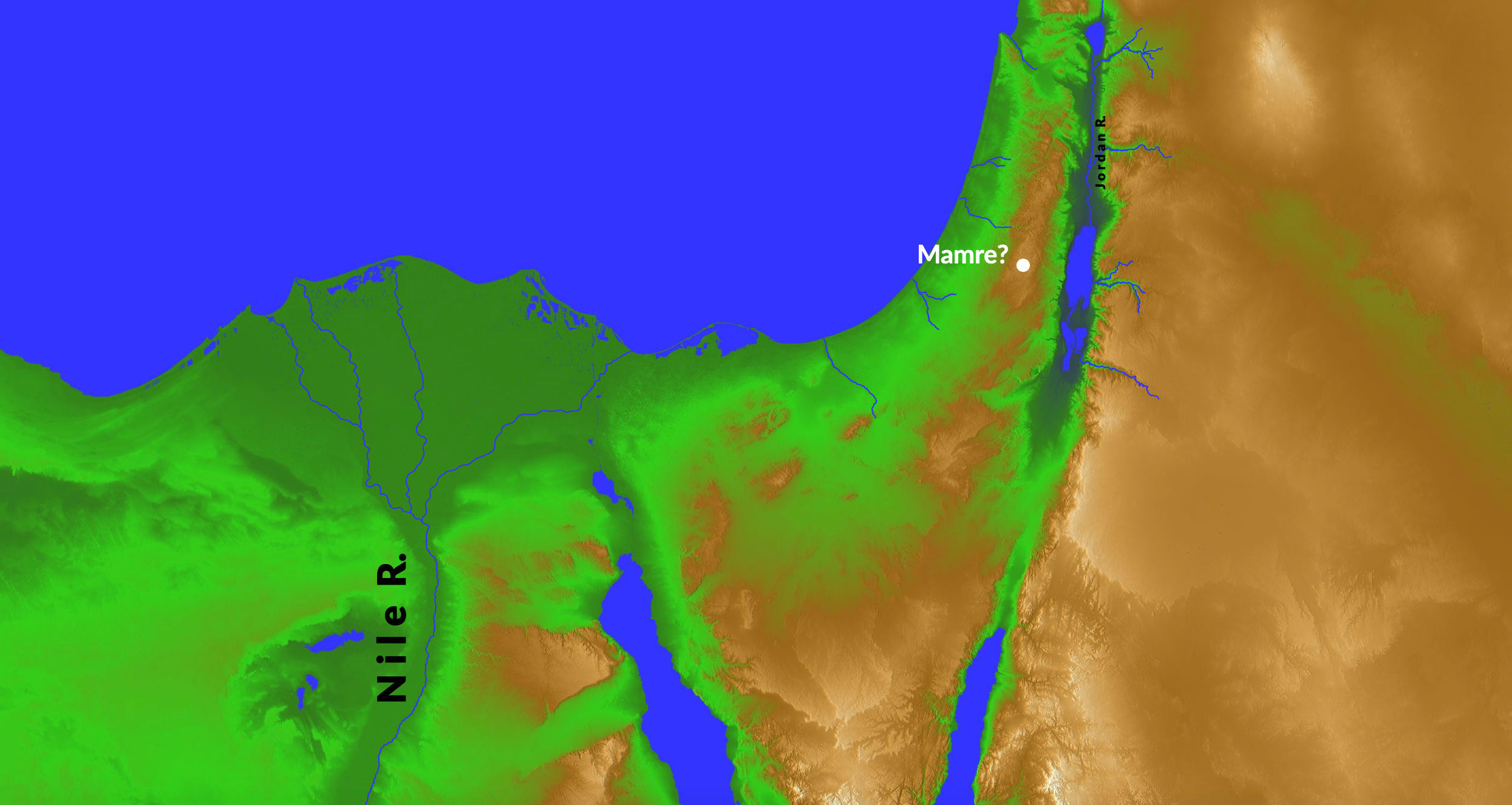
In the Bible, the phrase “beyond the Jordan” refers to the east side of the Jordan River, which is the right side of this map. Jacob had made Joseph swear to bury him in Mamre. Mamre is west of the Jordan River. Joseph and the Egyptians came from Egypt, which is west of Mamre. When they traveled to bury Jacob, they went past Mamre to the east side of the Jordan River valley to observe seven days of mourning.
Gen. 50:11 Now the inhabitants of the land, the Canaanites, saw the mourning at the threshing floor of Atad, and they said, “This is an immense mourning for the Egyptians.” Therefore it was named Abel-mizraim, which is beyond the Jordan.
The Hebrew word “abel” means mourn. “Mizraim” is the Hebrew name for Egypt. Atad was named “Mourning of Egypt”.
Gen. 50:12 ¶ Thus his sons did for him as he had commanded them.
Gen. 50:13 Indeed, his sons carried him to the land of Canaan and buried him in the cave of the field of Machpelah before Mamre, which Abraham had bought along with the field for his possession as a burial site from Ephron the Hittite.
Gen. 50:14 After he had buried his father, Joseph returned to Egypt, he and his brothers, and all who had gone up with him to bury his father.
Gen. 50:15 ¶ Then Joseph’s brothers saw that their father was dead, and they said, “What if Joseph bears a grudge against us and returns back to us all the evil which we dealt against him!”
Verse 15 took place 17 years after Joseph’s brothers moved back to Egypt. The move to Egypt took place at least 11 years after Joseph was sold by his brothers. This means 28 years after selling their brother, Joseph’s brothers were still worried about being punished for selling Joseph. This is a warning that if we decide to harm someone, we may fear retribution for many decades into the future.
Gen. 50:16 So they sent a message to Joseph, saying, “Your father commanded before he died, saying,
Gen. 50:17 ‘Thus you shall say to Joseph, “Please forgive, I beg you, the transgression of your brothers and their sin, for they dealt evil against you.”’ So now, please forgive the transgression of the slaves of the God of your father.” And Joseph wept when they spoke to him.
Joseph’s brothers claimed their father wanted Joseph to forgive them for doing evil against them. It is unknown if Jacob actually said this, or if Joseph’s brothers were lying again. This could have happened, but the Bible does not record this event. Just because the Bible does not tell us it happened does not mean it did not happen. On the other hand, just because Joseph’s brothers claimed it happened does not mean it did happen. The Bible does not even tell us if Jacob ever learned the truth about how Joseph’s brothers sold him.
Gen. 50:18 Then his brothers also came and fell down before him and said, “Behold, we are your slaves.”
Gen. 50:19 But Joseph said to them, “Do not be afraid, for am I in God’s place?
Take note of the question “am I in God’s place?” Joseph understood that God was the One who sent him to Egypt; and it was God who would determine if his brothers should be punished for selling him.
This is an illustration of the command found in the New Testament in Romans 12:19 “never taking your own revenge, beloved—instead leave room for the wrath of God.”
Gen. 50:20 As for you, you meant evil against me, but God meant it for good in order to do what has happened on this day, to keep many people alive.
Joseph endured many trials during his life, but instead of focusing on the pain, he focused on the benefits of his suffering. God used his trials to put him into a position where he was able to save his family during the famine.
When we experience trials, our natural reaction is to resent the suffering and seek revenge against anyone who harms us. However, we should follow Joseph’s example and look for the positive. Trials and tribulations make us better people; and God often uses those events to accomplish good things.
Gen. 50:21 So now, do not be afraid; I will provide for you and your little ones.” And he comforted them and spoke to their heart.
Gen. 50:22 ¶ Now Joseph stayed in Egypt, he and his father’s household, and Joseph lived 110 years.
Joseph was 30 years old when Pharaoh placed him in command of all Egypt (see Genesis 41:46). Joseph was 37 when the years of plenty ended and 44 when the famine ended. This means Joseph lived another 66 years after the famine ended. The obstacles and setbacks Joseph endured before he became ruler of Egypt was less than 25% of his overall life.
Gen. 50:23 And Joseph saw the third generation of Ephraim’s sons; also the sons of Machir, the son of Manasseh, were born on Joseph’s knees.
Gen. 50:24 And Joseph said to his brothers, “I am about to die, but God will surely take care of you and bring you up from this land to the land which He swore to Abraham, to Isaac, and to Jacob.”
Gen. 50:25 Then Joseph made the sons of Israel swear, saying, “God will surely take care of you, and you shall carry my bones up from here.”
Gen. 50:26 So Joseph died at the age of 110 years; and they embalmed him, and he was placed in a coffin in Egypt.
Joseph endured many trials during his life, but instead of focusing on the pain, he focused on the benefits of his suffering. God used his trials to put him into a position where he was able to save his family during the famine.
When we experience trials, our natural reaction is to resent the suffering and seek revenge against anyone who harms us. However, we should follow Joseph’s example and look for the positive. Trials and tribulations make us better people; and God often uses those events to accomplish good things. This approach also helps us obey the command to not seek revenge, but leave room for the wrath of God.
How did your trials and tribulations make you a better person?
How did obstacles in your life move you to a better place in life?
In what ways are you thankful for the pain and suffering you have endured?
Thanks for visiting Bible Mountain. If you have already joined my email list, thank you and please tell others about Bible Mountain. If you have not joined my email list yet, please do so now. In order to join, go to Bible Mountain dotcom, click on subscribe, and that will take you to a page where you can sign up. Your email address will not be sold nor given away. Once again, thanks for visiting Bible Mountain.
“Scripture quotations taken from the (LSB®) Legacy Standard Bible®, Copyright © 2021 by The Lockman Foundation. Used by permission. All rights reserved. Managed in partnership with Three Sixteen Publishing Inc. LSBible.org and 316publishing.com.”