
The death of a loved one is hard. There is a sense of loss. It is so hard that a time of grief is normal and expected. However, over time, the wounds heal, and life goes on. As hard as it is to bury a loved one, at least when you have a body to bury, you have certainty.
Every once in a while, there is a story in the news about a person who suddenly disappears, and despite much searching, a body is never found. That leads to a great dilemma for the family. Since there is no body, there is no proof the person died. On the other hand, if months and years go by without seeing the person, then the person is probably dead.
The story of Joseph illustrates why this situation is more painful for the family than having a body to bury. When you have a dead body, you know the person is dead, and you can grieve and move on with life. However, if a person disappears and a body is never found, the family never actually knows for sure if the person has died. While it is likely the person is dead, it is possible, as we see in the life of Joseph, that the person is actually still alive.
When Joseph revealed his identity to his brothers, there were still five more years of famine to endure. Therefore, Joseph and Pharaoh offered to provide a place in Egypt for Jacob and all his descendants to live, so that they would have food for themselves and their livestock.
Gen. 45:24 ¶ So he sent his brothers away, and they departed. And he said to them, “Do not be stirred up on the journey.”
The pronoun “he” refers to Joseph.
Note that Joseph told his brothers not to be “stirred” on the journey. The Hebrew word that is translated “stirred” means “to be agitated, quiver, quake, be excited, perturbed”. At this point the brothers had many reasons to be afraid. They had sold Joseph many years before and told their father that Joseph had been killed. Now they were going to go home and tell their father that Joseph was still alive. They didn’t know what would happen if and when their father found out they had lied to him all those years.
Gen. 45:25 Then they went up from Egypt, and came to the land of Canaan to their father Jacob.
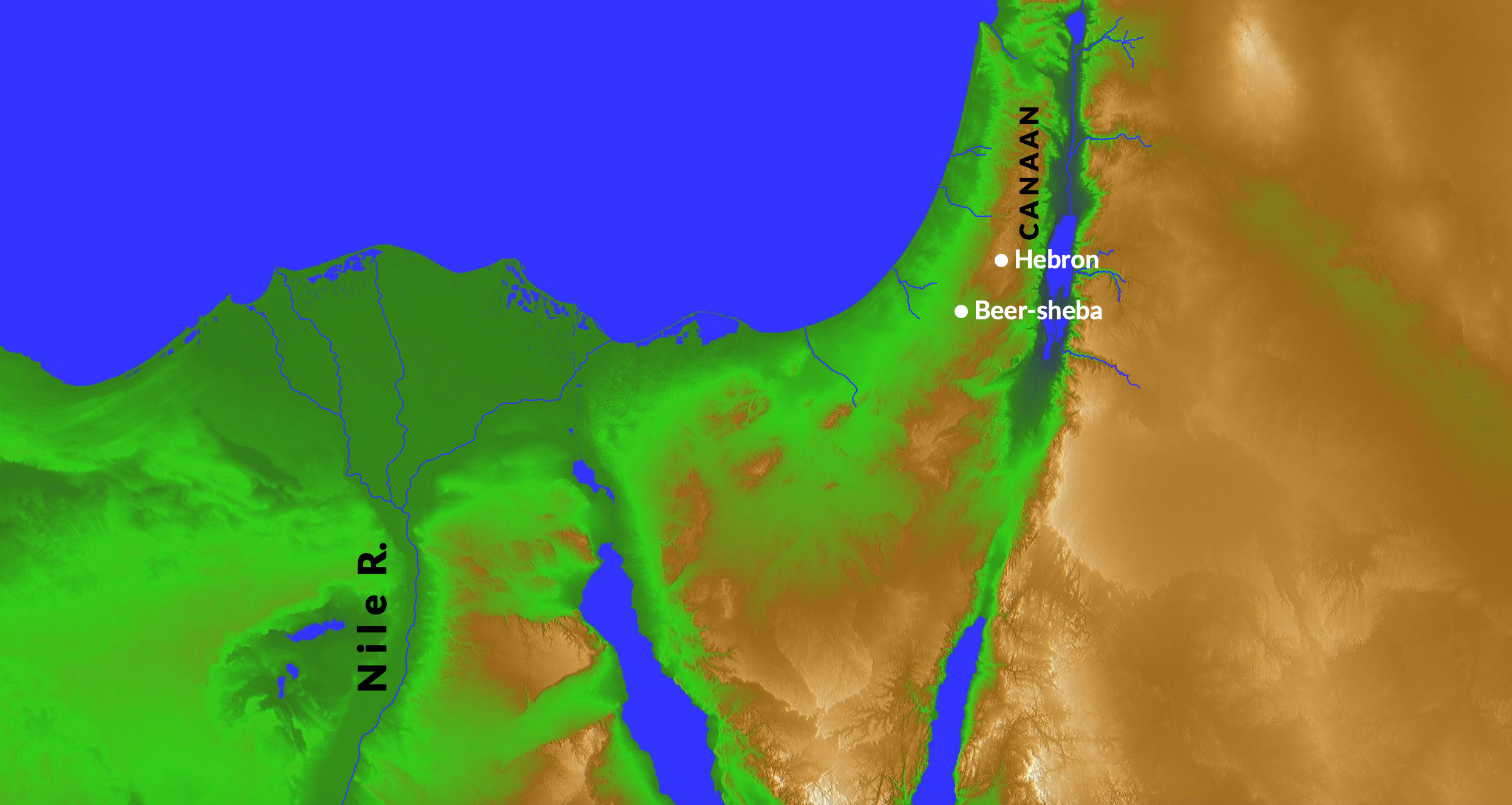
It was roughly 300 miles / 500 km from Egypt to Canaan. That would have been at least a 10 day journey. The Bible doesn’t say specifically where Jacob was living at this time, but it was most likely in Hebron because it appears that is where Jacob settled when he came back from his sojourn with Laban (see Genesis 35:27).
Gen. 45:26 And they told him, saying, “Joseph is still alive, and indeed he is ruler over all the land of Egypt.” But his heart was stunned, for he did not believe them.
Look at the phrases “his heart was stunned” and “he did not believe them”. At this point in time, Jacob had lived almost 20 years under the belief that Joseph had been killed.
Since Joseph had not actually been killed, Jacob never had Joseph’s body to bury. The only proof he had that Joseph was dead was the absence of Joseph, and being presented with Joseph’s tunic which was covered in blood.
Part of the grieving process is going through a period of denial, but that doesn’t last 20 years. Even though Jacob never had Joseph’s body to bury, after 20 years, Jacob would have accepted the fact that Joseph was dead.
Now, suddenly, Jacob’s sons were telling him that Joseph was still alive. That would have been difficult to believe.
There are situations today where people disappear, and their bodies are never found. That creates a dilemma for the family. Without a body, there is no proof the person died; therefore, there is reason to always hold out hope they are still alive. On the other hand, if months and years go by and the person never comes back, at some point the family has to move on with life and accept that their loved one is dead.
Gen. 45:27 Yet they told him all the words of Joseph that he had spoken to them, and he saw the wagons that Joseph had sent to carry him. Then the spirit of their father Jacob revived.
Look at the word “revived”. Genesis 43:14 indicates that Jacob was a broken and despondent man. The possibility that Joseph was still alive brought hope and optimism back into Jacob.
Gen. 45:28 And Israel said, “It is enough! My son Joseph is still alive. I will go and see him before I die.”
Notice the sentence “It is enough!” Jacob’s sons presented enough evidence that Jacob became convinced Joseph was still alive.
Gen. 46:1 ¶ So Israel set out with all that he had and came to Beersheba and offered sacrifices to the God of his father Isaac.
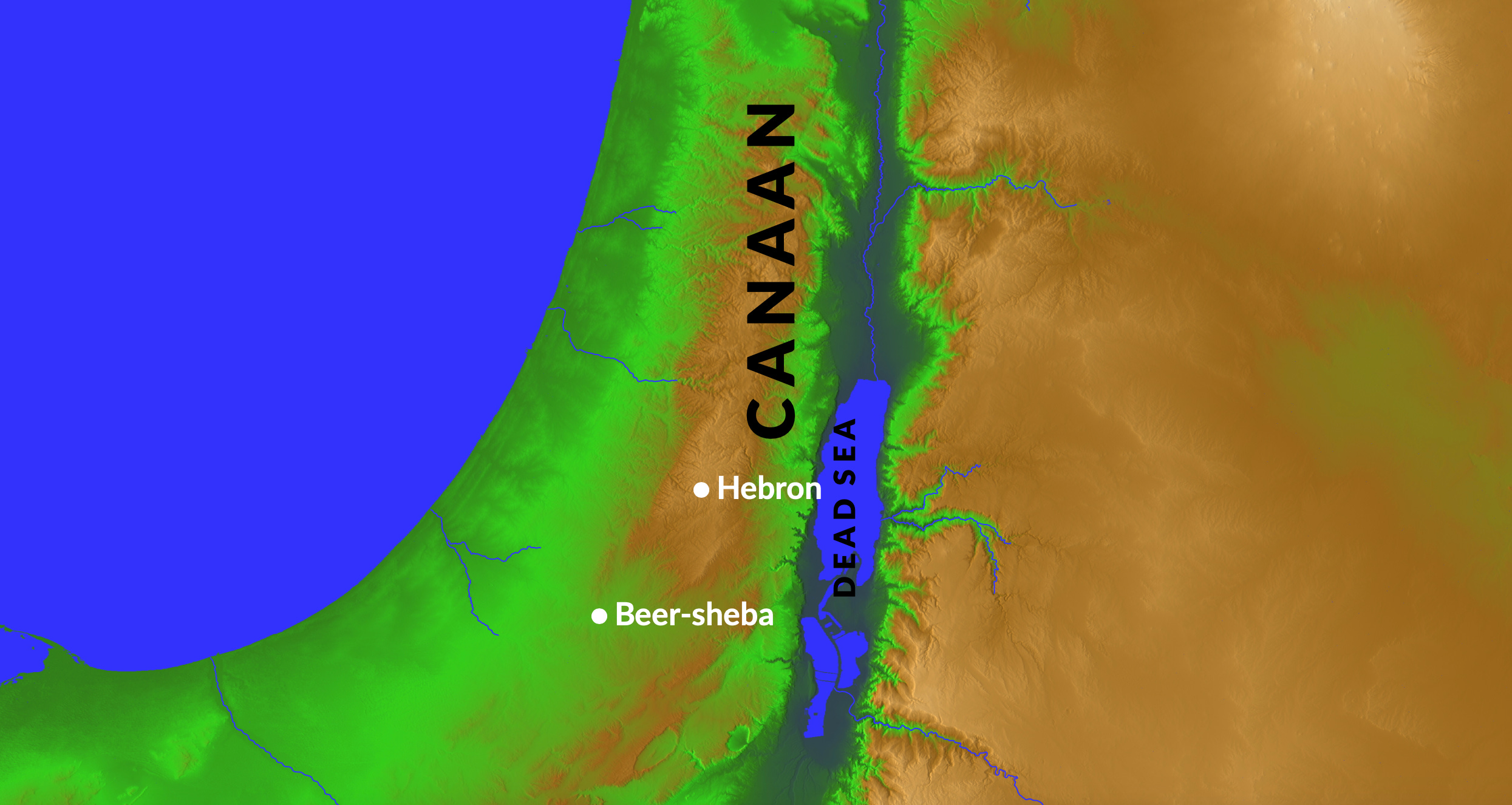
The colors on the map indicate elevation. Jacob had been living up in the hill country of Canaan, probably at Hebron which is around 3,100 feet / 950 m above sea level. Beer-sheba is at the base of the hill country, around 900 feet / 275 m above sea level. Both Abraham and Isaac spent time living near Beer-sheba and had encounters with Yahweh there (see Genesis 21:33 and 26:24), so it made sense Jacob went there to offer sacrifices.
Gen. 46:2 And God spoke to Israel in visions of the night and said, “Jacob, Jacob.” And he said, “Here I am.”
Gen. 46:3 And He said, “I am God, the God of your father; do not be afraid to go down to Egypt, for I will make you a great nation there.
Gen. 46:4 I Myself will go down with you to Egypt, and I Myself will also bring you up again; and Joseph will close your eyes with his hand.”
Gen. 46:5 ¶ Then Jacob arose from Beersheba; and the sons of Israel carried their father Jacob and their little ones and their wives in the wagons which Pharaoh had sent to carry him.
Gen. 46:6 And they took their livestock and their possessions, which they had accumulated in the land of Canaan, and they came to Egypt, Jacob and all his seed with him:
Gen. 46:7 his sons and his grandsons with him, his daughters and his granddaughters, and all his seed he brought with him to Egypt.
Gen. 46:8 ¶ Now these are the names of the sons of Israel—of Jacob and his sons—who were coming to Egypt: Reuben, Jacob’s firstborn.
Gen. 46:9 The sons of Reuben: Hanoch and Pallu and Hezron and Carmi.
Gen. 46:10 The sons of Simeon: Jemuel and Jamin and Ohad and Jachin and Zohar and Shaul the son of a Canaanite woman.
Gen. 46:11 The sons of Levi: Gershon, Kohath, and Merari.
Gen. 46:12 The sons of Judah: Er and Onan and Shelah and Perez and Zerah (but Er and Onan died in the land of Canaan). And the sons of Perez were Hezron and Hamul.
Gen. 46:13 The sons of Issachar: Tola and Puvvah and Iob and Shimron.
Gen. 46:14 The sons of Zebulun: Sered and Elon and Jahleel.
Gen. 46:15 These are the sons of Leah, whom she bore to Jacob in Paddan-aram, with his daughter Dinah; all his sons and his daughters numbered thirty-three.
Gen. 46:16 ¶ The sons of Gad: Ziphion and Haggi, Shuni and Ezbon, Eri and Arodi and Areli.
Gen. 46:17 The sons of Asher: Imnah and Ishvah and Ishvi and Beriah and their sister Serah. And the sons of Beriah: Heber and Malchiel.
Gen. 46:18 These are the sons of Zilpah, whom Laban gave to his daughter Leah; and she bore to Jacob these sixteen persons.
Gen. 46:19 ¶ The sons of Jacob’s wife Rachel: Joseph and Benjamin.
Gen. 46:20 Now to Joseph in the land of Egypt were born Manasseh and Ephraim, whom Asenath, the daughter of Potiphera, priest of On, bore to him.
Gen. 46:21 The sons of Benjamin: Bela and Becher and Ashbel, Gera and Naaman, Ehi and Rosh, Muppim and Huppim and Ard.
Gen. 46:22 These are the sons of Rachel, who were born to Jacob; there were fourteen persons in all.
Gen. 46:23 ¶ The sons of Dan: Hushim.
Gen. 46:24 The sons of Naphtali: Jahzeel and Guni and Jezer and Shillem.
Gen. 46:25 These are the sons of Bilhah, whom Laban gave to his daughter Rachel, and she bore these to Jacob; there were seven persons in all.
As hard as it is to bury a loved one, at least when there is a body to bury, you have proof your family member is dead. When a person disappears and a body is never found, the family enters a time of uncertainty. The family will never know for sure whether or not their family member is dead or alive. The story of Joseph illustrates that, while it is unlikely, it is possible for a person to live decades while their family thinks they are dead.
When you bury a beloved friend or relative, take time to grieve, but also be thankful that you have certainty. At least you know the person is dead, and you can grieve and move on with life.
Do you know anyone who is dealing with a situation where a person disappeared without a trace, and it is unknown if the person is dead or alive?
What complications are they dealing with due to the unknowns?
Thanks for visiting Bible Mountain. If you have already joined my email list, thank you and please tell others about Bible Mountain. If you have not joined my email list yet, please do so now. In order to join, go to Bible Mountain dotcom, click on subscribe, and that will take you to a page where you can sign up. Your email address will not be sold nor given away. Once again, thanks for visiting Bible Mountain.
“Scripture quotations taken from the (LSB®) Legacy Standard Bible®, Copyright © 2021 by The Lockman Foundation. Used by permission. All rights reserved. Managed in partnership with Three Sixteen Publishing Inc. LSBible.org and 316publishing.com.”