
Anyone who has any familiarity at all with Old Testament history knows that idolatry was a constant problem. Oftentimes, periods of idolatry were times when people completely ignored Yahweh and worshipped idols of wood and stone instead.
Most evangelicals think modern Christianity does not have an idolatry problem because we do not worship physical gods that were man-made. That is true, but the 35th chapter of Genesis illustrates a variation of idolatry that does exist today.
When Jacob and his family lived near Shechem, the prince of the land raped Jacob’s daughter and asked Jacob to give her to him as his wife. The sons of Jacob asked the men of Shechem to circumcise themselves first, which they did. While the men were in pain, Simeon and Levi killed all the men and the sons of Jacob plundered the entire city.
Gen. 35:1 ¶ Then God said to Jacob, “Arise, go up to Bethel and live there, and make an altar there to God, who appeared to you when you fled from your brother Esau.”
Bethel was the location where Jacob had a dream and saw a ladder reaching into heaven, with Yahweh standing above it. The morning after the dream, Jacob vowed to make Yahweh his God if Yahweh kept him on his journey and brought him back to his father (see Genesis 28:10-22).
Now, God instructed Jacob to live in Bethel and make an altar.
Look at the word “up”. Bethel is south of Shechem, so we would normally think Jacob was traveling down to Bethel. However, Shechem is about 1,700 feet above sea level while Bethel is around 2,900 feet above sea level, so Jacob was literally going up when he went to Bethel.
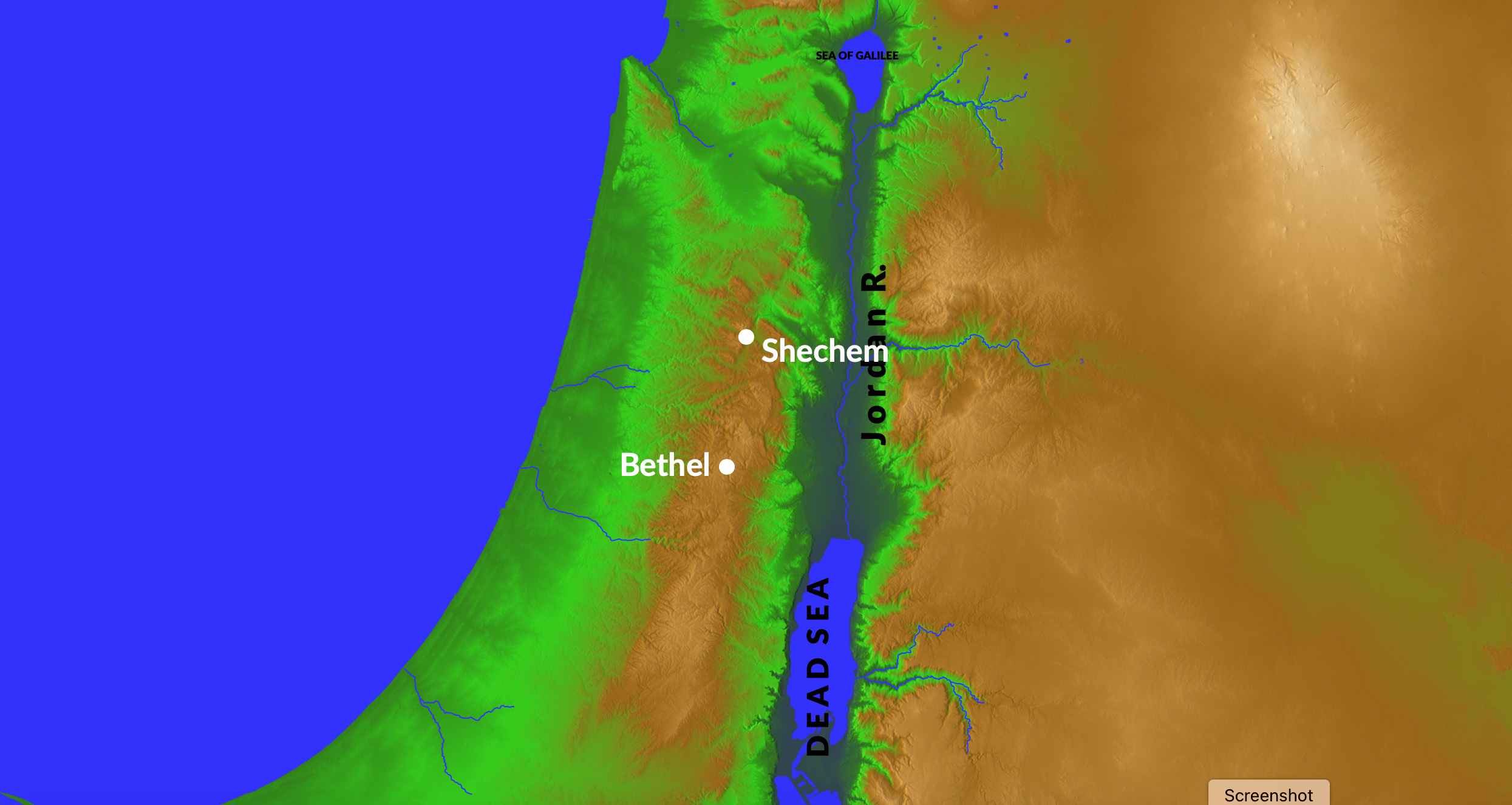
Bethel is 20 miles / 30 km south of Shechem. That would be a one day journey.
Gen. 35:2 So Jacob said to his household and to all who were with him, “Put away the foreign gods which are among you and cleanse yourselves and change your garments;
Pay attention to the command to “Put away the foreign gods”. We often picture Abraham, Isaac, and Jacob and their families as being fully devoted to Yahweh. However, we see that Jacob’s family had multiple gods. Fortunately, Jacob understood that his family should not take all their foreign gods to Bethel, the house of Yahweh, the place where he had made a vow to Yahweh.
Modern Christians tend to think this is not a problem in 21st century American Christianity. They believe the God of the Bible is our only God. It is true that modern Christians do not have physical gods made of wood, stone, or other materials. However, if you define a god as the thing that has supreme importance, or the thing that drives your daily decisions, then we have many gods such as sports, entertainment, work, money, pleasure, comfort, travel, and possessions.
Gen. 35:3 and let us arise and go up to Bethel, and I will make an altar there to God, who answered me in the day of my distress and has been with me wherever I have gone.”
Gen. 35:4 So they gave to Jacob all the foreign gods which they had and the rings which were in their ears, and Jacob hid them under the oak which was near Shechem.
Gen. 35:5 ¶ Then they journeyed on, and there was a terror from God upon the cities which were around them, and they did not pursue the sons of Jacob.
When Simeon and Levi killed the men of Shechem, Jacob was afraid the surrounding cities would attack him (see Genesis 34:30). Instead, God sent fear upon the cities, and they did not pursue Jacob’s family.
Gen. 35:6 So Jacob came to Luz (that is, Bethel), which is in the land of Canaan, he and all the people who were with him.
Gen. 35:7 And he built an altar there and called the place El-bethel, because there God had revealed Himself to him when he fled from his brother.
“El” is the Hebrew word for god. “Beth” is the Hebrew word for house. Jacob called this place the House of God.
Gen. 35:8 Then Deborah, Rebekah’s nurse, died, and she was buried below Bethel under the oak; it was named Allon-bacuth.
“Allon” is the Hebrew word for oak. “Bacuth” means to weep. The oak tree was called the oak of weeping.
Gen. 35:9 ¶ Then God appeared to Jacob again when he came from Paddan-aram, and He blessed him.
Gen. 35:10 And God said to him,
“Your name is Jacob;
Your name shall no longer be called Jacob,
But Israel shall be your name.”
Thus He called his name Israel.
Jacob had already received this name when he wrestled with Yahweh (see Genesis 32:28).
The Hebrew word “Jacob” means heel.
The Hebrew word “Isra” means contend or strive. The Hebrew word “El” means God. Israel means God strives.
Gen. 35:11 God also said to him,
“I am God Almighty;
Be fruitful and multiply;
A nation and an assembly of nations shall come from you,
And kings shall come forth from your loins.
Gen. 35:12 And the land which I gave to Abraham and Isaac,
I will give it to you,
And I will give the land to your seed after you.”
There are multiple passages in which Yahweh promised this land to Abraham, Isaac, and Jacob (Genesis 12:7, 13:15, 15:7, 15:18, 17:8, 26:3, and 28:13).
Gen. 35:13 Then God went up from him in the place where He had spoken with him.
Gen. 35:14 And Jacob set up a pillar in the place where He had spoken with him, a pillar of stone, and he poured out a drink offering on it; he also poured oil on it.
Gen. 35:15 So Jacob named the place where God had spoken with him, Bethel.
Gen. 35:16 ¶ Then they journeyed from Bethel; and there was still some distance to go to Ephrath, and Rachel gave birth, and she suffered severely in her labor.
Gen. 35:17 Now it happened that when she was in severe labor the midwife said to her, “Do not fear, for now you have another son.”
Gen. 35:18 Now it happened as her soul was departing (for she died), that she named him Ben-oni; but his father called him Benjamin.
The Hebrew word “ben” means son. The Hebrew word “oni” means sorrow. Rachel was in sorrow when her son was born, so she called him the son of her sorrow.
The Hebrew word “jamin” means right hand, so Jacob called his child the son of his right hand.
Gen. 35:19 So Rachel died and was buried on the way to Ephrath (that is, Bethlehem).
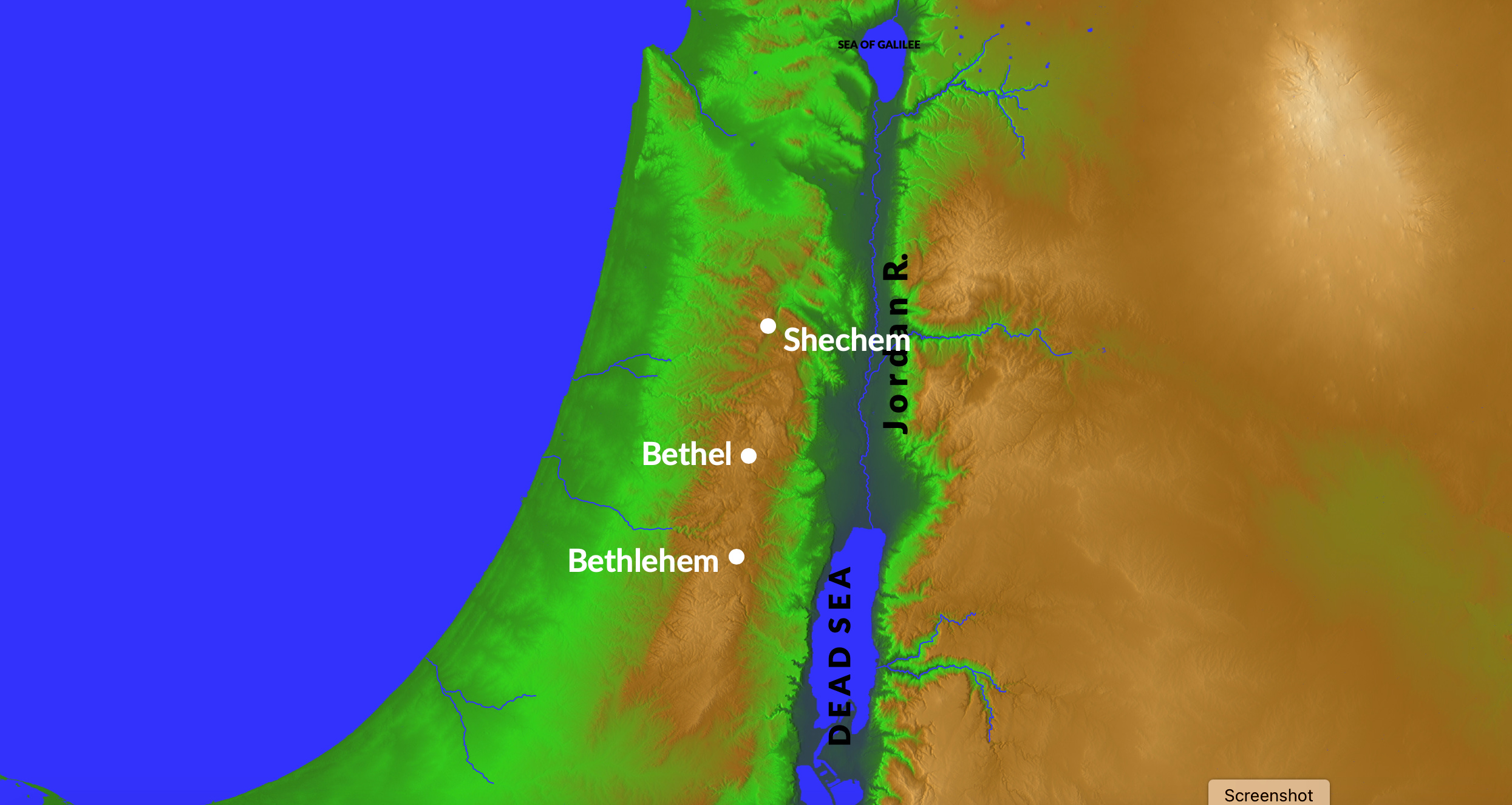
It was about 15 miles / 24 km from Bethel to Bethlehem. The road from one to the other was on the watershed between the Mediterranean Sea and the Jordan River, and was a fairly level path.
Gen. 35:20 And Jacob set up a pillar over her grave; that is the pillar of Rachel’s grave to this day.
Gen. 35:21 Then Israel journeyed on and pitched his tent beyond the tower of Eder.
Idolatry was a constant problem in the Old Testament time period. Oftentimes, periods of idolatry were times when people completely ignored Yahweh and worshipped idols of wood and stone instead. There were also occasions when people worshipped false gods in addition to Yahweh. Jacob’s family did that.
Modern Christians tend to think this is not a problem in 21st century American Christianity. They believe the God of the Bible is our only God. It is true that modern Christians do not have physical gods made of wood, stone, or other materials. However, if you define a god as the thing that has supreme importance, or the thing that drives your daily decisions, then we have many gods such as sports, entertainment, work, money, pleasure, comfort, travel, and possessions.
We must follow Jacob’s example, put away all our false gods, and make Yahweh the supreme importance in our lives.
What is the biggest influence over how you use your time and money?
Is it a god?
What do you need to put away in your life in order to put away all false gods?
Thanks for visiting Bible Mountain. If you have already joined my email list, thank you and please tell others about Bible Mountain. If you have not joined my email list yet, please do so now. In order to join, go to Bible Mountain dotcom, click on subscribe, and that will take you to a page where you can sign up. Your email address will not be sold nor given away. Once again, thanks for visiting Bible Mountain.
“Scripture quotations taken from the (LSB®) Legacy Standard Bible®, Copyright © 2021 by The Lockman Foundation. Used by permission. All rights reserved. Managed in partnership with Three Sixteen Publishing Inc. LSBible.org and 316publishing.com.”