
It is hard for humans to admit they wronged another person. It is also hard for the wronged party to forgive the person who mistreated them. Sometimes those broken relationships are never healed.
Jacob and Esau are an example of a situation that could have resulted in permanent alienation. Fortunately, they are also an example of what two parties need to do in order to overcome past hurts and resume a relationship.
Jacob knew his brother Esau was coming to meet him with 400 men. Since Jacob had deceived their father into blessing him instead of Esau, Jacob rightly feared Esau intended to harm him. Jacob sent a huge gift to Esau ahead of himself, then as he approached Esau he bowed to the ground seven times.
Gen. 33:4 ¶ Then Esau ran to meet him and embraced him and fell on his neck and kissed him, and they wept.
Gen. 33:5 And he lifted up his eyes and saw the women and the children and said, “Who are these with you?” And he said, “The children whom God has graciously given your servant.”
One of the difficulties of reading the Bible is following all the pronouns. In this verse Esau spoke first, then Jacob.
Gen. 33:6 Then the servant-women came near with their children, and they bowed down.
Jacob was with Laban 20 years. He was only married for 13 years when he left Laban. That means his sons would still have been young children under the age of 13 when he met Esau.
Gen. 33:7 Leah likewise came near with her children, and they bowed down; and afterward Joseph came near with Rachel, and they bowed down.
Gen. 33:8 And he said, “What do you mean by all these camps which I have met?” And he said, “To find favor in the sight of my lord.”
Once again Esau spoke first, then Jacob.
Gen. 33:9 But Esau said, “I have plenty, my brother; let what you have be your own.”
Gen. 33:10 And Jacob said, “No, please, if now I have found favor in your sight, then take my present from my hand, for I see your face as one sees the face of God, and you have received me favorably.
Gen. 33:11 Please take my blessing which has been brought to you, because God has dealt graciously with me and because I have everything.” Thus he urged him, and he took it.
Esau agreed to take the gift.
It is hard for humans to admit they wronged another person. It is also hard for the wronged party to forgive the person who mistreated them. Sometimes those broken relationships are never healed. There are siblings who are permanently estranged from one another as a result of something that happened years prior.
The conflict between Jacob and Esau is an example of a situation that could have resulted in permanent estrangement. However, Jacob bowed down to Esau seven times, expressing humility, and Esau was willing to look past the deception and welcome Jacob. They are an example of what humans need to do to avoid permanent estrangement when one person has wronged another.
Gen. 33:12 ¶ Then Esau said, “Let us take our journey and go, and I will go before you.”
Gen. 33:13 But he said to him, “My lord knows that the children are weak and that the flocks and herds which are nursing are a care to me. And if they are driven hard one day, all the flocks will die.
The pronoun “he” refers to Jacob.
Gen. 33:14 Please let my lord pass on before his servant, and I will lead on slowly, according to the pace of the cattle that are before me and according to the pace of the children, until I come to my lord at Seir.”
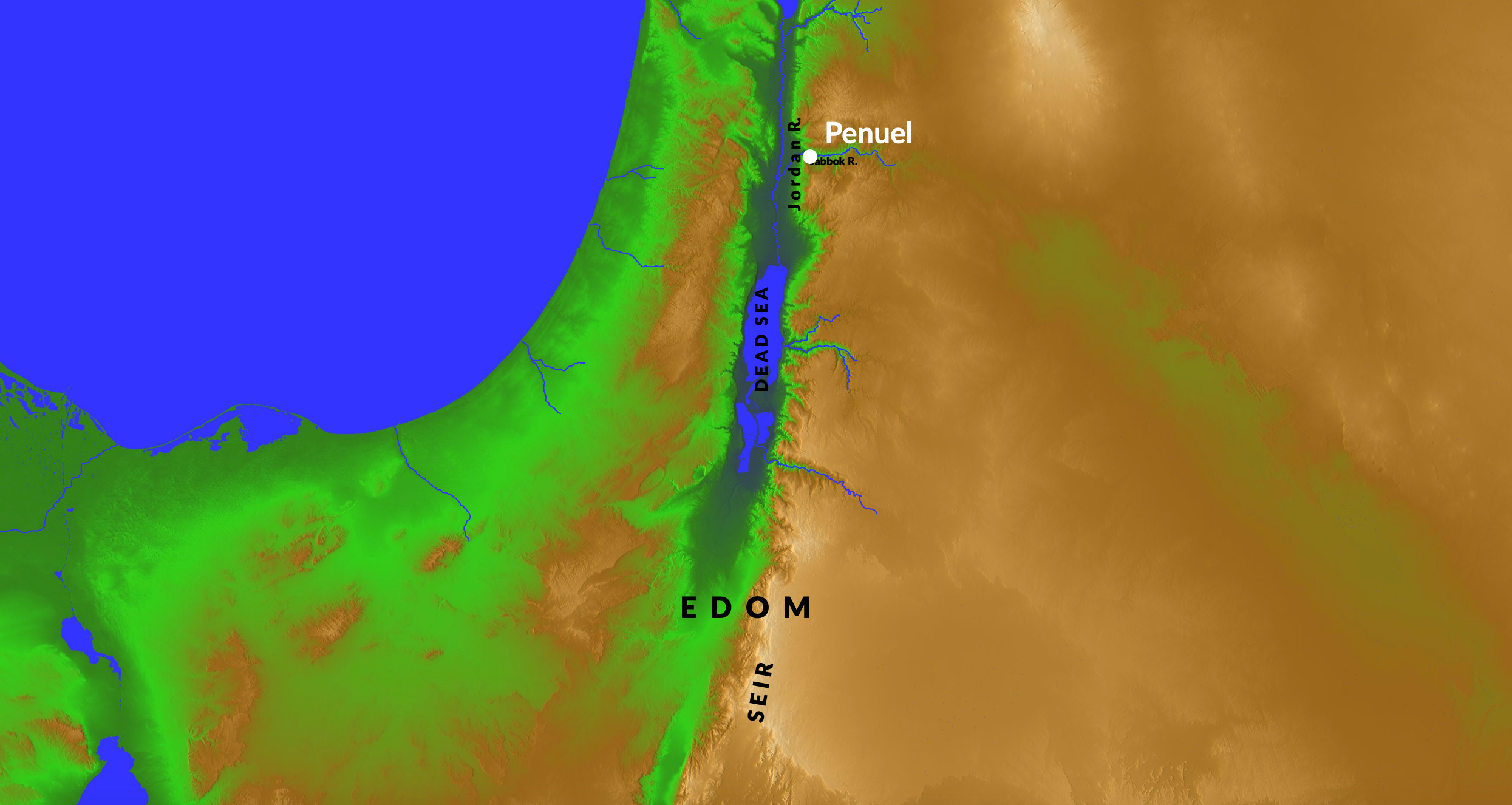
Esau lived in Seir. Seir was south of the Dead Sea. It is around 125 miles / 200 km from Penuel to Seir. That would be at least a 5 day journey.
Gen. 33:15 ¶ Then Esau said, “Please let me leave with you some of the people who are with me.” But he said, “Why do this? Let me find favor in the sight of my lord.”
Gen. 33:16 So Esau returned that day on his way to Seir.
Gen. 33:17 But Jacob journeyed to Succoth and built for himself a house and made booths for his livestock; therefore the place is named Succoth.
Notice the word “house”. If Jacob built a house for himself and booths for his livestock, then he spend a significant amount of time in Succoth before the events of verse 18.
The word “succoth” is the Hebrew word for booths. Jacob built booths for his livestock, so he named the place Booths.
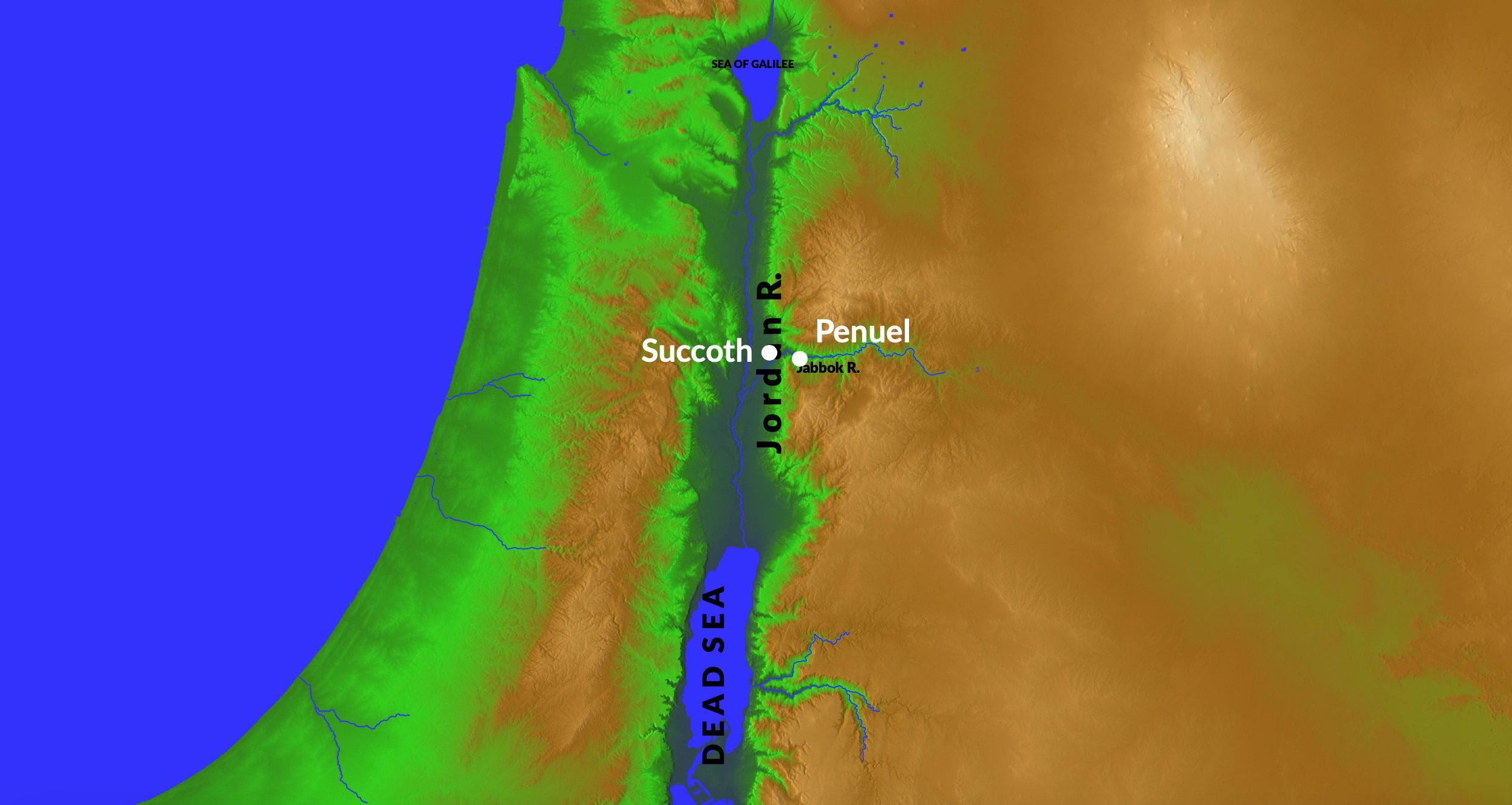
After Jacob and Esau separated, Jacob traveled west, down into the Jordan River valley to Succoth.
Gen. 33:18 ¶ Now Jacob came safely to the city of Shechem, which is in the land of Canaan, when he came from Paddan-aram, and he camped before the city.
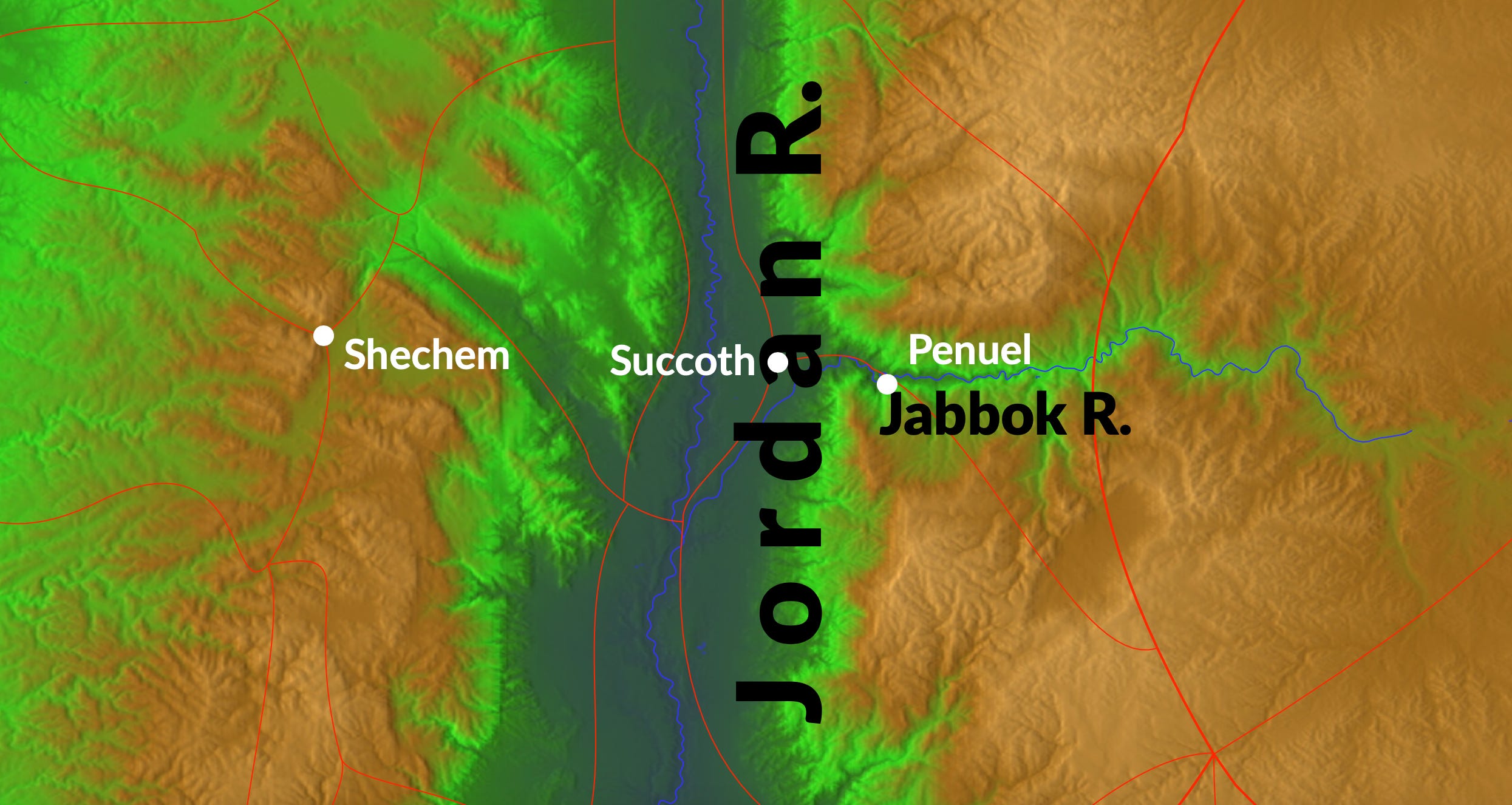
The colors on the map indicate elevation. Browns are the higher elevations while dark greens are the lowest elevations. The red lines denote ancient highways.
It is about 20 miles / 32 km from Succoth to Shechem as the crow flies. Theoretically, that could be traveled in one day. However, they had to cross the Jordan River. Plus, Succoth is 800 feet / 245 m below sea level; whereas, Shechem is 1,730 feet / 530 meters above sea level. That is like climbing a 2,500 foot / 800 m mountain.
Due to the shape and direction of the valleys, they did not travel in a straight line. They would have walked south along the Jordan River, then northwest up the valley, before turning south to arrive at Shechem. The path they followed was probably around 30 miles / 50 km long.
Gen. 33:19 Then he bought a portion of a field where he had pitched his tent from the hand of the sons of Hamor, Shechem’s father, for one hundred qesitah.
Gen. 33:20 Then he set up there an altar and called it El-Elohe-Israel.
Look at the name “El-Elohe-Israel”. El is the Hebrew word for God and is singuler. Elohe is the plural form of El. Israel was Jacob’s new name. The words are in construct form meaning it should read God of gods of Israel.
Referring to God as the God of gods implies the supremacy of God over all other gods. By including his own name, Jacob indicated the God of gods was his God.
Gen. 34:1 ¶ Now Dinah the daughter of Leah, whom she had borne to Jacob, went out to see the daughters of the land.
Gen. 34:2 Then Shechem the son of Hamor the Hivite, the prince of the land, saw her and took her and lay with her and violated her.
Don’t miss the word “violated”. Shechem raped Dinah.
Gen. 34:3 And he was deeply attracted to Dinah the daughter of Jacob, and he loved the young woman and spoke to the heart of the young woman.
Gen. 34:4 So Shechem spoke to his father Hamor, saying, “Get me this girl as a wife.”
Gen. 34:5 Now Jacob heard that he had defiled Dinah his daughter; but his sons were with his livestock in the field, so Jacob kept silent until they came in.
Gen. 34:6 Then Hamor the father of Shechem went out to Jacob to speak with him.
Gen. 34:7 Now the sons of Jacob came in from the field when they heard it; and the men were grieved, and they were very angry because he had done a disgraceful thing in Israel by lying with Jacob’s daughter, for such a thing ought not to be done.
It is hard for humans to admit they wronged another person. It is also hard for the wronged party to forgive the person who mistreated them. Sometimes those broken relationships are never healed.
The conflict between Jacob and Esau is an example of a situation that could have resulted in permanent estrangement. However, Jacob bowed down to Esau seven times, expressing humility, and Esau was willing to look past the deception and welcome Jacob. They are an example of what humans need to do to avoid permanent estrangement when one person has wronged another person.
What is an occasion when you either wronged a person or were wronged by a friend or family member?
To what extent did you or are you willing to do your part to overcome the offense and resume the relationship?
Thanks for visiting Bible Mountain. If you have already joined my email list, thank you and please tell others about Bible Mountain. If you have not joined my email list yet, please do so now. In order to join, go to Bible Mountain dotcom, click on subscribe, and that will take you to a page where you can sign up. Your email address will not be sold nor given away. Once again, thanks for visiting Bible Mountain.
“Scripture quotations taken from the (LSB®) Legacy Standard Bible®, Copyright © 2021 by The Lockman Foundation. Used by permission. All rights reserved. Managed in partnership with Three Sixteen Publishing Inc. LSBible.org and 316publishing.com.”