
Humans have a tendency to act without thinking about the future ramifications of that act. Oftentimes, the only thing we can see is the here and now. However, decisions often have long-term effects. If we help a person, they will remember that for years and might help us many years in the future. If we harm a person, they might harm us in future decades.
The story of Jacob stealing the blessing from Esau illustrates this principle. When Rebekah suggested that Jacob deceive his father into giving the blessing to him instead of to Esau, Jacob went along with the idea. However, 20 years later, Jacob was still dealing with the after-effects of that deception.
As Jacob approached the land of Canaan, he was told that his brother Esau was coming to meet him, accompanied by 400 men. Since Jacob had stolen the blessing from Esau, Jacob was afraid Esau meant to harm him, so Jacob prepared a gift for Esau. He sent 580 goats, sheep, camels, cows, and donkeys ahead of him in the care of his servants.
Gen. 32:17 And he commanded the first one in front, saying, “When my brother Esau meets you and asks you, saying, ‘To whom do you belong, and where are you going, and to whom do these animals in front of you belong?’
The pronoun “he” refers to Jacob and the words “first one” refer to one of his servants.
Gen. 32:18 then you shall say, ‘These belong to your servant Jacob; it is a present sent to my lord, to Esau. And behold, he also is behind us.’”
Gen. 32:19 Then he commanded also the second and the third and all those who followed the flocks, saying, “After this manner you shall speak to Esau when you find him;
Gen. 32:20 and you shall say, ‘Behold, your servant Jacob also is behind us.’” For he said, “I will appease his face with the present that goes before me. Then afterward I will see his face; perhaps he will lift up my face.”
Jacob hoped to appease Esau with his gift. Keep in mind, Jacob was afraid of Esau because of something he did 20 years earlier. He went along with his mother’s plan to deceive his father, but 20 years later that act of deception was still haunting him.
Humans have a tendency to act without thinking about the future ramifications of that act. Oftentimes, the only thing we can see is the here and now. However, if we harm or deceive another person, they will remember that for a long time. If they ever get a chance to take revenge, they might do so. It is wise to think about the long term ramifications of anything we do, not just the immediate, short-term benefits.
Gen. 32:21 So the present passed on before him, while he himself spent that night in the camp.
Gen. 32:22 ¶ And he arose that same night and took his two wives and his two servant-women and his eleven children and crossed the ford of the Jabbok.
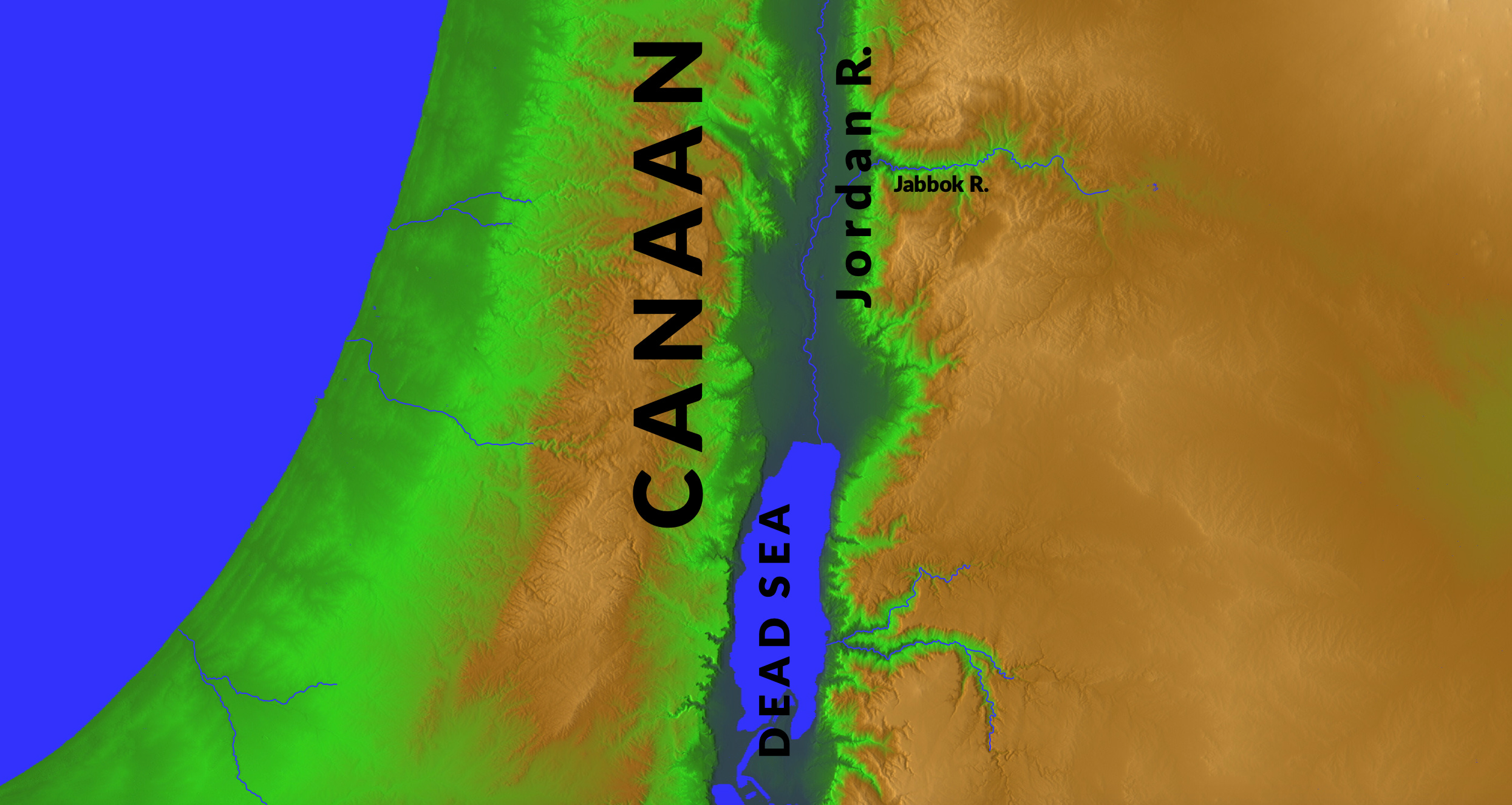
The Jabbok River is east of Canaan and feeds into the Jordan River.
Gen. 32:23 And he took them and sent them across the stream. And he sent across whatever he had.
Gen. 32:24 ¶ Then Jacob was left alone, and a man wrestled with him until the breaking of dawn.
Gen. 32:25 And he saw that he had not prevailed against him, so he touched the socket of his thigh; and so the socket of Jacob’s thigh was dislocated while he wrestled with him.
The pronoun “he” refers to the man who was wrestling with Jacob. The man did not prevail against Jacob.
Gen. 32:26 Then he said, “Let me go, for the dawn is breaking.” But he said, “I will not let you go unless you bless me.”
The man asked Jacob to let him go, but Jacob refused to do so unless the man blessed him.
Gen. 32:27 So he said to him, “What is your name?” And he said, “Jacob.”
Gen. 32:28 Then He said, “Your name shall no longer be Jacob, but Israel; for you have striven with God and with men and have prevailed.”
This sentence reveals the man wrestling Jacob was God Himself.
The Hebrew word “Jacob” means heel.
The Hebrew word “Isra” means contend or strive. The Hebrew word “El” means God. Israel means God strives.
Gen. 32:29 Then Jacob asked him and said, “Please tell me your name.” But he said, “Why is it that you ask my name?” And he blessed him there.
The man blessed Jacob.
Gen. 32:30 So Jacob named the place Peniel, for he said, “I have seen God face to face, yet my life has been delivered.”
The Hebrew word “peni” means face. The Hebrew word “El” means God. Peniel means face of God.
Gen. 32:31 And the sun rose upon him just as he crossed over Penuel, and he was limping on his thigh.
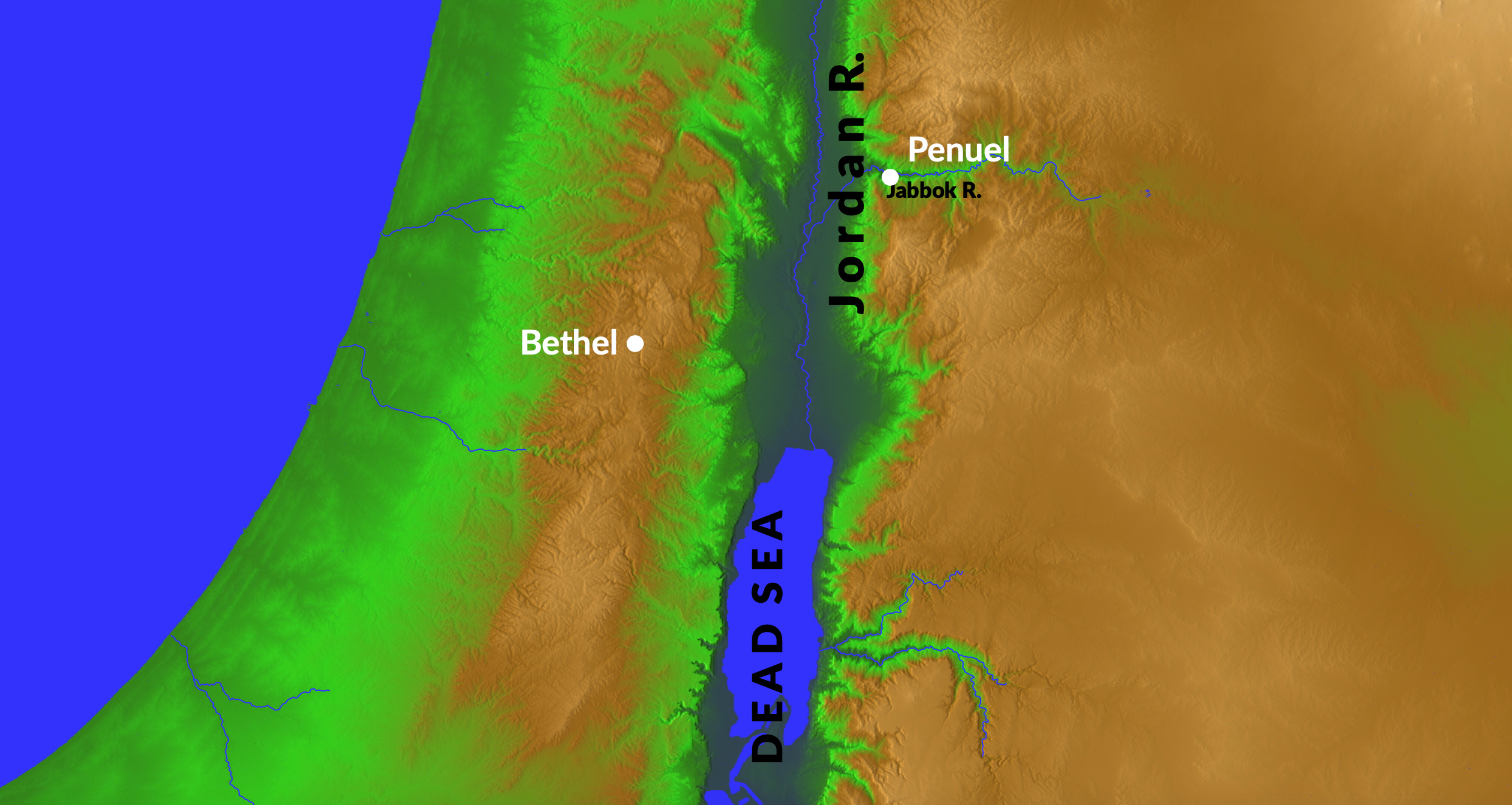
Penuel is only about 30 miles / 50 km away from Bethel. That would be a 1-2 day journey. Bethel is where Jacob saw Yahweh at the top of the ladder into heaven (see Genesis 28:19).
Gen. 32:32 Therefore, to this day the sons of Israel do not eat the sinew of the hip which is on the socket of the thigh because he touched the socket of Jacob’s thigh in the sinew of the hip.
Gen. 33:1 ¶ Then Jacob lifted up his eyes and saw, and behold, Esau was coming, and four hundred men with him. So he divided the children among Leah and Rachel and the two servant-women.
Gen. 33:2 And he put the servant-women and their children first, and Leah and her children after them, and Rachel and Joseph after them.
Gen. 33:3 But he himself passed on ahead of them and bowed down to the ground seven times, until he came near to his brother.
Humans have a tendency to act without thinking about the future ramifications of that act. Oftentimes, the only thing we see is the here and now. However, if we harm or deceive another person, they will remember that for a long time. If they ever get a chance to take revenge, they might do so. It is wise to think about the long term ramifications of anything we do, not just the immediate, short-term benefits.
What are examples you have seen of someone making a decision that they regret many years or decades after the deed?
What did you do many years ago that continues to have ramifications today, whether good or bad?
What did you not think about when you did that deed many years ago?
What is a current decision you need to make, and what might be the future ramifications of that decision?
Thanks for visiting Bible Mountain. If you have already joined my email list, thank you and please tell others about Bible Mountain. If you have not joined my email list yet, please do so now. In order to join, go to Bible Mountain dotcom, click on subscribe, and that will take you to a page where you can sign up. Your email address will not be sold nor given away. Once again, thanks for visiting Bible Mountain.
“Scripture quotations taken from the (LSB®) Legacy Standard Bible®, Copyright © 2021 by The Lockman Foundation. Used by permission. All rights reserved. Managed in partnership with Three Sixteen Publishing Inc. LSBible.org and 316publishing.com.”