
Daily Scripture Reading Genesis 31:4-30
Many people today believe God is always kind, loving, and would never harm anyone. They not only believe a good God would never allow bad things to happen to good people, they also believe a good God would never do bad things to bad people. Consequently, they don’t believe in hell.
Genesis 31 tells us about some interaction between Jacob and Laban, his father-in-law. Yahweh was not an impartial player in that interaction. He clearly favored Jacob over Laban, and caused bad things to happen to Laban. This reality should shape how we view God and His willingness to allow or cause bad things to happen.
Laban and Jacob agreed that Jacob would receive all the striped, speckled, and spotted animals as his wages. Jacob practiced selective breeding, and Yahweh intervened on behalf of Jacob, and Jacob became very wealthy while Laban’s flocks became feeble. Laban and his sons began to be unfriendly toward Jacob.
Gen. 31:4 So Jacob sent and called Rachel and Leah to his flock in the field,
Gen. 31:5 and he said to them, “I see your father’s face, that it is not friendly toward me as formerly, but the God of my father has been with me.
Look at the words “of my father”. Jacob recognized that Yahweh was making him successful, but he still referred to Yahweh as his father’s God, not his own.
The words “has been with me” show that Jacob understood that Yahweh was giving him success over Laban.
Gen. 31:6 You also know that I have served your father with all my power.
Gen. 31:7 Yet your father has cheated me and changed my wages ten times; however, God did not allow him to harm me.
Look at the words “cheated” and “ten times”. The Bible does not specify everything Laban did to Jacob; however, it is clear Laban was very dishonest. Jacob was correct to complain about Laban’s dishonesty, but it was also somewhat hypocritical because Jacob had deceived his very own father into giving him the blessing that was intended for Esau.
Notice the words “God did not allow him to harm me.” Jacob believed Yahweh was protecting him.
Gen. 31:8 If he spoke thus, ‘The speckled shall be your wages,’ then all the flock bore speckled; and if he spoke thus, ‘The striped shall be your wages,’ then all the flock bore striped.
Gen. 31:9 Thus God has delivered your father’s livestock and given them to me.
Jacob employed methods of selective breeding, but he also acknowledged that God caused his success.
Look at the words “given them to me”. It was not a situation where both Jacob and Laban prospered. Jacob prospered at the expense of Laban, and it was Yahweh who was taking Laban’s flock from Laban and giving it to Jacob.
Many people today believe God is always kind, loving, and would never harm anyone. They not only believe a good God would never allow bad things to happen to good people, they also believe a good God would never do bad things to bad people.
This passage disproves that belief. Yahweh is capable of favoring one person over another and causing bad things to happen to certain people. If Yahweh made Jacob prosper at Laban’s expense, Yahweh can do the same thing today.
Gen. 31:10 Now it happened at the time when the flock were mating that I lifted up my eyes and saw in a dream, and behold, the male goats which were mating were striped, speckled, and mottled.
Gen. 31:11 Then the angel of God said to me in the dream, ‘Jacob,’ and I said, ‘Here I am.’
Gen. 31:12 He said, ‘Lift up now your eyes and see that all the male goats which are mating are striped, speckled, and mottled; for I have seen all that Laban has been doing to you.
Gen. 31:13 I am the God of Bethel, where you anointed a pillar, where you made a vow to Me; now arise, leave this land, and return to the land of your kin.’”
When Jacob was at Bethel, he vowed that if God kept him on his journey, gave him food and clothing, and brought him back to his father’s house, then Yahweh would be his God (see Genesis 28:20-21). So far, Yahweh had been with Jacob. Yahweh had given Jacob wives, children, food, clothing, and many flocks. Now it was time for Jacob to return home and fulfill his vow to make Yahweh his God.
Gen. 31:14 Then Rachel and Leah said to him, “Do we still have any portion or inheritance in our father’s house?
Gen. 31:15 Are we not counted by him as foreigners? For he has sold us and has also entirely consumed our purchase price.
Gen. 31:16 Surely all the riches which God has delivered over to us from our father belong to us and our children; now then, do whatever God has said to you.”
Jacob’s wives understood that God had taken their father’s wealth and given it to Jacob and their sons.
Gen. 31:17 ¶ Then Jacob arose and put his children and his wives upon camels;
Gen. 31:18 and he drove away all his livestock and all his possessions which he had accumulated, his acquired livestock which he had accumulated in Paddan-aram, in order to go to the land of Canaan to his father Isaac.
Gen. 31:19 Now Laban had gone to shear his flock. Then Rachel stole the household idols that were her father’s.
Notice the phrase “Rachel stole the household idols”. Jacob loved Rachel more than Leah, but it was Rachel who was exhibiting loyalty to idols. Also, despite Jacob giving Yahweh credit for his success, Rachel still wanted idols.
Gen. 31:20 And Jacob deceived Laban the Aramean by not telling him that he was fleeing.
Look at the word “deceived”. Jacob and Laban did not have a healthy relationship.
Gen. 31:21 So he fled with all that he had; and he arose and crossed the River and set his face toward the hill country of Gilead.
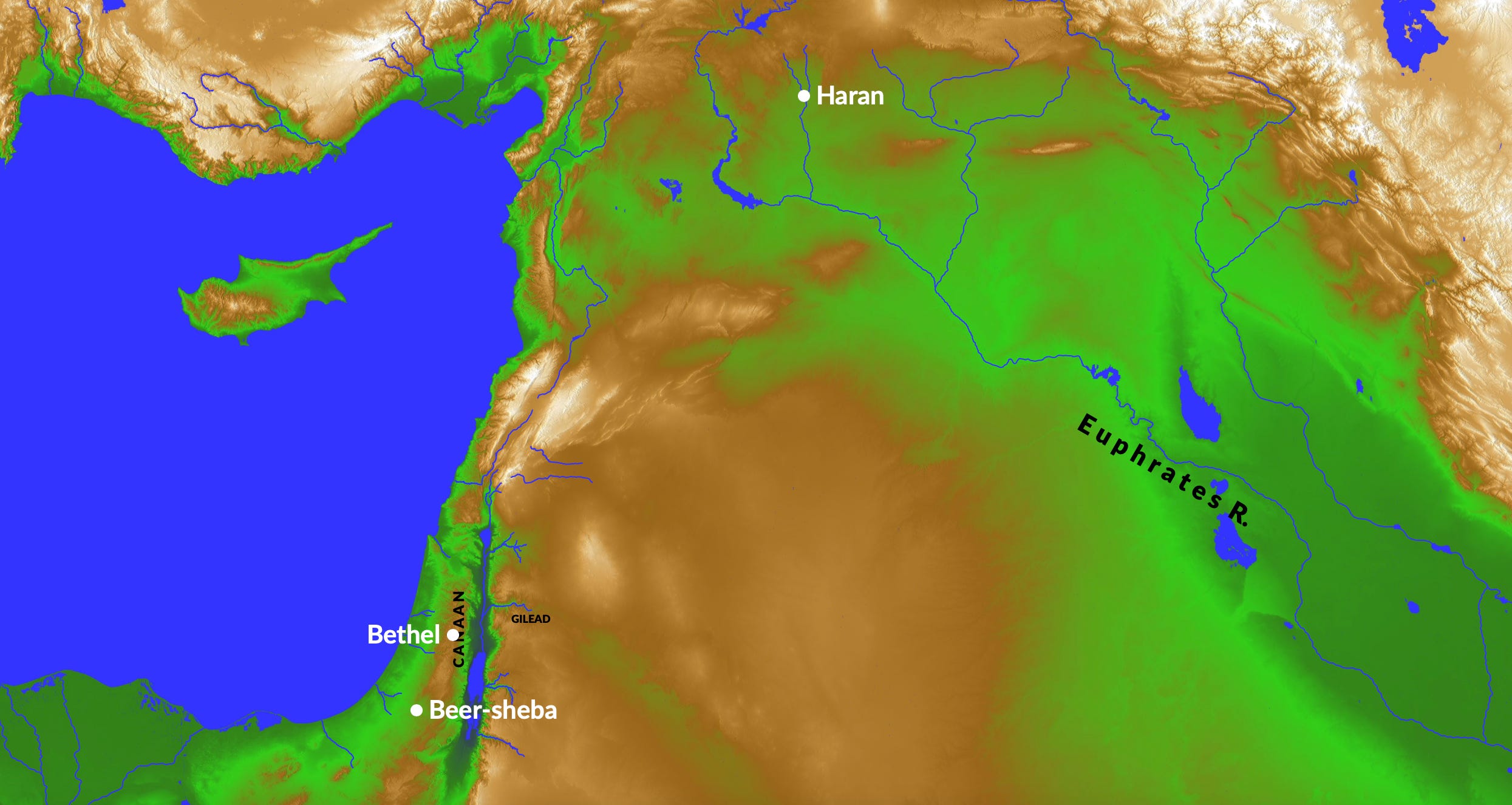
Laban lived near Haran. The River probably refers to the Euphrates River. Gilead was close to Canaan.
Gen. 31:22 ¶ Then it was told to Laban on the third day that Jacob had fled;
Gen. 31:23 so he took his relatives with him and pursued him a distance of seven days’ journey, and he overtook him in the hill country of Gilead.
It is around 375 miles / 600 km from Haran to Gilead.
Gen. 31:24 And God came to Laban the Aramean in a dream of the night and said to him, “Beware lest you speak to Jacob either good or bad.”
Take note of the word “beware”. Yahweh told Laban to be very careful.
Gen. 31:25 ¶ So Laban caught up with Jacob. Now Jacob had pitched his tent in the hill country, and Laban with his relatives camped in the hill country of Gilead.
Gen. 31:26 Then Laban said to Jacob, “What have you done by deceiving me and carrying away my daughters like captives of the sword?
Gen. 31:27 Why did you flee secretly and deceive me and not tell me—so that I might have sent you away with gladness and with songs, with tambourine and with lyre—
Gen. 31:28 and not allow me to kiss my sons and my daughters? Now you have acted foolishly.
Laban acted as if he would have gladly sent Jacob and his family away, but after all the deception and dishonesty Jacob had endured, it is understandable why Jacob would not have believed Laban.
Gen. 31:29 It is in my hand to do evil against you, but the God of your father spoke to me last night, saying, ‘Beware of speaking either good or evil to Jacob.’
Notice the phrase “It is in my hand to do evil.” That is not true. Yahweh clearly favored Jacob over Laban, so Laban was not free to do evil to Jacob.
Gen. 31:30 So now you have indeed gone away because you longed greatly for your father’s house; but why did you steal my gods?”
Many people today believe God is always kind, loving, and would never harm anyone. They not only believe a good God would never allow bad things to happen to good people, they also believe a good God would never do bad things to bad people.
This passage disproves that belief. Yahweh is capable of favoring one person over another and causing bad things to happen to certain people. If Yahweh made Jacob prosper at Laban’s expense, then Yahweh can do the same thing today. If Yahweh prevented Laban from harming Jacob, then Yahweh can protect people from harm today.
What are some situations today where Yahweh might be causing bad things to happen to certain people?
In what ways might Yahweh be protecting certain people in the 21st century?
How should this passage in Genesis shape your understanding of God and the reality of hell?
Thanks for visiting Bible Mountain. If you have already joined my email list, thank you and please tell others about Bible Mountain. If you have not joined my email list yet, please do so now. In order to join, go to Bible Mountain dotcom, click on subscribe, and that will take you to a page where you can sign up. Your email address will not be sold nor given away. Once again, thanks for visiting Bible Mountain.
“Scripture quotations taken from the (LSB®) Legacy Standard Bible®, Copyright © 2021 by The Lockman Foundation. Used by permission. All rights reserved. Managed in partnership with Three Sixteen Publishing Inc. LSBible.org and 316publishing.com.”