
When one person or organization is far more successful than others, those who are less successful often become jealous. This happens in sports, business, and families. Sports teams that win over and over again are hated and accused of cheating. Poor people often resent rich people without cause.
This phenomenon is not new. It happened to Isaac 4,000 years ago. However, just because it is common, does not mean it is good and healthy. The story about the Philistines being envious of Isaac prompts us to examine our response when we experience an abundance of success or a lack of success.
There was a famine, but Yahweh told Isaac not to go to Egypt, so Isaac went to Gerar in the land of the Philistines. The 8th verse of chapter 26 tells us Isaac was there a long time, but the Bible does not define a long time. He was potentially there long enough for the famine to have ended.
Gen. 26:12 ¶ And Isaac sowed in that land and reaped in the same year one hundredfold. And Yahweh blessed him,
One hundredfold means for each bushel he planted, he harvested one hundred bushels. That is an excellent yield. This indicates the famine was over, or perhaps there never was a famine in Gerar.
Don’t miss the statement that Yahweh blessed Isaac. Yahweh is the One who gave Isaac the great harvest.
Gen. 26:13 and the man became great and continued to grow greater until he became very great;
Gen. 26:14 and he had possessions of flocks and possessions of herds and many servants, so that the Philistines were jealous of him.
Look at the word “jealous”. Isaac was so rich and prosperous that the Philistines envied him. Yahweh was the One who made Isaac great, so the Philistines essentially resented Yahweh’s actions.
The Philistines exhibited a normal human response to success. When one person or organization is far more successful than others, those who are less successful often become jealous. Sports teams that win over and over again often become hated. The New York Yankees in baseball and the New England Patriots in American football are great examples.
If you are the successful person or organization that is hated, at some point you need to learn how to take the hate as a compliment. If someone resents your accomplishments, they are admitting that you are better than them.
If you are the person who is the hater, ask yourself how hating someone else’s accomplishments helps you. If you resent someone else, you are admitting that they are superior. Furthermore, if God gave them their prosperity, then your envy is actually dissatisfaction with God’s actions.
Gen. 26:15 Now all the wells which his father’s servants had dug in the days of Abraham his father, the Philistines stopped up by filling them with earth.
The jealousy lead to hostility.
Gen. 26:16 Then Abimelech said to Isaac, “Go away from us, for you are too mighty for us.”
Abimelech’s desire for Isaac to go away indicates some fear or desperation. Abimelech may have been afraid that Isaac would take control of Gerar. Perhaps Isaac’s wealth made it difficult for the men of Gerar to accumulate their own wealth because Isaac’s flocks demanded so much pastureland that the men of Gerar did not have a place for their flocks.
Gen. 26:17 And Isaac departed from there and camped in the valley of Gerar and settled there.
Gen. 26:18 ¶ Then Isaac dug again the wells of water which had been dug in the days of his father Abraham, but the Philistines had stopped them up after the death of Abraham; and he called them by the same names by which his father had called them.
Gen. 26:19 Then Isaac’s servants dug in the valley and found there a well of flowing water.
Gen. 26:20 And the herdsmen of Gerar contended with the herdsmen of Isaac, saying, “The water is ours!” So he named the well Esek, because they quarreled with him.
The Hebrew word Esek is usually translated as “contend”. The herdsman of Gerar contended with the herdsman of Isaac, so Isaac named the well “Contend”.
This is more indication that jealousy led to strife.
Gen. 26:21 Then they dug another well, and they contended over it also, so he called it Sitnah.
The Hebrew word “sitnah” is a variation of the Hebrew word “Satan”, which means adversary or accuser.
Gen. 26:22 Then he moved away from there and dug another well, and they did not contend over it; so he named it Rehoboth, and he said, “At last Yahweh has made room for us, and we will be fruitful in the land.”
The Hebrew word “Rehoboth” is a variation of the Hebrew word that is translated “room”. There was finally room for Isaac’s flocks, so he named the well “room”.
Gen. 26:23 ¶ And he went up from there to Beersheba.
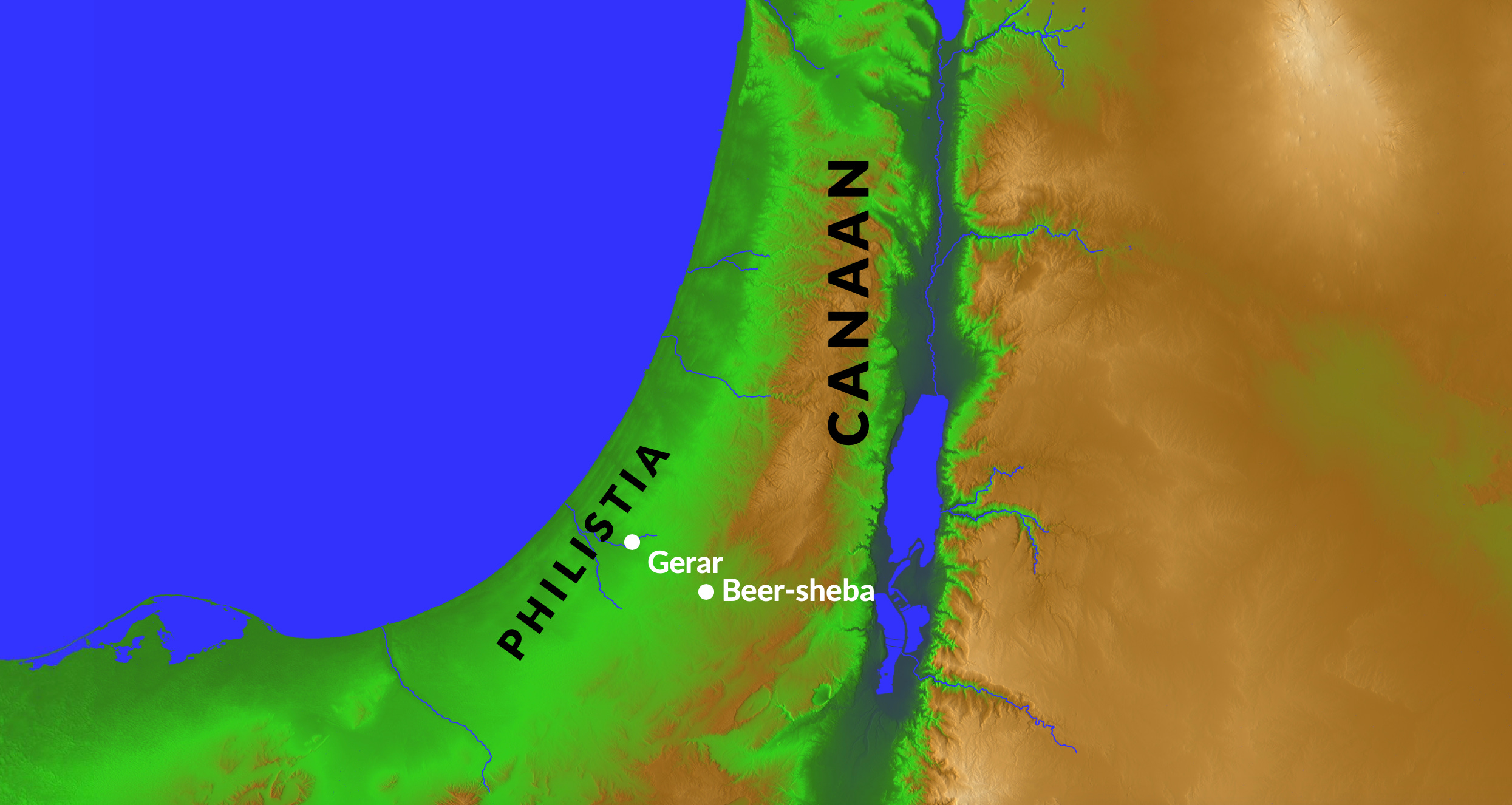
It was about 15 miles / 25 km from Gerar to Beersheba.
Gen. 26:24 And Yahweh appeared to him that night and said,
“I am the God of your father Abraham;
Do not fear, for I am with you.
I will bless you and multiply your seed,
For the sake of My servant Abraham.”
Look at the phrase “for the sake of My servant Abraham”. Abraham’s actions caused Yahweh to reward Abraham’s son. As we make choices in our lives, we should consider that making good choices may benefit our children and grandchildren as well as us.
Gen. 26:25 So he built an altar there and called upon the name of Yahweh and pitched his tent there; and there Isaac’s servants dug out a well.
Gen. 26:26 ¶ Now Abimelech came to him from Gerar with his adviser Ahuzzath and Phicol the commander of his army.
Gen. 26:27 And Isaac said to them, “Why have you come to me, since you hate me and have sent me away from you?”
Gen. 26:28 Then they said, “We see plainly that Yahweh has been with you; so we said, ‘Let there now be an oath between us—between you and us—and let us cut a covenant with you,
Gen. 26:29 that you will do us no harm, just as we have not touched you and have done to you nothing but good and have sent you away in peace. You are now the blessed of Yahweh.’”
Gen. 26:30 Then he made them a feast, and they ate and drank.
Gen. 26:31 In the morning they arose early, and each swore to the other; then Isaac sent them away, and they departed from him in peace.
The word “swear” is a translation of the Hebrew word “sheba”.
Gen. 26:32 Now it happened on that day, that Isaac’s servants came in and told him about the well which they had dug and said to him, “We have found water.”
Gen. 26:33 So he called it Shibah; therefore the name of the city is Beersheba to this day.
The Hebrew word “beer” means well. The Hebrew word “sheba” means swear or oath. Isaac swore an oath with Abimelech, so the well that was dug in that area was called the well of the oath.
Gen. 26:34 ¶ And Esau was forty years old, and he took as a wife Judith the daughter of Beeri the Hittite, and also Basemath the daughter of Elon the Hittite;
Gen. 26:35 and they brought bitterness to Isaac and Rebekah.
Notice the word “bitterness”. Esau’s wives were not good additions to the family.
When one person or organization is far more successful than others, those who are less successful often become jealous. Sports teams that win over and over again are hated and accused of cheating. Poor people often resent rich people without cause.
The Philistines envied Isaac’s success, but Yahweh gave Isaac his prosperity, so they were actually resenting Yahweh’s actions.
What is an occasion when you have been hated for your success?
In what ways was the hate a compliment?
Who do you envy because they have more than you?
How does your envy help you?
How does your envy hurt you?
Thanks for visiting Bible Mountain. If you have already joined my email list, thank you and please tell others about Bible Mountain. If you have not joined my email list yet, please do so now. In order to join, go to Bible Mountain dotcom, click on subscribe, and that will take you to a page where you can sign up. Your email address will not be sold nor given away. Once again, thanks for visiting Bible Mountain.
“Scripture quotations taken from the (LSB®) Legacy Standard Bible®, Copyright © 2021 by The Lockman Foundation. Used by permission. All rights reserved. Managed in partnership with Three Sixteen Publishing Inc. LSBible.org and 316publishing.com.”