
Most Christians grasp the concept that we should pray. The Bible tells us to pray about everything. Thus, we ask God for many things that deep down we believe we would get even without praying for them, such as food, clothing, shelter, and safe journeys.
I am not sure how many Christians actually grasp the concept that praying can sway God from one course of action to another. In other words, I am not sure how many believers have such a deep conviction that prayer works that they ask for things they know they won’t get without divine intervention. There is a sentence in the 25th chapter of Genesis that teaches us very clearly that God is willing to change history in response to a human request.
After the death of Sarah, Abraham sent a servant to find a wife for Isaac. The servant was successful, and Rebekah became Isaac’s wife. Isaac loved Rebekah, and his marriage comforted him after his mother’s death.
Gen. 25:1 ¶ Now Abraham took another wife, whose name was Keturah.
Gen. 25:2 And she bore to him Zimran and Jokshan and Medan and Midian and Ishbak and Shuah.
Take note of the name “Midian”. The descendants of Midian became the Midianites and were a recurring player in Israel’s history. Moses lived in Midian for 40 years before he led the Israelites our of Egypt. The Israelites fought the Midianites at the end of their 40 years in the wilderness and then the Midianites oppressed Israel during the days of the judges.
Gen. 25:3 Now Jokshan was the father of Sheba and Dedan. And the sons of Dedan were Asshurim and Letushim and Leummim.
Gen. 25:4 And the sons of Midian were Ephah and Epher and Hanoch and Abida and Eldaah. All these were the sons of Keturah.
Gen. 25:5 And Abraham gave all that he had to Isaac;
Gen. 25:6 but to the sons of the concubines which Abraham had, Abraham gave gifts while he was still living, and he sent them away from his son Isaac eastward, to the land of the east.
The land of Canaan had been promised to Abraham’s descendants, but that promise was going to be fulfilled through Isaac, so Abraham sent the rest of his descendants out of Canaan to the east.
Gen. 25:7 ¶ These are the days of the years of Abraham’s life that he lived, 175 years.
Gen. 25:8 And Abraham breathed his last and died in a good old age, an old man and full of days; and he was gathered to his people.
Gen. 25:9 Then his sons Isaac and Ishmael buried him in the cave of Machpelah, in the field of Ephron the son of Zohar the Hittite, facing Mamre,
Gen. 25:10 the field which Abraham bought from the sons of Heth; there Abraham was buried with Sarah his wife.
Abraham’s purchase of this field is recorded in Genesis 23.
Gen. 25:11 Now it happened after the death of Abraham, that God blessed his son Isaac; and Isaac lived by Beer-lahai-roi.
Gen. 25:12 ¶ Now these are the generations of Ishmael, Abraham’s son, whom Hagar the Egyptian, Sarah’s servant-woman, bore to Abraham;
Gen. 25:13 and these are the names of the sons of Ishmael, by their names, in the order of their birth: Nebaioth, the firstborn of Ishmael, and Kedar and Adbeel and Mibsam
Gen. 25:14 and Mishma and Dumah and Massa,
Gen. 25:15 Hadad and Tema, Jetur, Naphish, and Kedemah.
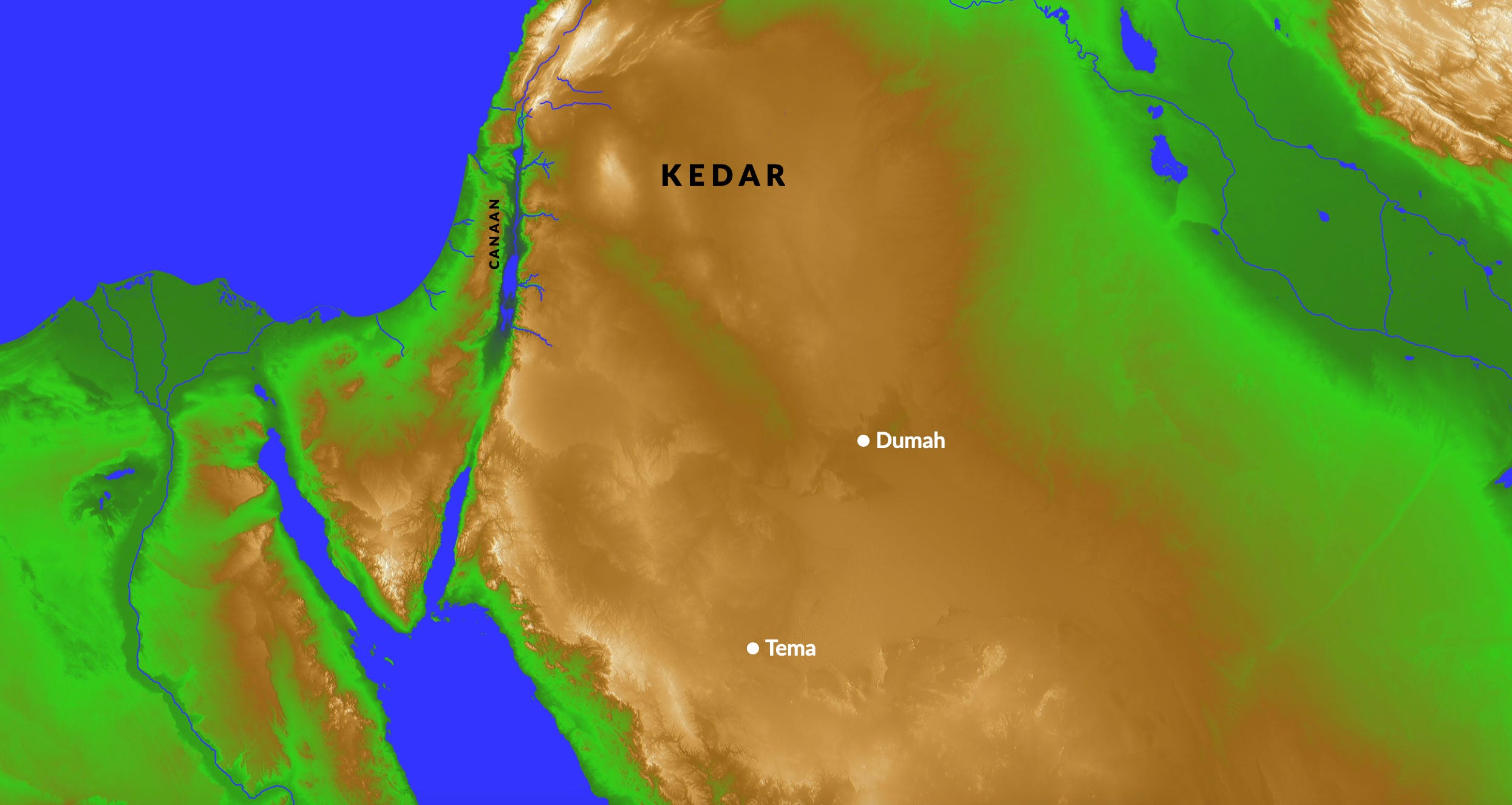
Kedar, Dumah, and Tema were located east of Canaan.
Gen. 25:16 These are the sons of Ishmael and these are their names, by their villages, and by their camps; twelve princes according to their tribes.
Gen. 25:17 These are the years of the life of Ishmael, 137 years; and he breathed his last and died and was gathered to his people.
Gen. 25:18 And they dwelt from Havilah to Shur which is east of Egypt as one goes toward Assyria; he settled in the face of all his brothers.
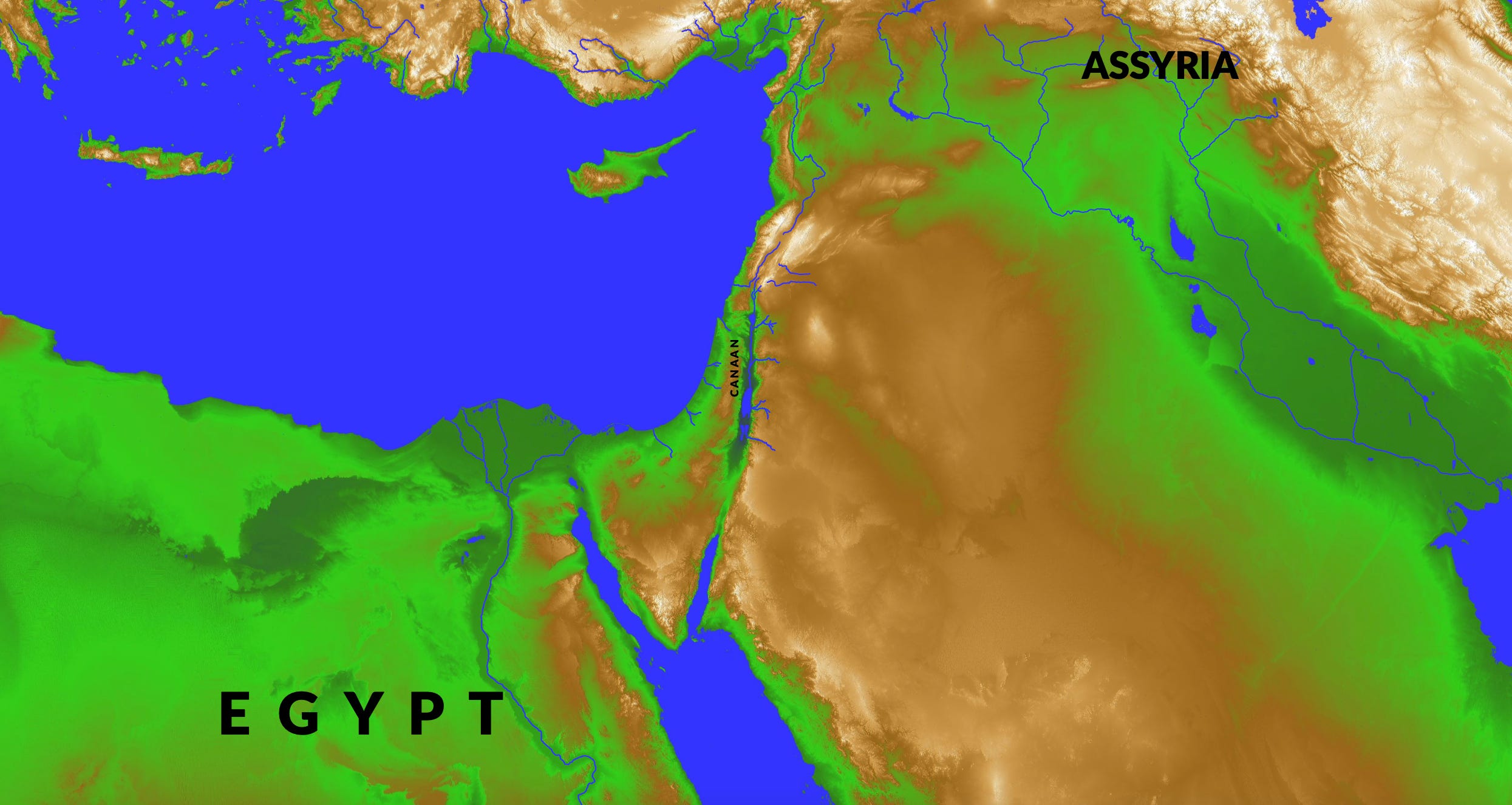
The descendants of Ishmael lived between Egypt and Assyria.
Gen. 25:19 ¶ Now these are the generations of Isaac, Abraham’s son: Abraham became the father of Isaac;
Gen. 25:20 and Isaac was forty years old when he took Rebekah, the daughter of Bethuel the Aramean of Paddan-aram, the sister of Laban the Aramean, to be his wife.
Notice that Isaac was forty years old when he married Rebekah.
Gen. 25:21 And Isaac entreated Yahweh on behalf of his wife because she was barren; and Yahweh was moved by his entreaty. So Rebekah his wife conceived.
Notice the word “barren”. Apparently, there was a long enough period of time after marriage when Rebekah did not conceive that they came to the conclusion that Rebekah could not conceive.
Look at the phrase “Yahweh was moved by his entreaty.” Isaac asked Yahweh to give Rebekah a child, and Yahweh did so. Yahweh acted in response to the request of a man. This tells us prayer works.
Most Christians grasp the concept that we should pray. I am not sure we quite grasp the astounding reality that a human is able to sway God’s actions.
When we pray and ask for our daily needs, or for safe journeys, that is good. The Bible tells us to ask for our daily bread. However, deep down we are pretty confident we would get those things even without praying for them.
However, if we have a request that we doubt we will get without divine intervention, do we really believe that God will listen and change history based on our prayers?
Gen. 25:22 But the children struggled together within her; and she said, “If it is so, why then am I this way?” So she went to inquire of Yahweh.
Gen. 25:23 And Yahweh said to her,
“Two nations are in your womb;
And two peoples will be separated from your body;
And one people shall be stronger than the other;
And the older shall serve the younger.”
Gen. 25:24 And her days to give birth were fulfilled, and behold, there were twins in her womb.
Gen. 25:25 And the first came forth red, all over like a hairy garment; and they named him Esau.
Gen. 25:26 Afterward his brother came forth with his hand holding on to Esau’s heel, so his name was called Jacob; and Isaac was sixty years old when she gave birth to them.
The Hebrew name “Jacob” is a variation of the Hebrew word that is translated heel. In other words, Jacob’s name was “Heel”. They called him “Heel” because he was holding Esau’s heel when he was born.
Isaac was sixty years old when the twins were born. Isaac married Rebekah when he was forty, so there was a twenty year period between marriage and the birth of the twins. That twenty year period of barrenness would have convinced Isaac and Rebekah that the only hope to have children was for Yahweh to give them children.
Most Christians grasp the concept that we should pray. We routinely ask God for things that we believe we would get even without divine intervention. I am not sure we quite grasp the astounding reality that a human is able to sway God’s actions. I am not sure we ask God for the impossible, having a deep belief that God can do the impossible.
In what ways do your prayers consist mostly of asking God for things that deep down you believe you would get even without divine intervention?
What are the impossible things you would like to see God do?
How often do you pray for those things?
Do you truly believe God can do the impossible?
Thanks for visiting Bible Mountain. If you have already joined my email list, thank you and please tell others about Bible Mountain. If you have not joined my email list yet, please do so now. In order to join, go to Bible Mountain dotcom, click on subscribe, and that will take you to a page where you can sign up. Your email address will not be sold nor given away. Once again, thanks for visiting Bible Mountain.
“Scripture quotations taken from the (LSB®) Legacy Standard Bible®, Copyright © 2021 by The Lockman Foundation. Used by permission. All rights reserved. Managed in partnership with Three Sixteen Publishing Inc. LSBible.org and 316publishing.com.”