
Christians often come to a point in life where we have to make a big life decision. Sometimes the correct choice is not obvious. In those situations, it is tempting to ask God to give us a tangible sign so that we know what He wants us to do. We often call that “laying out a fleece”.
Unfortunately, some Christians design their fleece in such a way that they don’t really know that God intervened and actually gave them an answer. Plus, sometimes their fleece is designed in such a way that they essentially “force” God to give them an answer immediately.
The 24th chapter of Genesis tells us that one of Abraham’s servants asked God to give him a sign as a way of giving some guidance. The design of his sign did not have those flaws and helps illustrate how we should design a fleece, if we decide to try “laying out a fleece”.
Gen. 24:1 ¶ Now Abraham was old, advanced in age; and Yahweh had blessed Abraham in every way.
Gen. 24:2 And Abraham said to his servant, the oldest of his household, who ruled over all that he owned, “Please place your hand under my thigh,
The request to “place your hand under my thigh” makes no sense to us in the 21st century. Apparently, this practice had significance in the ancient near east.
Gen. 24:3 and I will make you swear by Yahweh, the God of heaven and the God of earth, that you shall not take a wife for my son from the daughters of the Canaanites, among whom I live,
Look at the word “swear”. Today, we make agreements binding by putting them in writing, signing them, and getting them notarized. In Abraham’s day, they made agreements binding by swearing an oath.
Gen. 24:4 but you will go to my land and to my kin, and take a wife for my son Isaac.”
Gen. 24:5 And the servant said to him, “Suppose the woman is not willing to follow me to this land; should I indeed take your son back to the land from where you came?”
Gen. 24:6 Then Abraham said to him, “Beware lest you take my son back there!
Gen. 24:7 Yahweh, the God of heaven, who took me from my father’s house and from the land of my kin, and who spoke to me and who swore to me, saying, ‘To your seed I will give this land,’ He will send His angel before you, and you will take a wife for my son from there.
Notice the word “swore”. Yahweh not only promised the land to Abraham’s seed, He swore that He would give the land to Abraham’s seed. Again, swearing an oath was how people in Bible times made binding commitments.
Gen. 24:8 But if the woman is not willing to follow you, then you will be free from this oath of mine; only do not take my son back there.”
Gen. 24:9 So the servant placed his hand under the thigh of Abraham his master and swore to him concerning this matter.
Gen. 24:10 ¶ Then the servant took ten camels from the camels of his master, and he went with all kinds of good things of his master’s in his hand. So he arose and went to Mesopotamia, to the city of Nahor.
Don’t miss the number of camels. Ten camels can carry a lot of stuff. The fact that Abraham could spare ten camels, the men needed to lead ten camels, and could send enough goods that ten camels were needed, indicates the wealth of Abraham.
Mesopotamia was in the valley formed by the Tigris and Euphrates Rivers.
Nahor was Abraham’s brother. The city of Nahor referred to the city in which Nahor lived, which refers to Haran. We know that because Gen. 27:43 tells us Rebekah was from Haran.
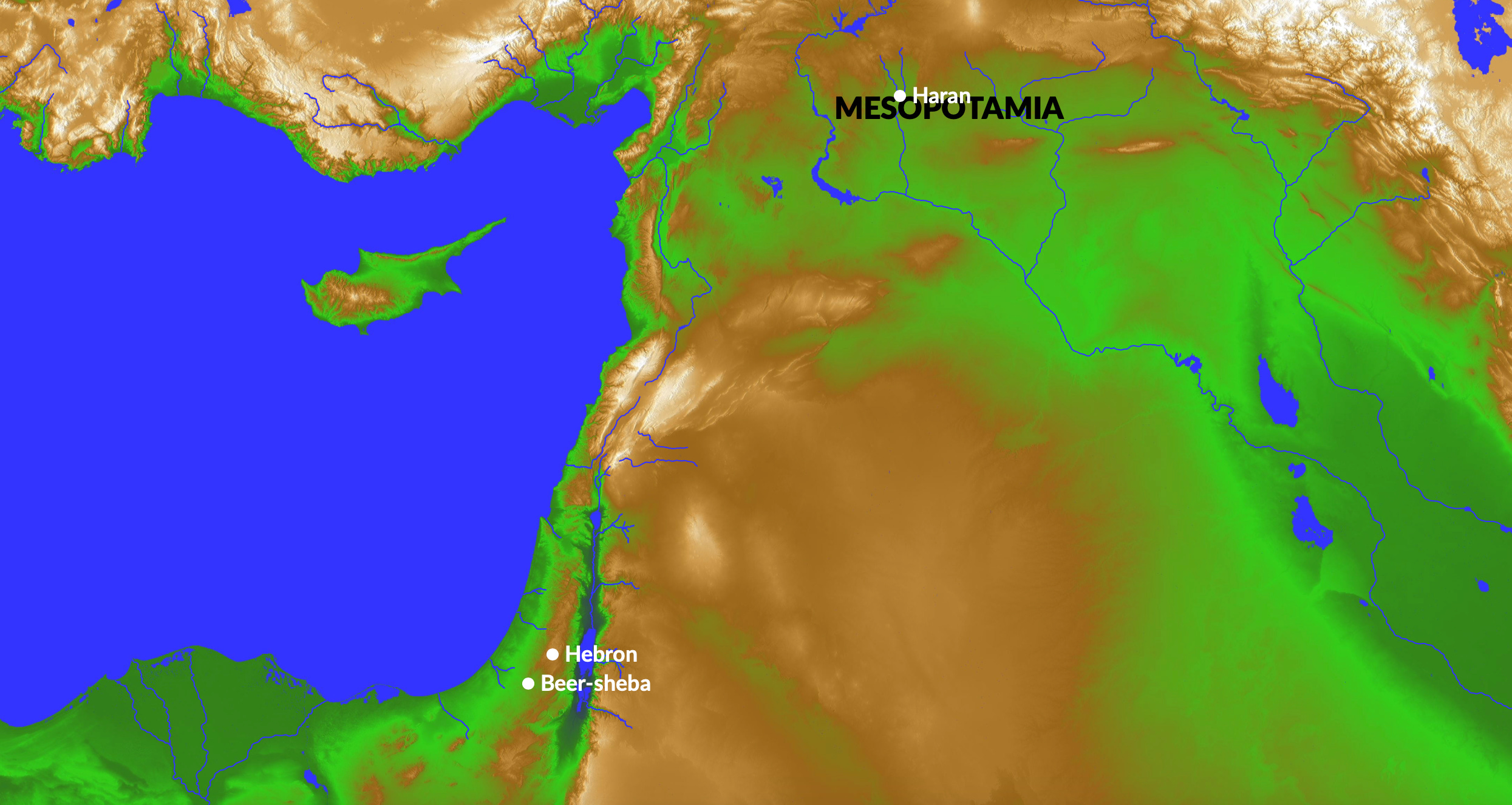
It was at least 400 miles / 650 km from Canaan to Haran. That would be at least a two week journey.
Gen. 24:11 And he made the camels kneel down outside the city by the well of water at evening time, the time when the women go out to draw water.
Gen. 24:12 And he said, “O Yahweh, the God of my master Abraham, please cause this to happen before me today, and show lovingkindness to my master Abraham.
Gen. 24:13 Behold, I am standing by the spring of water, and the daughters of the men of the city are coming out to draw water;
Gen. 24:14 now may it be that the young woman to whom I say, ‘Please let down your jar so that I may drink,’ and she says, ‘Drink, and I will give water to your camels to drink also’—may she be the one whom You have decided for Your servant Isaac; and by this I will know that You have shown lovingkindness to my master.”
Abraham’s servant asked Yahweh to give him a physical sign to indicate who was the lady to marry Isaac. The servant essentially “laid out a fleece”.
Notice that the servant was not going to ask her to water his camels. He asked Yahweh to motivate a lady to offer that on her own. Also, the servant did not “force” Yahweh to give him an answer. If many young ladies had come by and none of them offered to water his camels, then he would know that Yahweh was not giving him direction.
Christians often come to a point in life where we have to make a big life decision. Sometimes the correct choice is not obvious. It is tempting to ask God to give us a tangible sign so that we know what He wants us to do.
The Bible does not directly encourage nor prohibit Christians from asking God for a sign. However, if we are going to ask God for a sign, we should make sure our request has integrity.
Here is what I mean by that. If we flip a coin and say “Heads means God wants me to do x, and tails means God wants me to do y”, then we don’t know for sure that God intervened in the coin flip and gave us direction. If we flip a coin, it will come up heads or tails regardless of whether God intervenes or not. If we use a test like that, we are essentially telling God He has to give us an answer right now.
In the case of Abraham’s servant, he asked God to indicate His choice by causing the young lady to offer to water his camels. If no lady offered to do that, then the servant would know God had not given him any direction.
If we are going to ask God for a sign, our sign needs to be designed in such a way that God has the option of not giving us an answer. If we flip a coin ten times and say “Ten heads in a row means God wants me to do x, and ten tails in a row means God wants me to do y”, then our sign has integrity because God has the option of not giving us an answer. If we get ten heads or ten tails in a row, we can be fairly certain that God chose to intervene in the coin flip and give us some direction. If we don’t get either of those options, then we know that God is not willing to give us an answer.
Gen. 24:15 ¶ And before he had finished speaking, behold, Rebekah who was born to Bethuel the son of Milcah, the wife of Abraham’s brother Nahor, was coming out with her jar on her shoulder.
Gen. 24:16 Now the young woman was very beautiful in appearance, a virgin, and no man had known her; and she went down to the spring and filled her jar and came up.
Gen. 24:17 Then the servant ran to meet her and said, “Please give me a little water to drink from your jar.”
Gen. 24:18 And she said, “Drink, my lord”; and she quickly lowered her jar to her hand and gave him a drink.
Gen. 24:19 Now when she had finished giving him a drink, she said, “I will draw also for your camels until they have finished drinking.”
Rebekah volunteered to water his camels. Thus, the servant knew Yahweh was indicating Rebekah was the lady to be the wife of Isaac.
Gen. 24:20 So she hurried and emptied her jar into the watering channel and ran again to the well to draw, and she drew for all his camels.
Gen. 24:21 Meanwhile, the man was gazing at her in silence, to know whether Yahweh had made his journey successful or not.
Christians often come to a point in life where we have to make a big life decision. Sometimes the correct choice is not obvious. In those situations, it is tempting to ask God to give us a tangible sign so that we know what He wants us to do. We often call that “laying out a fleece”.
The Bible does not directly encourage nor prohibit Christians from asking God for a sign. However, if we are going to ask God for a sign, we should make sure our request has integrity. Our “fleece” should be designed in such a way that God has the option of not answering. Plus, it should be designed in such a way that we know God intervened and actually gave us an answer.
Have you ever “laid out a fleece” asking God for direction?
If so, did you design your fleece in such a way that God had the option of not answering?
Was your fleece designed in such a way that if God chose to give you some direction, it was obvious that God had chosen to give you an answer?
Thanks for visiting Bible Mountain. If you have already joined my email list, thank you and please tell others about Bible Mountain. If you have not joined my email list yet, please do so now. In order to join, go to Bible Mountain dotcom, click on subscribe, and that will take you to a page where you can sign up. Your email address will not be sold nor given away. Once again, thanks for visiting Bible Mountain.
“Scripture quotations taken from the (LSB®) Legacy Standard Bible®, Copyright © 2021 by The Lockman Foundation. Used by permission. All rights reserved. Managed in partnership with Three Sixteen Publishing Inc. LSBible.org and 316publishing.com.”