
Traditionally, people have believed that God will bless those who bless the Jews and curse those who curse the Jews. If that is true, it has ramifications for all people and all governments throughout all history.
There are some who dispute that belief. They say that promise only applies to Abram. Today, we will read that promise and examine if it only applies to Abram or if it applies to all Jews.
Genesis 11 tells us about the tower of Babel which man began building so that they would not be scattered over the face of the earth. God was not happy about the tower because He wanted humans to go conquer the earth. Therefore, Yahweh confused the languages, so that people could not understand each other, and they ceased building the tower.
Then the author of Genesis began listing the descendants of Shem. Shem fathered Arpachshad, who fathered Shelah, who fathered Eber, who fathered Peleg, who fathered Reu, who fathered Serug.
Gen. 11:22 ¶ And Serug lived 30 years and became the father of Nahor;
Gen. 11:23 and Serug lived 200 years after he became the father of Nahor, and he became the father of other sons and daughters.
Gen. 11:24 ¶ Nahor lived 29 years and became the father of Terah;
Gen. 11:25 and Nahor lived 119 years after he became the father of Terah, and he became the father of other sons and daughters.
Gen. 11:26 ¶ And Terah lived 70 years and became the father of Abram, Nahor, and Haran.
Note the name Abram. The rest of the book of Genesis focuses on Abram and his descendants. Abram was a descendant of Shem, one of the sons of Noah. After the languages were confused at Babel, the descendants of Shem traveled east and became the Asians; thus, Abram was an Asian.
Gen. 11:27 ¶ Now these are the generations of Terah. Terah became the father of Abram, Nahor, and Haran; and Haran became the father of Lot.
Gen. 11:28 And Haran died in the presence of Terah his father in the land of his birth, in Ur of the Chaldeans.
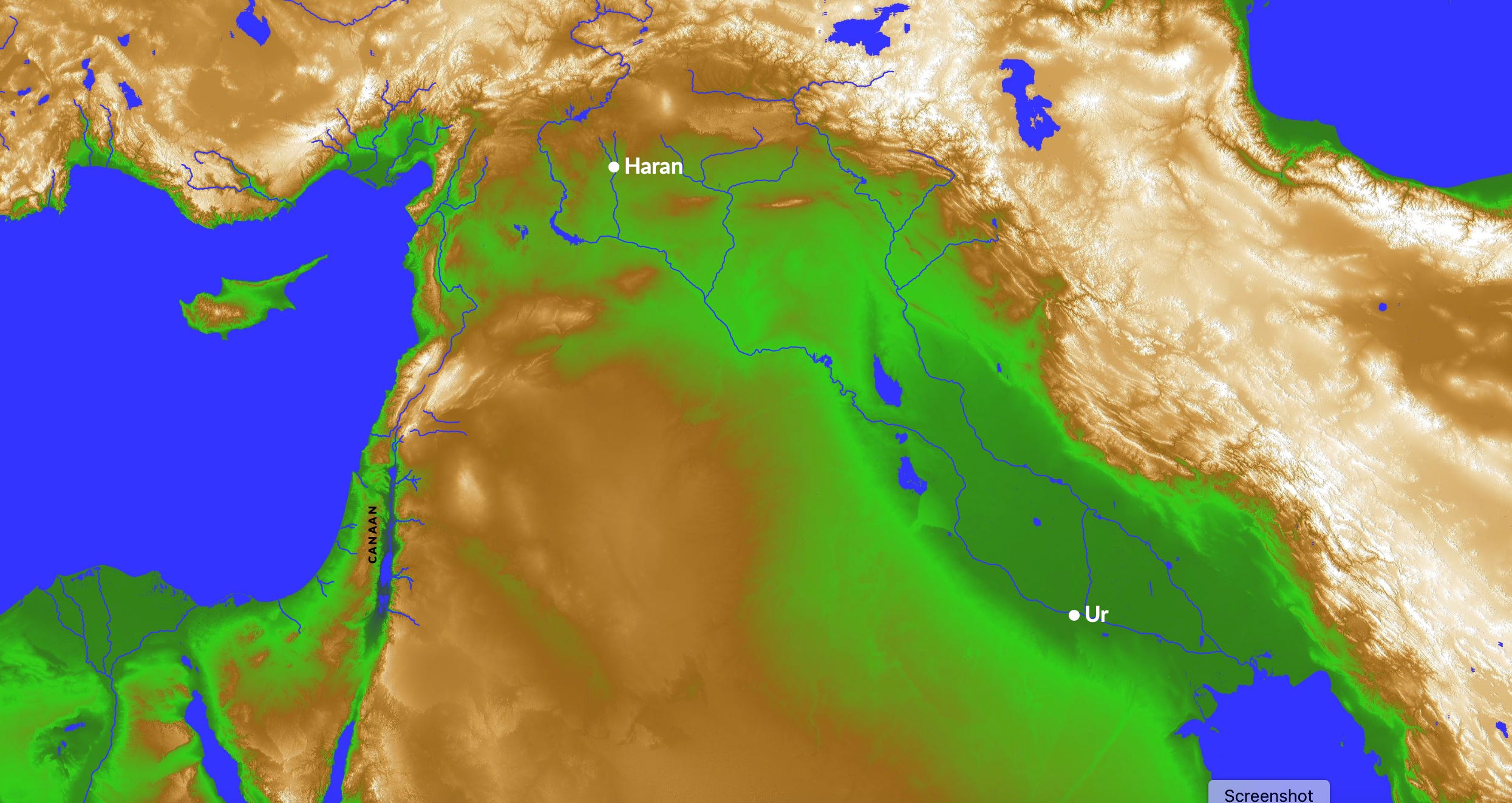
Abram was born in Ur. Ur was located in the lower end of the Mesopotamian Valley.
Gen. 11:29 Abram and Nahor took wives for themselves. The name of Abram’s wife was Sarai; and the name of Nahor’s wife was Milcah, the daughter of Haran, the father of Milcah and the father of Iscah.
Nahor married a daughter of Haran, meaning he married his niece. That is very inappropriate in our culture, partly because of the risk of genetic defects. In their culture it was probably somewhat normal, and the risk of genetic problems was probably less than it is today.
Gen. 11:30 And Sarai was barren; she had no child.
Take note that Sarai was barren. Sarai’s barrenness was a significant factor in the story of Abram’s life.
Gen. 11:31 ¶ And Terah took Abram his son, and Lot the son of Haran, his grandson, and Sarai his daughter-in-law, his son Abram’s wife; and they went out together from Ur of the Chaldeans in order to go to the land of Canaan; and they came as far as Haran and settled there.
Notice the intent was to go to Canaan, but they only went as far as Haran.
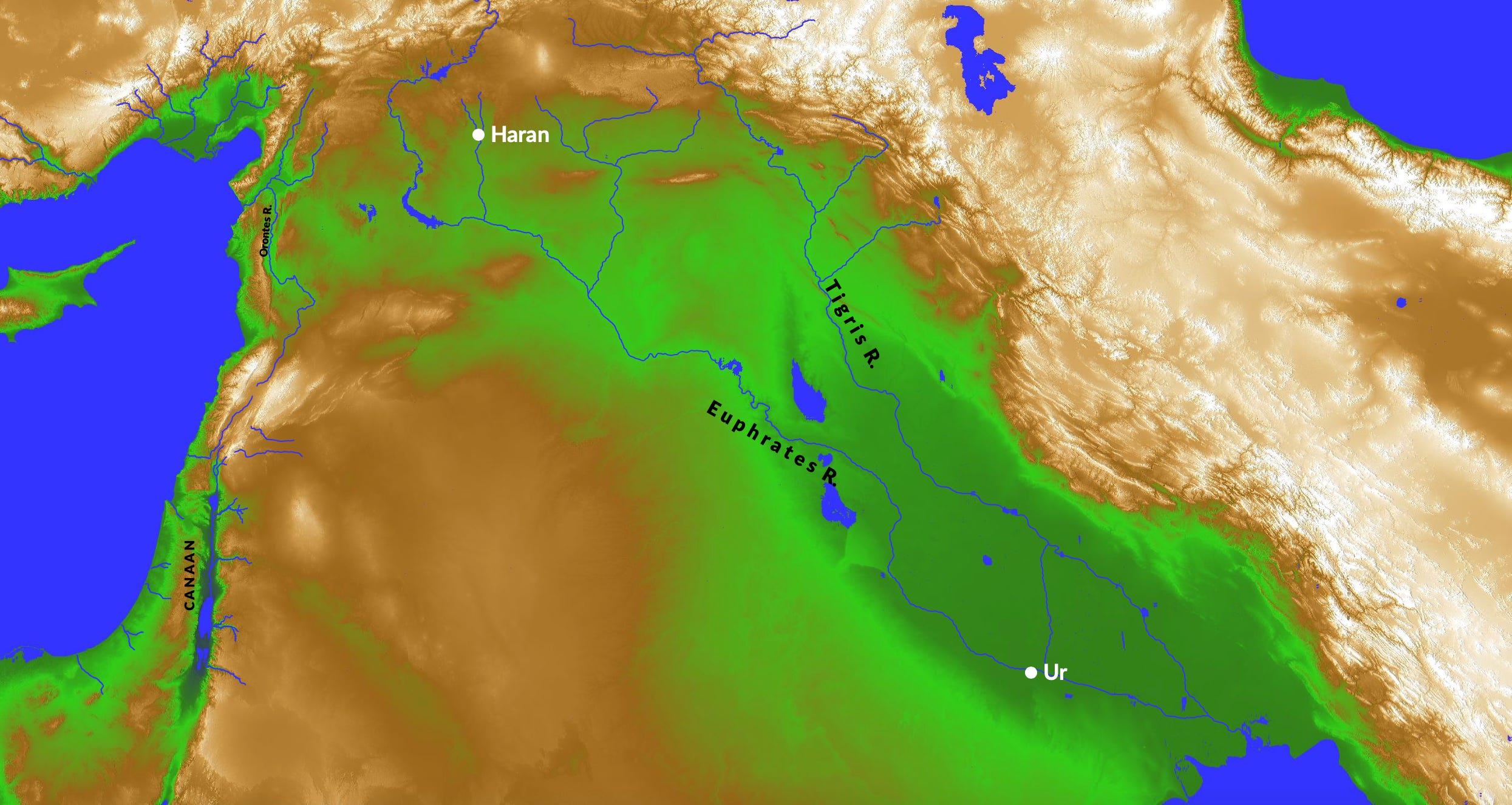
Canaan was directly west of Ur, so the shortest path would have been to go directly west. However, humans need water, and there is desert between Ur and Canaan, so the direct path would have been difficult to use. Therefore, in those days, when people traveled from the Ur to Canaan, they traveled up the Mesopotamian Valley, following the Euphrates River, then they traveled south along the Orontes River into Canaan. It was a longer walk, but they had water all along their path.
For some reason, Terah and his family settled in Haran rather than continue their journey down to Canaan.
It was about 550 miles / 900 km from Ur to Haran. Humans can walk about 30 miles per day, so the trek from Ur to Haran would have taken at least 18 days.
Gen. 11:32 And the days of Terah were 205 years; and Terah died in Haran.
Gen. 12:1 ¶ And Yahweh said to Abram,
“Go forth from your land,
And from your kin
And from your father’s house,
To the land which I will show you;
Verse 1 is a command from Yahweh to Abram to leave his relatives and go to a new land.
Gen. 12:2 And I will make you a great nation,
And I will bless you,
And make your name great;
And so you shall be a blessing;
Verse 2 is a promise from Yahweh to Abram. Sarai was childless, and yet Yahweh promised to turn Abram into a great nation.
The phrase “make your name great” meant Abram would be famous. That certainly came true. Abram is one of the most famous people in world history. Many people who become famous are forgotten after they die. However, 4,000 years after Abram’s lifetime, he is still well-known. He is revered by Jews, Moslems, and Christians.
Notice that Yahweh promised to bless Abram, and that Abram in turn would bless others.
Gen. 12:3 And I will bless those who bless you,
And the one who curses you I will curse.
And in you all the families of the earth will be blessed.”
Take note of the protection given to Abram. Yahweh would treat others according to how they treated Abram.
Traditionally, because of this verse, people have believed that God will bless those who bless the Jews and curse those who curse the Jews. If that is true, it has ramifications for all people and all governments throughout all history.
There are some who dispute that belief. They say this promise only applies to Abram. The pronoun “you” appears three times in this verse. In the original Hebrew, the pronoun “you” is in the singular form. This would indicate the promise only applies to Abram.
On the other hand, verse 2 contains a promise to make Abram into a great nation. You can argue the promise in verse 3 regarding blessing and cursing applies to the great nation that Abram would become. That would be an argument that the promise in verse 3 does apply to the Jews.
Furthermore, this is not the only time this promise was given. This promise was given to Jacob/Israel (see Genesis 27:29). Several centuries later, a prophet of Yahweh named Balaam blessed the nation of Israel saying “Blessed is everyone who blesses you, And cursed is everyone who curses you” (see Numbers 24:9). Since modern day Jews are descendants of the nation of Israel that received that blessing, then individuals, companies, organizations, and nations should keep this promise in mind when deciding how to treat the Jews.
Gen. 12:4 ¶ So Abram went forth as Yahweh had spoken to him; and Lot went with him. Now Abram was seventy-five years old when he departed from Haran.
Gen. 12:5 So Abram took Sarai his wife and Lot his brother’s son, and all their possessions which they had accumulated, and the persons which they had acquired in Haran, and they departed to go forth to the land of Canaan; thus they came to the land of Canaan.
Look at the words “all their possessions” and “persons which they had acquired”. We often picture this journey as three people walking along with a few animals. However, the text makes it clear this was a huge procession.
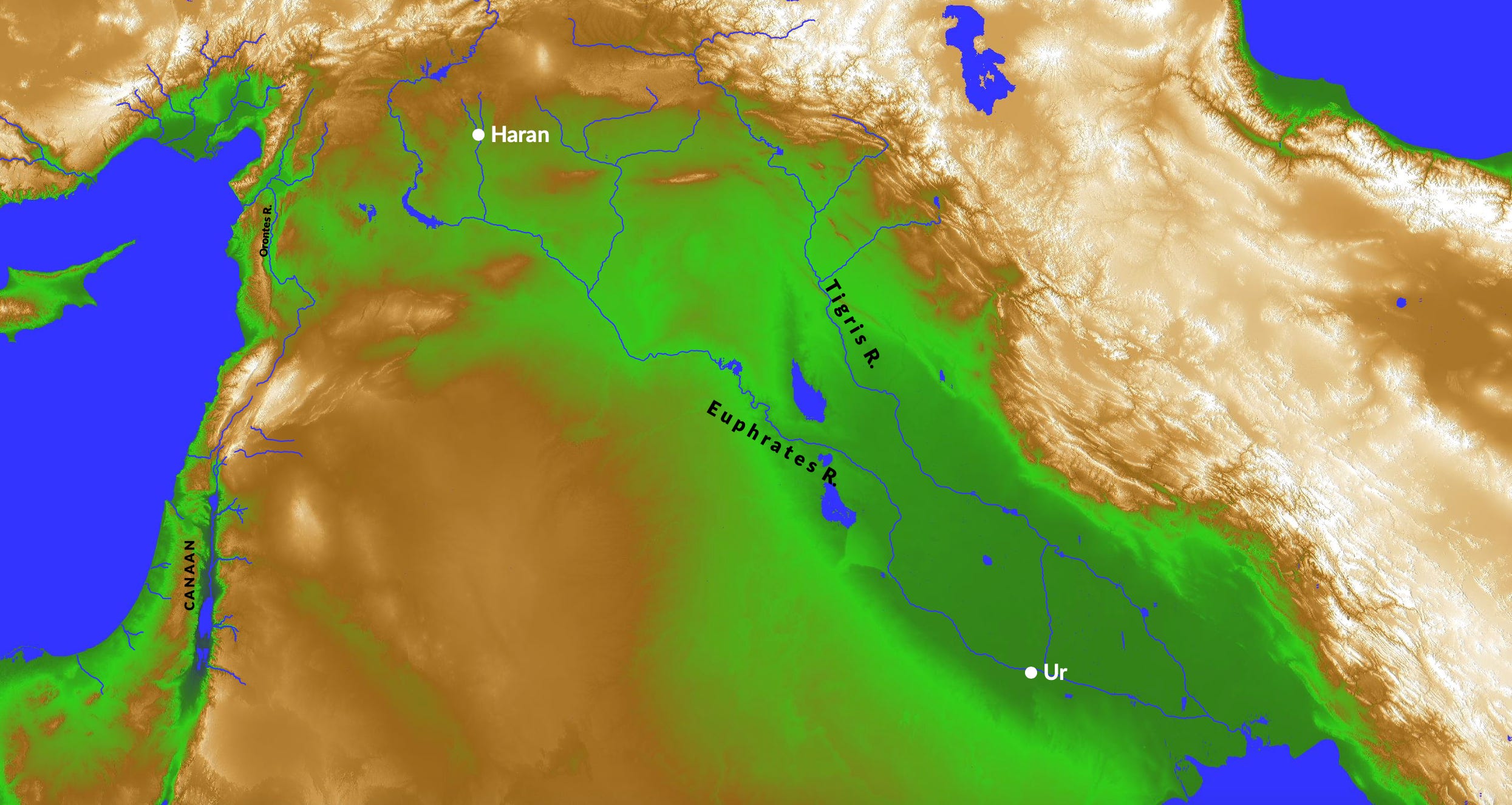
It was about 400 miles / 650 km from Haran to Canaan. That journey would have taken at least 13 days.
Gen. 12:6 And Abram passed through the land as far as the site of Shechem, to the oak of Moreh. Now the Canaanite was then in the land.
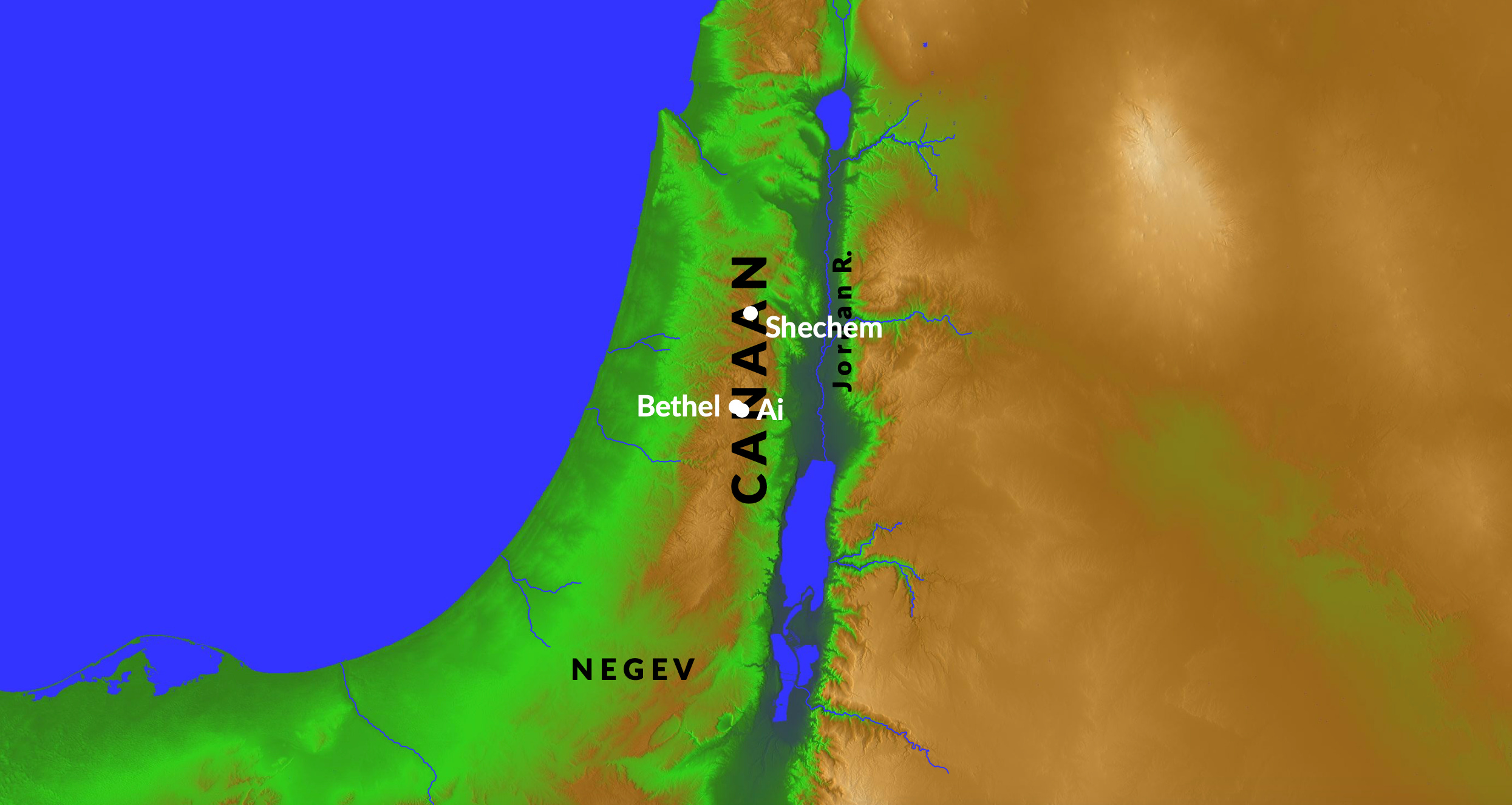
The colors on the map indicate elevation. The highest elevations are white. The next lower elevations are brown, then light green, then dark green. The dark green areas in the Jordan River valley are below sea level.
Shechem is in a brown area, which means Abram traveled up into the mountain range which sat between the Mediterranean Sea and the Jordan River Valley.
Gen. 12:7 Then Yahweh appeared to Abram and said, “To your seed I will give this land.” So he built an altar there to Yahweh who had appeared to him.
Take note of the promise “To your seed I will give this land”. This promise is repeated many times in the book of Genesis and is a theme throughout the Bible.
Gen. 12:8 Then he proceeded from there to the mountain on the east of Bethel, and he pitched his tent with Bethel on the west and Ai on the east; and there he built an altar to Yahweh and called upon the name of Yahweh.
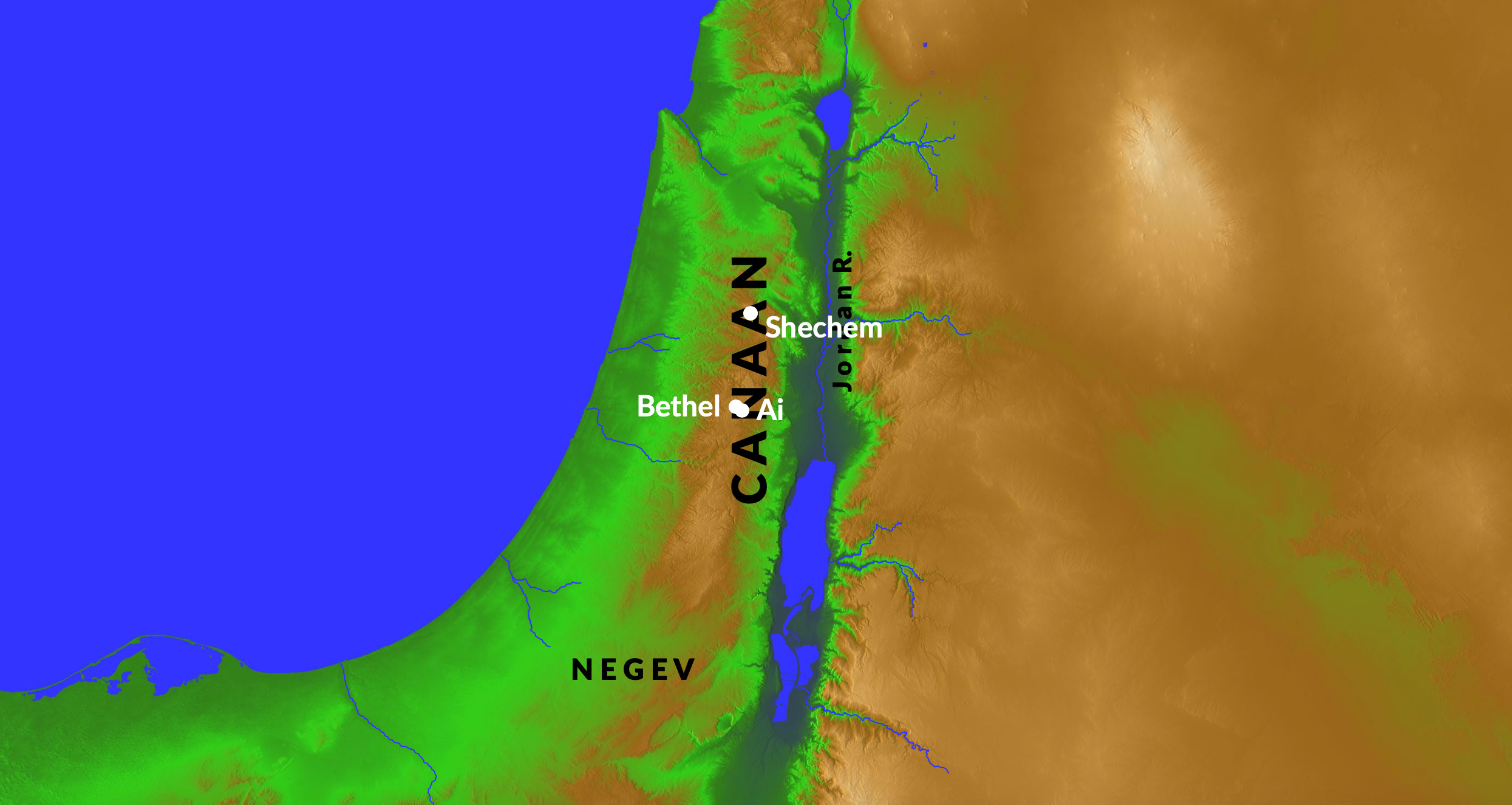
It is about 20 miles / 30 km from Shechem to Bethel. That would be about a one day walk. Bethel and Ai are also in the mountain range that runs between the Mediterranean Sea and the Jordan River Valley.
Gen. 12:9 And Abram journeyed on, continuing toward the Negev.
Traditionally, people have believed that God will bless those who bless the Jews and curse those who curse the Jews. If that is true, it has ramifications for all people and all governments throughout all history.
There are some who dispute that belief. They say this promise only applies to Abram. The pronoun “you” appears three times in this verse. In the original Hebrew, the pronoun “you” is in the singular form. This would indicate the promise only applies to Abram.
On the other hand, verse 2 contains a promise to make Abram into a great nation. You can argue the promise in verse 3 regarding blessing and cursing applies to the great nation that Abram would become. That would be an argument that the promise in verse 3 does apply to the Jews.
Furthermore, this is not the only time this promise was given. Several centuries later, a prophet of Yahweh named Balaam blessed the nation of Israel saying “Blessed is everyone who blesses you, And cursed is everyone who curses you” (see Numbers 24:9). Since modern day Jews are descendants of the nation of Israel that received that blessing, then this promise applies to all Jews.
How should people treat Jews in light of God’s promise to Abram?
How should countries treat the nation of Israel in light of this promise?
Thanks for visiting Bible Mountain. If you have already joined my email list, thank you and please tell others about Bible Mountain. If you have not joined my email list yet, please do so now. In order to join, go to Bible Mountain dotcom, click on subscribe, and that will take you to a page where you can sign up. Your email address will not be sold nor given away. Once again, thanks for visiting Bible Mountain.
“Scripture quotations taken from the (LSB®) Legacy Standard Bible®, Copyright © 2021 by The Lockman Foundation. Used by permission. All rights reserved. Managed in partnership with Three Sixteen Publishing Inc. LSBible.org and 316publishing.com.”