
Most Christians acknowledge that the Bible talks often about fearing God. Unfortunately, many Christians reject the notion that the Bible means fear when it says fear. Instead, they think the fear of God means to respect God or admire Him.
The reality is, when the Bible says fear God, it means fear. We should be afraid to disobey God. We should understand that acting against God is worse than acting against any human. The opening chapter of Exodus illustrates the fear of God and why we should fear God.
Ex. 1:1 ¶ Now these are the names of the sons of Israel who came to Egypt with Jacob; they came each one with his household:
Ex. 1:2 Reuben, Simeon, Levi, and Judah;
Ex. 1:3 Issachar, Zebulun, and Benjamin;
Ex. 1:4 Dan and Naphtali, Gad and Asher.
Ex. 1:5 And all the persons who came from the loins of Jacob were seventy in number, but Joseph was already in Egypt.
Ex. 1:6 Then Joseph died, and all his brothers and all that generation.
Ex. 1:7 But the sons of Israel were fruitful and increased and multiplied and became exceedingly mighty, so that the land was filled with them.
Ex. 1:8 ¶ And a new king arose over Egypt, who did not know Joseph.
Look at the word “new”. This does not necessarily mean one king died, and then his son came to power and did not know Joseph. There were multiple times in Egyptian history when a king was overthrown and another man seized power. That may be what happened in this case. This means the new king may not have been a descendant of the Pharaoh who placed Joseph in power.
Ex. 1:9 And he said to his people, “Behold, the people of the sons of Israel are more and mightier than we.
Notice the words “his people”. There were occasions in Egyptian history when foreigners took power in Egypt. It may be this new king was not even an Egyptian.
Take note of the words “more and mightier”. If the new king and his people group were not Egyptians, that would explain why his people group was outnumbered by the Israelites.
Ex. 1:10 Come, let us deal wisely with them, lest they multiply and it be in the event of war, that they also join themselves to those who hate us and fight against us and go up from the land.”
Don’t miss the new king’s fear. He understood that allowing another people group with different loyalties to flourish in his kingdom created the risk that the other people group would act against him and overpower his own people.
In recent decades, many societies in the western hemisphere have allowed millions of immigrants, both legal and illegal, to enter their countries. Most of those immigrants are not loyal to their new homeland. Many of the political leaders who are allowing this immigration do not seem to be concerned about the risk that the newcomers will act against the interest of the native population. The leaders who are allowing the immigration seem to be oblivious to the possibility that they may be the ones who will be overthrown.
Modern Christianity faces a similar threat that many church leaders choose to ignore. 1Cor 5:13 tells the church to “REMOVE THE WICKED MAN FROM AMONG YOURSELVES” because a little leaven leavens the whole lump. In other words, allowing wicked people to be in the church creates a risk that the wicked people will become the majority and corrupt the church.
Ex. 1:11 So they appointed taskmasters over them to afflict them with hard labors. And they built for Pharaoh storage cities, Pithom and Raamses.
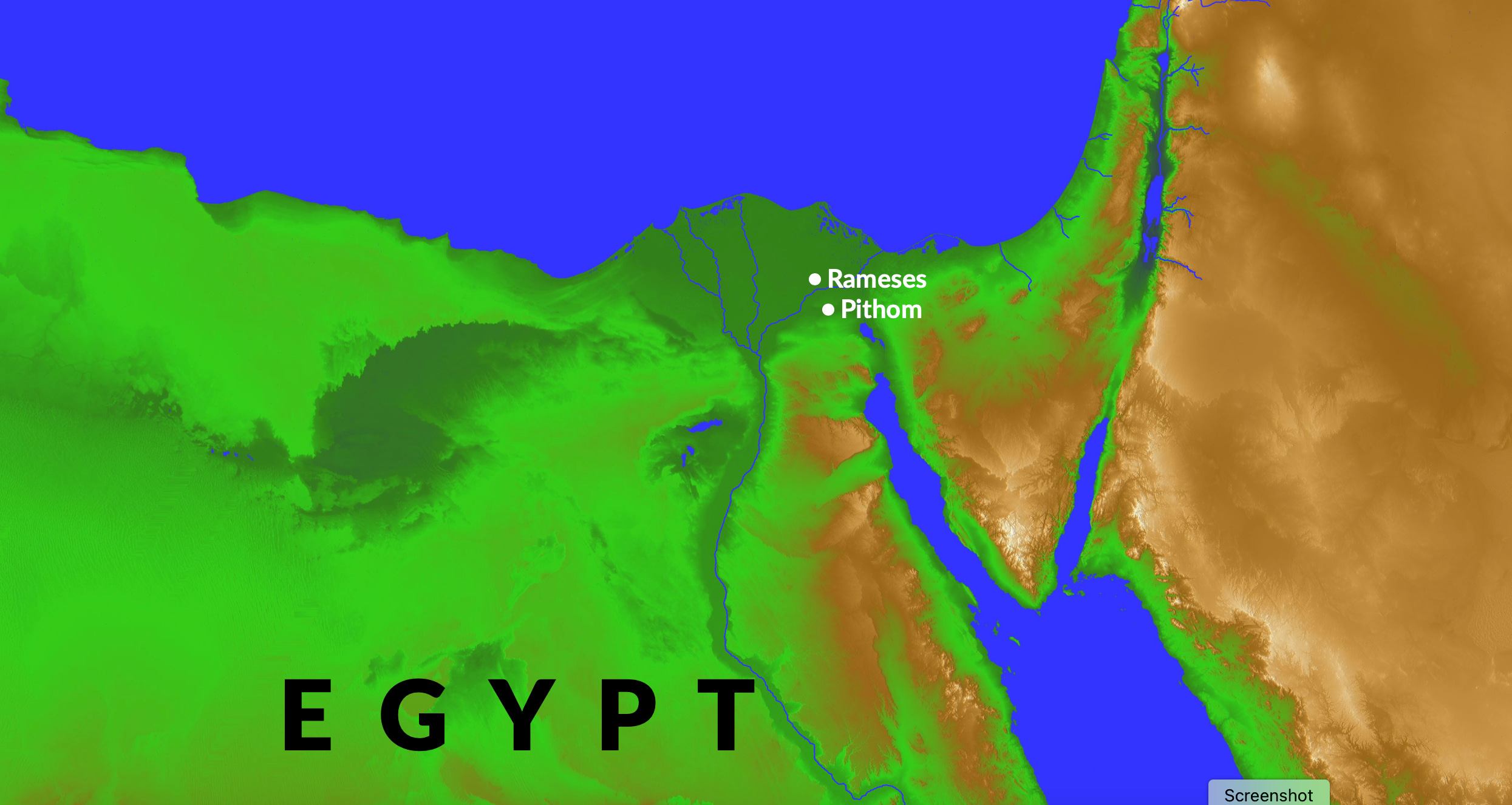
Ex. 1:12 But the more they afflicted them, the more they multiplied and the more they spread out, so that they were in dread of the sons of Israel.
It is ironic that the Israelites multiplied in the face of persecution. Sometimes that happens with Christianity. The church often multiplies faster under duress than it does under peace.
Ex. 1:13 So the Egyptians brutally compelled the sons of Israel to slave labor;
Ex. 1:14 and they made their lives bitter with hard slave labor in mortar and bricks and in all kinds of slave labor in the field, all their slave labor which they brutally compelled them to do.
Ex. 1:15 ¶ Then the king of Egypt spoke to the Hebrew midwives, one of whom was named Shiphrah and the other was named Puah;
Ex. 1:16 and he said, “When you are helping the Hebrew women to give birth and see them upon the birthstool, if it is a son, then you shall put him to death; but if it is a daughter, then she shall live.”
Ex. 1:17 But the midwives feared God and did not do as the king of Egypt had spoken to them, but let the boys live.
Notice the phrase “feared God”. The midwives feared God more than they feared the king of Egypt; therefore, they did not do as the king commanded them. The king of Egypt could have punished the midwives for disobedience, and the punishment could have been very painful, but the midwives understood that the consequences of disobeying God were greater than anything the king of Egypt could have done to them.
This is true for all humans of all ages and locations. Acting against God is worse than acting against the most powerful person in the world. Many Christians do not grasp this concept.
Ex. 1:18 So the king of Egypt called for the midwives and said to them, “Why have you done this thing, and let the boys live?”
Ex. 1:19 Then the midwives said to Pharaoh, “Because the Hebrew women are not as the Egyptian women; for they are vigorous and give birth before the midwife can come to them.”
Ex. 1:20 So God was good to the midwives, and the people multiplied and became very mighty.
Ex. 1:21 Now it happened that because the midwives feared God, He made households for them.
God rewarded the midwives by giving them their own children. Psalm 127:3 tells us children are a gift from God. Many people in the 21st century do not grasp that truth.
Ex. 1:22 And Pharaoh commanded all his people, saying, “Every son who is born you are to cast into the Nile, and every daughter you are to keep alive.”
Ex. 2:1 ¶ And a man from the house of Levi went and took a daughter of Levi as a wife.
Ex. 2:2 And the woman conceived and bore a son; and she saw that he was beautiful, so she hid him for three months.
Ex. 2:3 But she could not hide him any longer. So she took for him an ark of papyrus reeds and covered it over with tar and pitch. Then she put the child into it and put it among the reeds by the bank of the Nile.
Ex. 2:4 And his sister stood at a distance to know what would be done to him.
Most Christians acknowledge that the Bible talks often about fearing God. Unfortunately, many Christians reject the notion that the Bible means fear when it says fear. Instead, they think the fear of God means to respect God or admire Him.
The reality is, when the Bible says fear God, it means fear. We should be afraid to disobey God. We should understand that the consequences of disobeying God or acting against Him are greater than anything a human can possibly do to us.
How well does your church and pastor teach the concept that the consequences of disobeying God are greater than the consequences of acting against the most powerful person in the world; therefore, we should be more afraid to disobey God than we are afraid to disobey any man?
Thanks for visiting Bible Mountain. If you have already joined my email list, thank you and please tell others about Bible Mountain. If you have not joined my email list yet, please do so now. In order to join, go to Bible Mountain dotcom, click on subscribe, and that will take you to a page where you can sign up. Your email address will not be sold nor given away. Once again, thanks for visiting Bible Mountain.
“Scripture quotations taken from the (LSB®) Legacy Standard Bible®, Copyright © 2021 by The Lockman Foundation. Used by permission. All rights reserved. Managed in partnership with Three Sixteen Publishing Inc. LSBible.org and 316publishing.com.”