
In today’s Scripture reading, we will read a summary of Israel’s conquests on the east side of the Jordan River, conquests which took place before they entered the Promised Land. The details of the conquests remind us that Yahweh is in control, and no country is unconquerable, no matter how superior its military forces.
The opening chapters of Deuteronomy are a speech by Moses in which he recounted Israel’s history from their time as slaves in Egypt up to their present situation where they were camped on the banks of the Jordan River, ready to cross over into the Promised Land.
When we ceased reading yesterday, Moses was recounting the battle against Sihon, king of Heshbon. Moses had asked Sihon for permission to travel through his land, but Sihon went out to battle against Israel instead. Yahweh gave Israel victory over Sihon, and Israel captured all his cities and killed all his people.
Deut. 2:35 We took only the animals as our plunder and the spoil of the cities which we had captured.
Deut. 2:36 From Aroer which is on the edge of the valley of Arnon and from the city which is in the valley, even to Gilead, there was not a town that was too high for us; Yahweh our God gave all over to us.
Don’t miss the words “too high”. Moses reminded Israel that they defeated every city no matter how high it was.
Controlling the high ground is a huge advantage in warfare. That is why warplanes and helicopters are such important weapons systems today, and why controlling the sky is so important. In the 20th and 21st centuries, Israel has defeated much larger armies on multiple occasions because their air force controlled the skies. Much of the military success of the United States over the past 40 years has been due to our superior warplanes and helicopters. We also have satellite systems that can watch everything that happens on the ground.
In Bible times, air travel did not exist, so controlling the high ground literally meant controlling the highest elevations of land. Cities were built on the tops of hills, and then walls were built around the hills. Anyone attacking a city had to approach from a lower elevation, which put them at a disadvantage. Conquering a well-fortified city with high walls was a difficult task.
Ancient warriors did not have planes and helicopters, but they did develop launchers that could throw stones over city walls. That was one way to overcome the height advantage enjoyed by walled cities.
When Moses reminded Israel that no town was too tall, it was a reminder that they had defeated cities that had a huge height advantage. However, Yahweh was on their side, so they achieved victory no matter how much of a height advantage their enemy possessed.
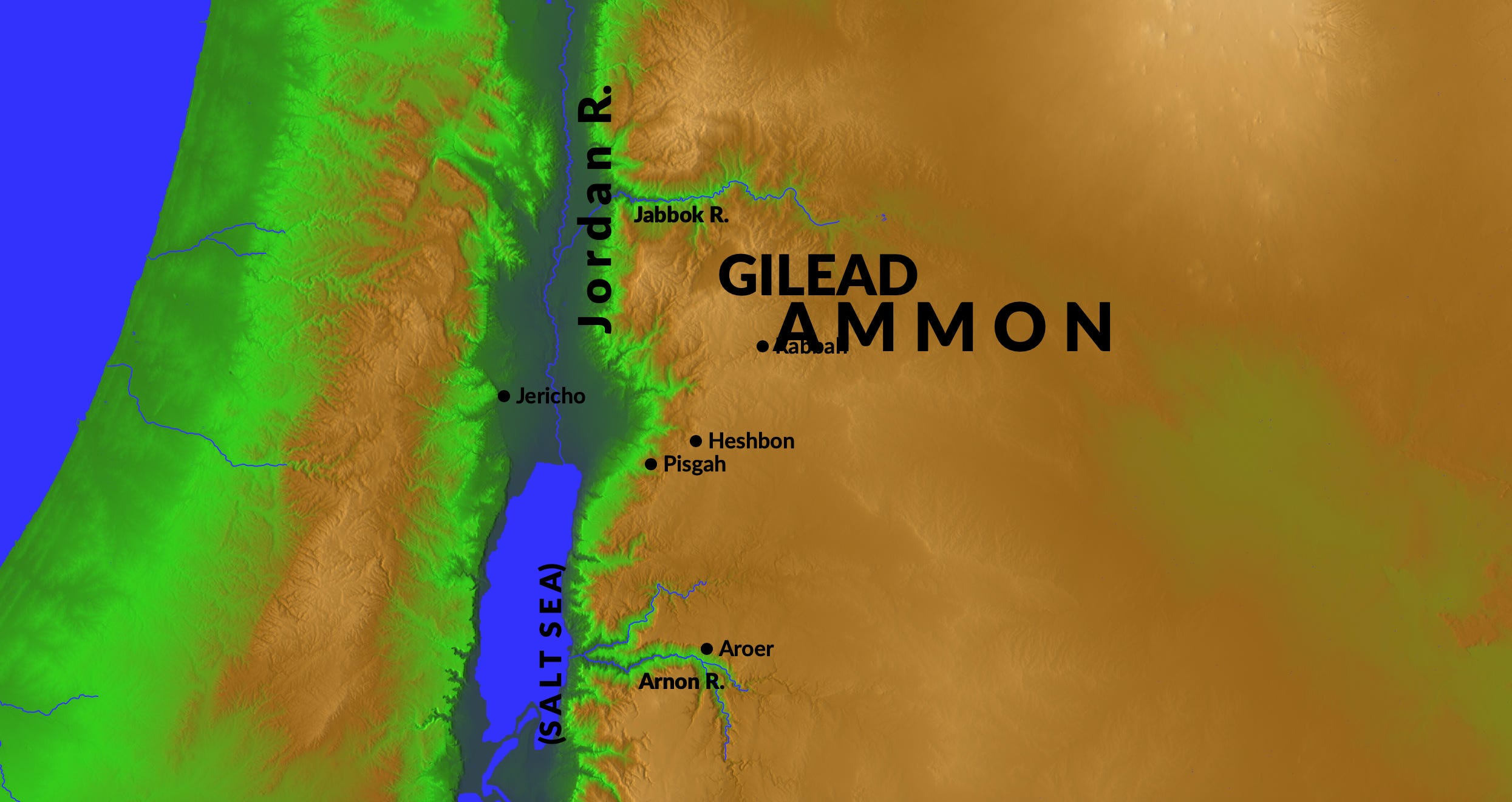
Sihon’s territory extended from the Arnon up to the edge of Gilead. Sihon’s capital was in Heshbon.
Deut. 2:37 Only you did not go near to the land of the sons of Ammon, all along the river Jabbok and the cities of the hill country, and wherever Yahweh our God had commanded us.
Ammon lived in Gilead and along the Jabbok River.
Deut. 3:1 ¶ “Then we turned and went up the road to Bashan, and Og king of Bashan, with all his people, came out to meet us in battle at Edrei.
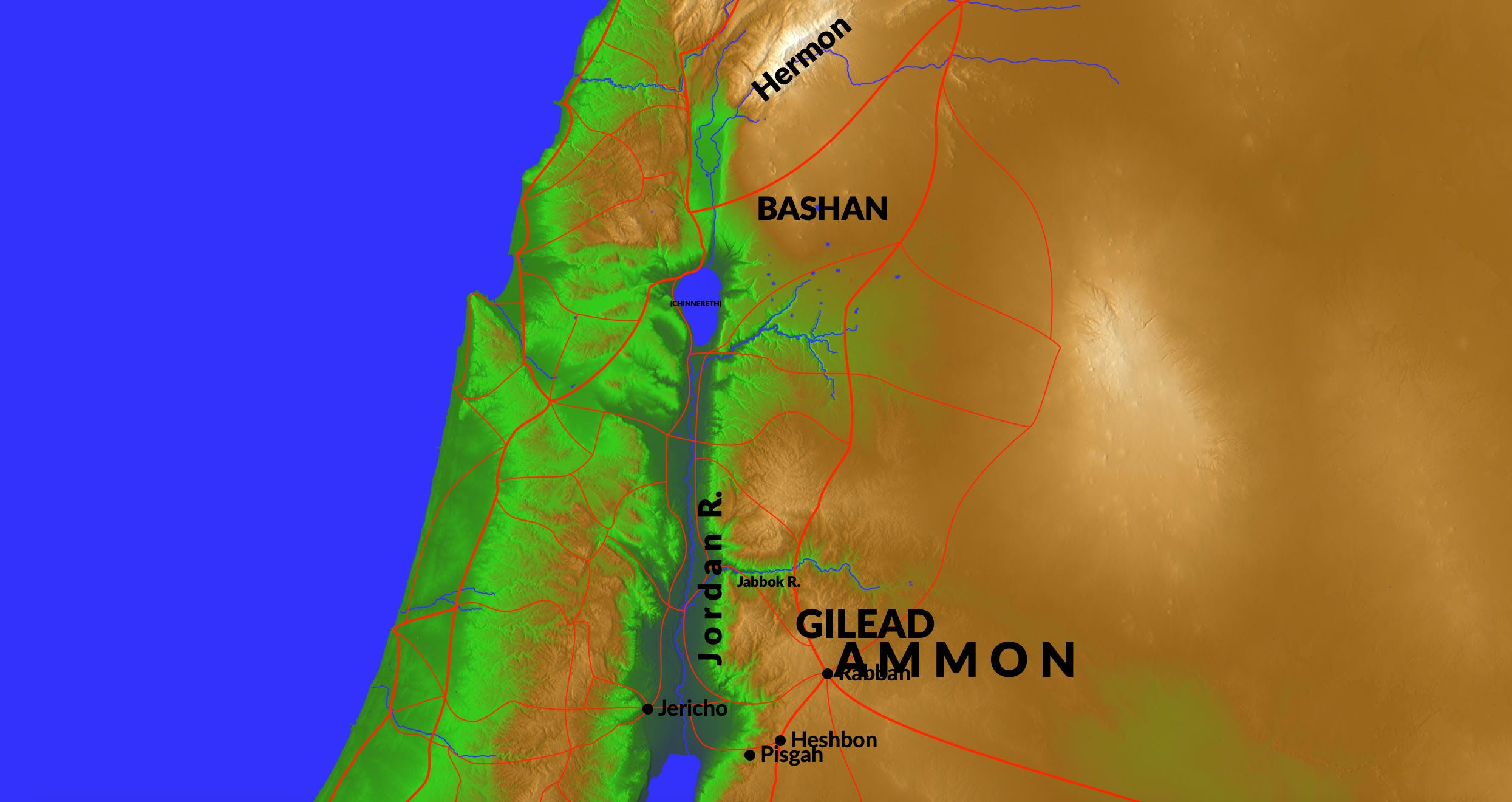
The red lines on this map represent ancient highways. Since Israel was not supposed to harass Ammon, they may have used the highway to the east which skirted around the Jabbok River in order to approach Bashan.
Deut. 3:2 But Yahweh said to me, ‘Do not fear him, for I have given him and all his people and his land over into your hand; and you shall do to him just as you did to Sihon king of the Amorites, who lived at Heshbon.’
Deut. 3:3 So Yahweh our God also gave Og, king of Bashan, with all his people over into our hand, and we struck them until there was no survivor remaining for him.
Deut. 3:4 And we captured all his cities at that time; there was not a town which we did not take from them: sixty cities, all the region of Argob, the kingdom of Og in Bashan.
Deut. 3:5 All these were cities fortified with high walls, gates and bars, besides a great many unwalled towns.
Notice the words “high walls, gates and bars”. The author of Deuteronomy was emphasizing the strength of the cities that were defeated by Israel.
When Israel approached those cities, the Amorites had a height advantage. The cities were built on hills and had high walls. There were gates and bars to keep people out. However, Yahweh fought for Israel, and Israel prevailed.
Deut. 3:6 And we devoted them to destruction, as we did to Sihon king of Heshbon, devoting to destruction the men, women, and little ones of every city.
Deut. 3:7 But all the animals and the spoil of the cities we took as our plunder.
Deut. 3:8 ¶ “Thus we took the land at that time from the hand of the two kings of the Amorites who were beyond the Jordan, from the valley of Arnon to Mount Hermon
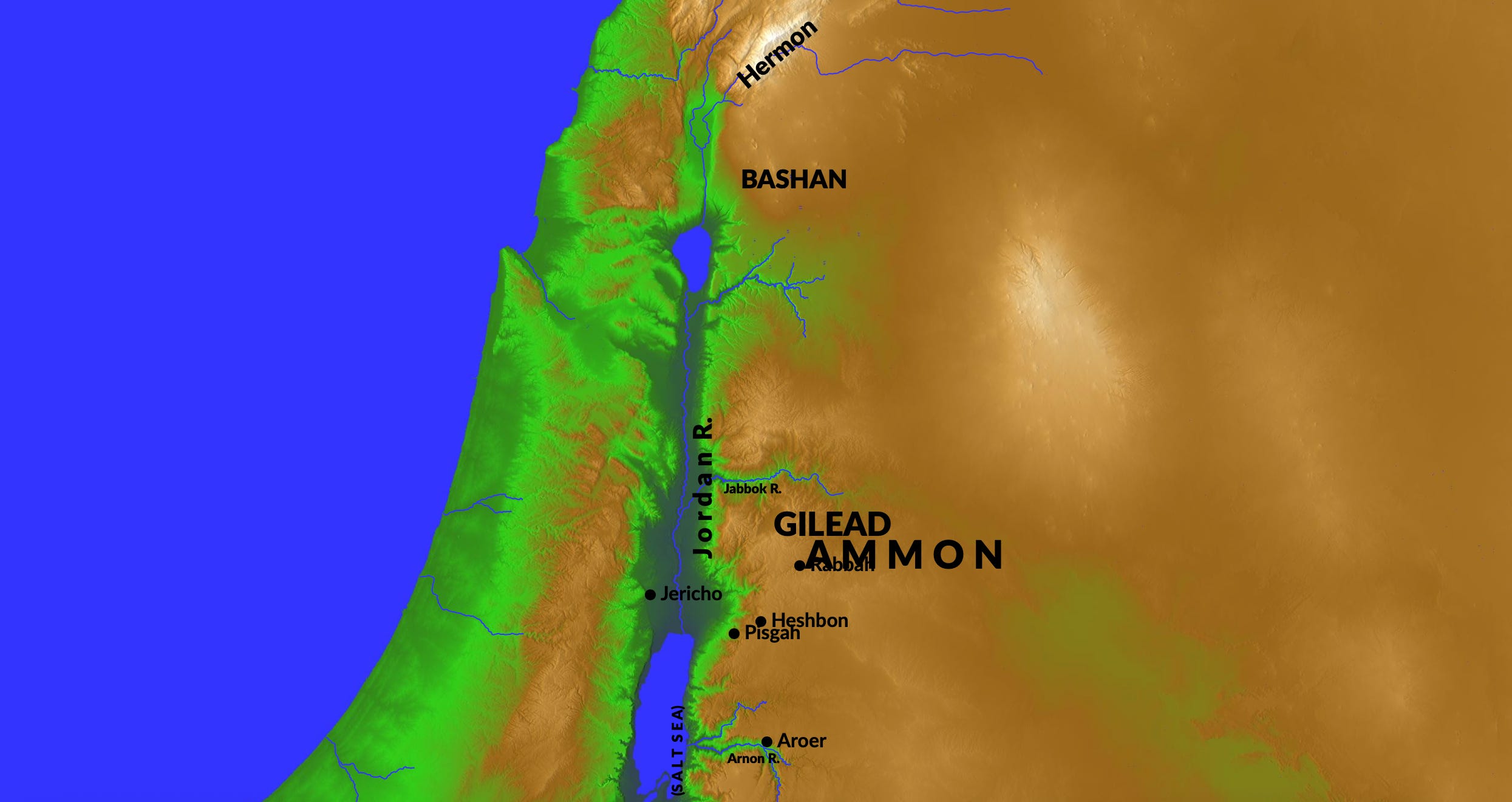
Deut. 3:9 (Sidonians call Hermon Sirion, and the Amorites call it Senir):
Deut. 3:10 all the cities of the plateau and all Gilead and all Bashan, as far as Salecah and Edrei, cities of the kingdom of Og in Bashan.
Deut. 3:11 (For only Og king of Bashan remained of the remnant of the Rephaim. Behold, his bedstead was an iron bedstead; it is in Rabbah of the sons of Ammon. Its length was nine cubits, and its width four cubits by ordinary cubit.)
Notice the parentheses around verse 11. This was not part of Moses’ speech. It was inserted by the author of Deuteronomy to give some background on the people group that was defeated by Israel.
Deut. 3:12 ¶ “So we took possession of this land at that time. From Aroer, which is by the valley of Arnon, and half the hill country of Gilead and its cities I gave to the Reubenites and to the Gadites.
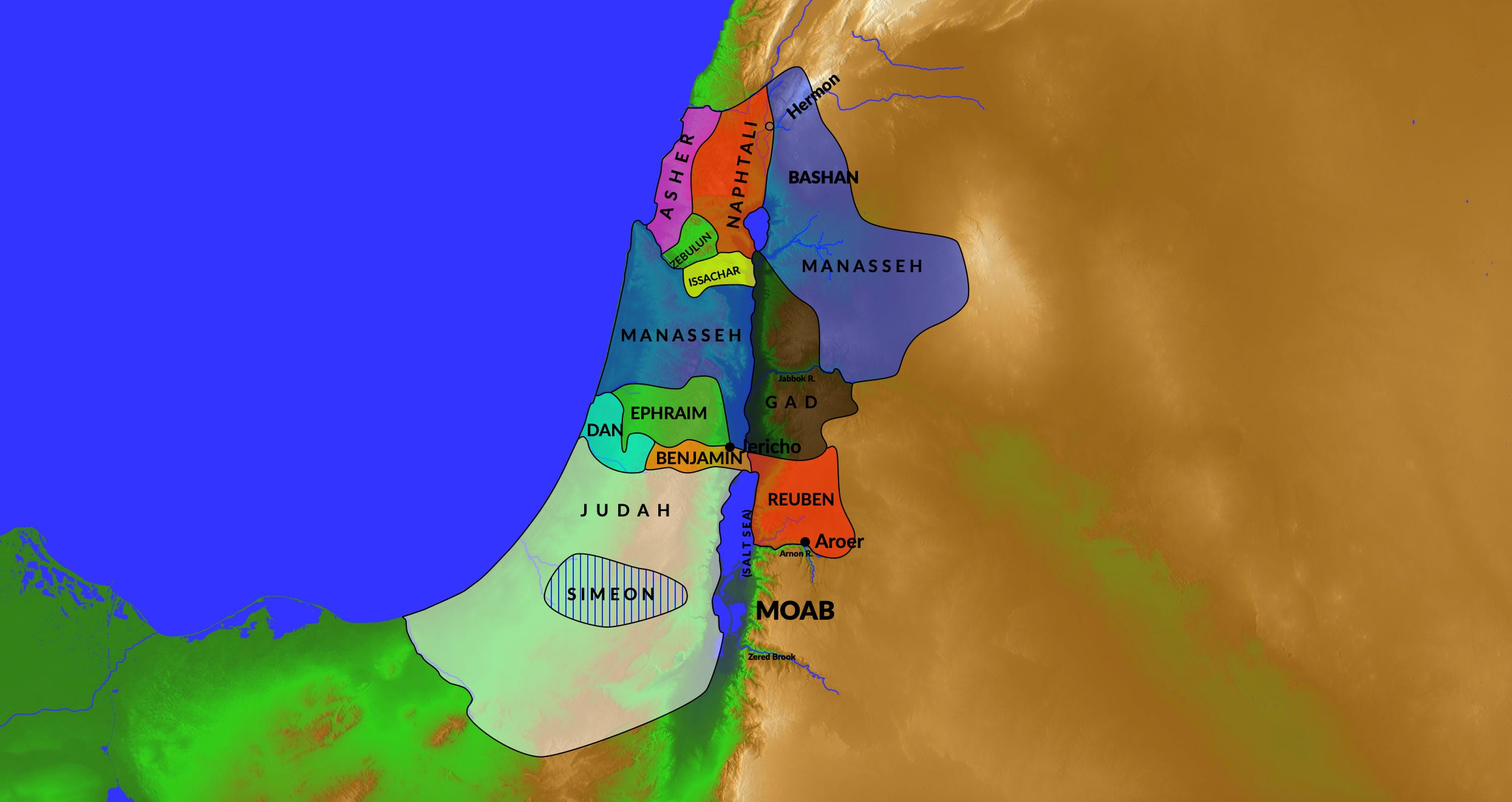
Deut. 3:13 And the rest of Gilead and all Bashan, the kingdom of Og, I gave to the half-tribe of Manasseh, all the region of Argob. (Concerning all Bashan, it is called the land of Rephaim.
Deut. 3:14 Jair the son of Manasseh took all the region of Argob as far as the border of the Geshurites and the Maacathites and called it—that is, Bashan—after his own name, Havvoth-jair, as it is to this day.)
Deut. 3:15 And to Machir I gave Gilead.
Deut. 3:16 And to the Reubenites and to the Gadites I gave from Gilead even as far as the valley of Arnon, the middle of the valley as a border and as far as the river Jabbok, the border of the sons of Ammon;
Deut. 3:17 the Arabah also, with the Jordan as a border, from Chinnereth even as far as the sea of the Arabah, the Salt Sea, at the foot of the slopes of Pisgah on the east.
When Israel conquered the two kings of the Amorites, they fought adversaries who had physical advantages. The Amorites fought from high, well-fortified cities. Israel had to approach the cities from lower elevations. However, Yahweh gave Israel the victory against stronger foes.
Today, the United States enjoys a huge military advantage over every army in the world because our equipment is far superior. Our satellites, warplanes, helicopters, and night vision capabilities allow us to see and control the battlefield in a manner never equaled in human history. However, just as Yahweh gave Israel the victory against well-fortified cities, so too, if God chooses to defeat the United States, He can do so at will, at any time of His choosing.
Thanks for visiting Bible Mountain. If you have already joined my email list, thank you and please tell others about Bible Mountain. If you have not joined my email list yet, please do so now. In order to join, go to Bible Mountain dotcom, click on subscribe, and that will take you to a page where you can sign up. Your email address will not be sold nor given away. Once again, thanks for visiting Bible Mountain.
“Scripture quotations taken from the (LSB®) Legacy Standard Bible®, Copyright © 2021 by The Lockman Foundation. Used by permission. All rights reserved. Managed in partnership with Three Sixteen Publishing Inc. LSBible.org and 316publishing.com.”