
Today’s passage is a short summary of Israel’s 40-year sojourn in the wilderness. We will see an example of what happens when humans take action without God’s blessing, and in contradiction to His orders.
The book of Deuteronomy is a review of Israel’s history and law. It is a series of speeches Moses gave the Israelites when they were camped on the east bank of the Jordan River, opposite Jericho. These speeches were the last things Moses did before he died.
When we stopped reading yesterday, Moses was reminding the Israelites why they had to wander in the wilderness for forty years. After receiving the law at Mount Sinai, Israel traveled to Kadesh-Barnea, from where Moses sent spies to spy out the Promised Land. The spies determined it was a good land, but the Israelites became afraid of the power of the Canaanites. They refused to believe that Yahweh would conquer Canaan for them. The Israelites accused Yahweh of hating them. Thus, Yahweh decreed that all the men who were at Kadesh-Barnea would die in the wilderness and never enter the Promised Land. Yahweh told Israel to turn around and go back into the wilderness.
In the following verse, the pronoun “you” refers to Israel and the pronoun “me” refers to Moses.
Deut. 1:41 ¶ “Then you said to me, ‘We have sinned against Yahweh; we will indeed go up and fight, just as Yahweh our God commanded us.’ And every man of you girded on his weapons of war and regarded it as easy to go up into the hill country.
Look at the phrase “regarded it as easy”. When the spies first gave their report and told of the strength of the Canaanites, Israel was afraid and doubted they could conquer the land. However, after Yahweh scolded them for doubting, they decided it was easy to conquer the land.
Deut. 1:42 And Yahweh said to me, ‘Say to them, “Do not go up and do not fight—for I am not among you—so that you are not defeated before your enemies.”’
Yahweh clearly warned Israel not to go into battle since Yahweh was not going with them.
Deut. 1:43 So I spoke to you, but you would not listen. Instead you rebelled against the command of Yahweh and acted presumptuously and went up into the hill country.
Notice the words “rebelled” and “acted presumptuously”. Yahweh had told Israel not to attempt to conquer the land, but they disobeyed. The word “presumptuous” means to be brazen, overconfident, and act out of line.
Deut. 1:44 And the Amorites who lived in that hill country came out to meet you and pursued you as bees do and crushed you from Seir to Hormah.
Take note of the word “crushed”. Israel didn’t simply lose. They lost badly.
Deut. 1:45 Then you returned and wept before Yahweh; but Yahweh did not listen to your voice nor give ear to you.
Look at the words “Yahweh did not listen”. Israel had disobeyed, so Yahweh did not listen to them.
Ponder how something like this might happen today. There are many commands in the Bible. Some of them, such as the rules on divorce and remarriage, the role of women in church and marriage, the prohibition on sex outside of marriage, and the need to be different from the culture, are routinely ignored in the modern church. Many Christians casually disobey those commands, but then they assume God will answer their prayers when they have problems in life. However, if a Christian routinely disobeys God, will He answer their prayers when they are in trouble? Today’s passage indicates He may not.
Deut. 1:46 So you remained in Kadesh many days, according to the days that you remained there.
Deut. 2:1 ¶ “Then we turned and set out for the wilderness by the way to the Red Sea, as Yahweh spoke to me, and circled Mount Seir for many days.
The “many days” amounted to almost four decades.
Deut. 2:2 And Yahweh spoke to me, saying,
Deut. 2:3 ‘You have circled this mountain long enough. Now turn north,
Seir was south of the Dead Sea. This means the Israelites’ wilderness wanderings took place in the area south of the Dead Sea.
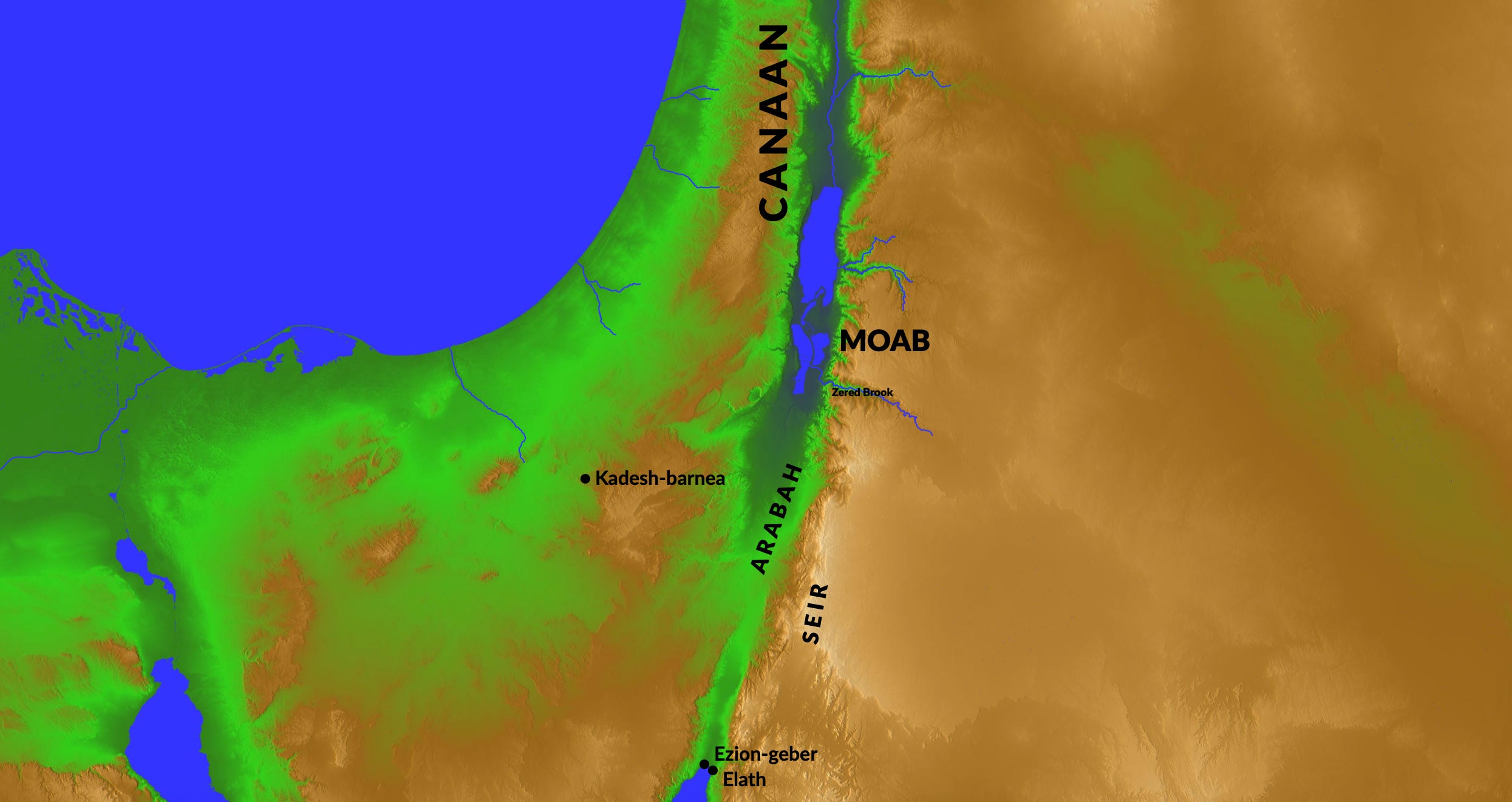
Deut. 2:4 and command the people, saying, “You are going to pass through the territory of your brothers the sons of Esau who live in Seir; and they will be afraid of you. So be very careful;
Deut. 2:5 do not provoke them, for I will not give you any of their land, even as little as a footstep because I have given Mount Seir to Esau as a possession.
Deut. 2:6 You shall buy food from them with money so that you may eat, and you shall also bargain with them for water with money so that you may drink.
Deut. 2:7 For Yahweh your God has blessed you in all the work of your hand; He has known your wanderings through this great wilderness. These forty years Yahweh your God has been with you; you have not lacked a thing.”’
Deut. 2:8 ¶ “So we passed beyond our brothers the sons of Esau, who live in Seir, away from the Arabah road, away from Elath and from Ezion-geber. And we turned and passed through by the way of the wilderness of Moab.
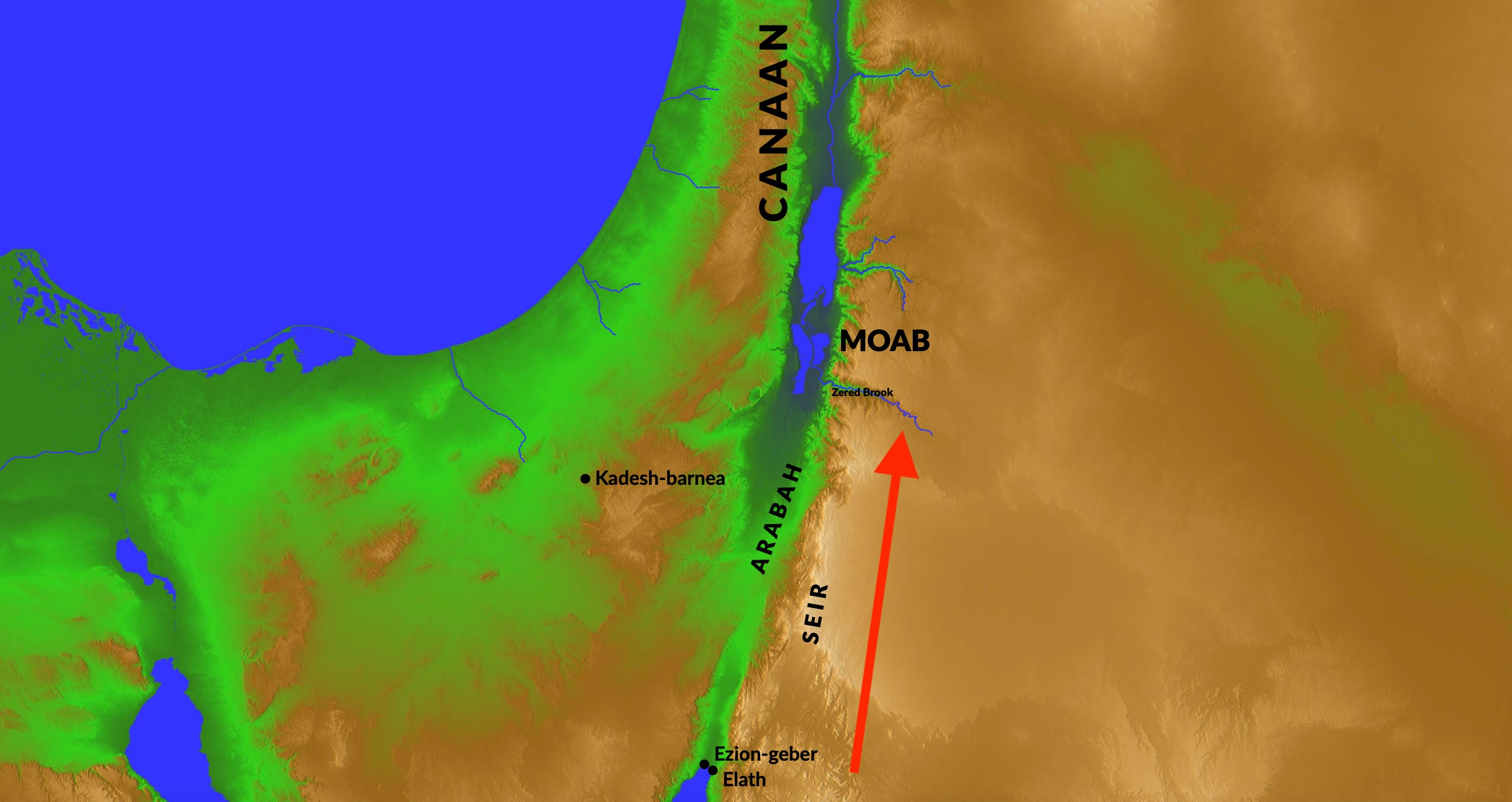
Israel traveled east of Seir and Moab.
Deut. 2:9 Then Yahweh said to me, ‘Do not harass Moab, nor provoke them to war, for I will not give you any of their land as a possession because I have given Ar to the sons of Lot as a possession.’
Deut. 2:10 (The Emim lived there formerly, a people as great, numerous, and tall as the Anakim.
Deut. 2:11 Like the Anakim, they are also regarded as Rephaim, but the Moabites call them Emim.
Deut. 2:12 Now the Horites formerly lived in Seir, but the sons of Esau dispossessed them and destroyed them from before them and settled in their place, just as Israel would do to the land of their possession which Yahweh gave to them.)
Notice the parentheses around verses 10-12. These verses are some background information given by the author of Deuteronomy. The Emim lived in Moab before Moab lived there. The Horites lived in Seir before the sons of Esau lived there.
Deut. 2:13 ‘Now arise and cross over the brook Zered yourselves.’ So we crossed over the brook Zered.
Deut. 2:14 Now the time that it took for us to come from Kadesh-Barnea until we crossed over the brook Zered was thirty-eight years, until all the generation of the men of war came to an end from within the camp, as Yahweh had sworn to them.
Notice the words “thirty-eight years”. The verses we are reading today summarize a period of thirty-eight years.
Deut. 2:15 Moreover the hand of Yahweh was against them, to bring them into confusion from within the camp until they all came to an end.
Look at the word “against”. The hand of Yahweh was against the Israelites who had rebelled against Him at Kadesh-Barnea.
Many Christians today assume God is all love, mercy, and forgiveness. A large number of churches and pastors minimize sin and God’s wrath. They reject the idea that God could ever be against them.
However, when the Israelites, Yahweh’s chosen people, disobeyed Yahweh, then Yahweh’s hand was against them. This warns us that if we disobey God, His hand might be against us.
If we choose to treat His commands casually or as optional, then we should be aware that He may not answer us when we need help and go to Him in prayer.
Thanks for visiting Bible Mountain. If you have already joined my email list, thank you and please tell others about Bible Mountain. If you have not joined my email list yet, please do so now. In order to join, go to Bible Mountain dotcom, click on subscribe, and that will take you to a page where you can sign up. Your email address will not be sold nor given away. Once again, thanks for visiting Bible Mountain.
“Scripture quotations taken from the (LSB®) Legacy Standard Bible®, Copyright © 2021 by The Lockman Foundation. Used by permission. All rights reserved. Managed in partnership with Three Sixteen Publishing Inc. LSBible.org and 316publishing.com.”